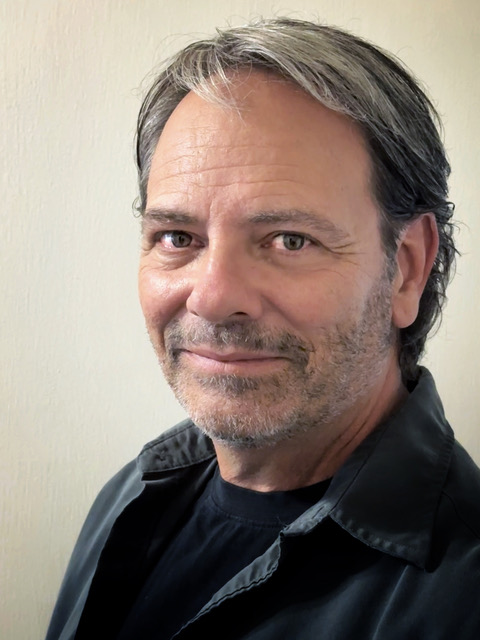
Sam W. Pisciotta’s work has appeared in many other fiction magazines, but “Morning Glory” is his first piece for Asimov’s, and you can read it in our [July/August issue, on sale now!] To mark Sam’s Asimov’s debut, we spoke with him about his favorite novels, his love of Virginia Woolf and Ray Bradbury, and his decision to give “Morning Glory” story an uplifting ending.
Asimov’s Editor: How did this story germinate? Was there a spark of inspiration, or did it come to you slowly?
Sam W. Pisciotta: I read an article about children not spending enough time playing outside. The idea is that as children spend an overwhelming amount of their time indoors on phones and video games and televisions, they’re spending less time in their backyards and in their neighborhood parks. A result is an increasing number of kids who are afraid of (or at least uncomfortable with) bugs and birds and other forms of nature. Honestly, I don’t know if the argument holds water, but it got me thinking.
Daisy is afraid of everything, and I’ve put her in a situation where she’s forced to confront her fears. She instinctively reaches for the technology that brings her comfort. Ironically, technology is the big, bad wolf knocking at her door.
AE: This is a dark story that takes a positive turn. Can you talk a little bit about why you made that decision?
SWP: Sure. “Morning Glory” could easily have developed into a dystopian story, and readers might even expect a dark ending as they plunge into Daisy’s world. But I wanted this to be a story of hope. I love both nature and technology, and I spend a lot of time with both. I believe that humanity can find equilibrium on this issue, and the idea that technology can bring us closer to nature appeals to me.
AE: How did the title of this piece come to you?
SWP: “Morning Glory” plays off the nature of those blossoming flowers: They open with light; they attract pollinators; they’re both fragile and resilient. Morning glories are an apt symbol for a character who comes to see the world differently and a world transformed by technology in a positive way.
AE: What is your history with Asimov’s?
SWP: This is my first story in Asimov’s, but I’ve been a fan of the magazine for much of my life. I’m so proud to have “Morning Glory” take a place in Asimov’s long history of beautiful and thought-provoking stories.
AE: Who or what are your greatest influences and inspirations?
SWP: Three names come to mind—Ray Bradbury, Virginia Woolf, and Ken Nordine. I loved what each of them had to say, and especially how they expressed their thoughts. Although they spoke with unique voices, I find a common thread in their works: language is beautiful and powerful and, above all, fun. I inherited that from them, I believe.
Also, I’m a fan of horror and dystopian literature, but I very much love a happy ending. Mostly that’s what I choose to write. For that, you can blame my lifelong addiction to Star Trek. I believe the direction of evolution is upward.
“Morning Glory” could easily have developed into a dystopian story, and readers might even expect a dark ending as they plunge into Daisy’s world. But I wanted this to be a story of hope.
AE: So, if you could choose a science fiction universe to live within, you would choose the Star Trek universe?
SWP: Absolutely. A life of exploration in a society that values tolerance and respect for others. There’s so much hope for humanity in those stories. The Federation establishes a society that allows for the expression of the individual. It’s the best of both worlds.
And of course, transporters. As a person who habitually runs late, I really appreciate the idea of a transporter. Oh, and who wouldn’t want to take a turn on the holodeck?
AE: What are some of your favorite books?
SWP: To the Lighthouse by Woolf and Dandelion Wine by Bradbury for their beautiful language. I’ve really enjoyed Okorafor’s Binti series, Wells’ Murderbot Diaries, and P. Djèlí Clark’s books in the Dead Djinn Universe. One of my all-time favorite works is The Street of Crocodiles by Bruno Schultz. It blurs fantasy and reality brilliantly, and I’ve always considered it a masterpiece. More recently, I finished Anthony Doerr’s Cloud Cuckoo Land. What a read! It’s enthralling and utterly poignant. I admire the way the novel spans centuries but still ends with a splinter-sharp narrative focus.
AE: Do you have any advice for up-and-coming writers?
SWP: Read a lot of books, both fiction and non-fiction. Read poetry. Go to museums and art galleries. Talk to strangers. Walk through forests and sit on beaches. Every now and then, lie down and look up at the stars. Your creative soup requires ingredients.
Writing has always been an important part of my life. I remember writing stories for my mom when I was a kid. But I was older when I started writing seriously and with purpose. I sometimes wish I would have started writing speculative fiction sooner, but I was living life and gaining experiences that would eventually work into my fiction. The years have taught me the value of balancing hard work with daydreaming.
AE: How can our readers follow you and your writing?
SWP: You can follow me on Twitter and Instagram at /silo34. I’m also a visual artist, so you’ll find my artwork online, as well, particularly on Instagram and at my website: http://www.silo34.com.
 From Earth to the Stars