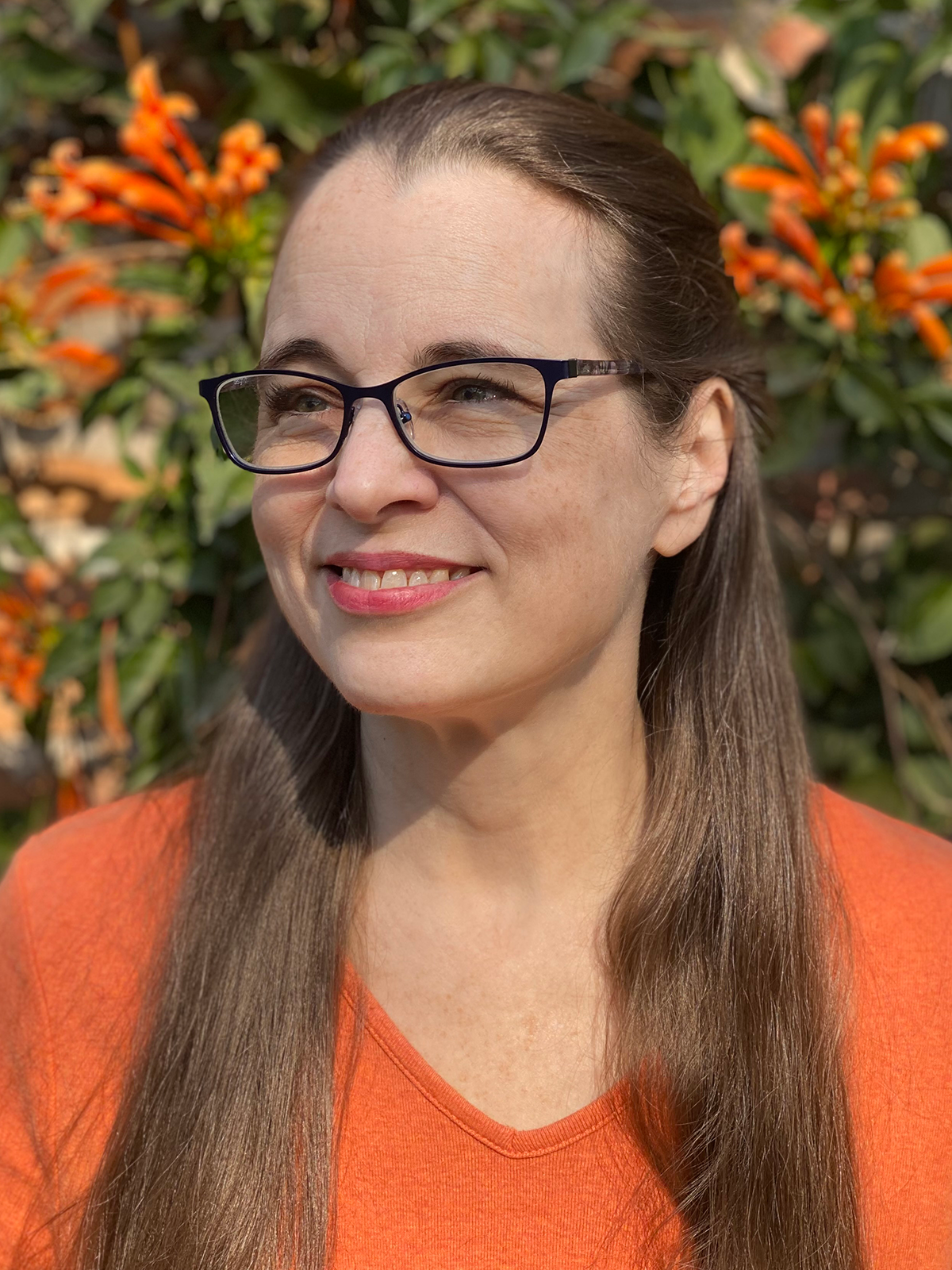
Author Karawynn Long shares her experience as an Autistic person and discusses the ways Autistic people are beginning to make their voices heard in blogs, essays, videos, and literature. Read Long’s latest story for Asimov’s, “Hope Is the Thing With Feathers,” in our [July/August issue, on sale now!]
“Hope Is the Thing With Feathers” exists because in late 2019, mere months before my fiftieth birthday, I accidentally discovered that I’m autistic.
I managed to reach age forty-nine without the slightest clue to this important fact about myself because for decades the academic study of autism has been dominated by non-autistic researchers who began with erroneous assumptions about the condition and conducted their research unscientifically and through a biased lens. The result has been widespread circulation among psychologists of non-representative stereotypes and flatly inaccurate information; those in turn have been magnified and perpetuated—again by non-autistics—in popular media.
I was able to celebrate my fiftieth birthday as a self-aware Autistic person only because, in the last decade or so, authentic Autistic voices have gotten significantly louder. The number of first-person blogs, essays, books, podcasts, and social media posts has exploded, both driven by and driving a veritable tsunami of adult epiphanies. A whole cohort of self-aware Autistic research psychologists have entered the field, particularly in the UK, and their publications have begun shifting the academic conversation in a more accurate direction.
My first clue came from an unexpected quarter—a podcast episode which told the story of a woman very much like myself who went looking for help for her anxiety and—surprise!—ended up discovering she was autistic. I responded to this information in (what I now realize is) the most autistic way ever: by hoovering up absolutely every piece of information about autism that I could find. I quickly became aware of the vast divide between most of the academic literature and the lived experience of Autistic people, so my research leaned ever more heavily on memoirs and other first-person accounts.
In the beginning, I gravitated toward experiences and presentations that were similar to my own, but eventually my curiosity grew to encompass the experiences of autistics whose situations are very different. My particular version of autism came packaged with hyperlexia; I learned to both speak and read at a precocious age. But there are others who have almost the exact opposite experience.
So I sought out stories from autistic people who experienced various sorts of profound communication challenges. Some autistic kids are simply delayed: they don’t speak at all for many years, but eventually develop spoken language indistinguishable from non-autistic children. Others have “unreliable speech,” where they have imperfect mental control over the words and sounds they utter. And still others have verbal apraxia, a brain-body disconnect that impedes their ability to shape their mouths in the intricate ways required for speech. These challenges are often accompanied by full-body dyspraxia or apraxia, an experience that at its most severe might be likened to being “locked-in,” except that one’s body is not inert but acts in unexpected ways and contrary to one’s wishes.
I was able to celebrate my fiftieth birthday as a self-aware Autistic person only because, in the last decade or so, authentic Autistic voices have gotten significantly louder.
In these first-person accounts—blog posts and videos and published memoirs —a pervasive and tragic pattern emerged. Autistic teens and young adults described living without any way to communicate, often for a decade or more, while the adults around them mistook their lack of coherent speech for lack of intelligence. Kids who felt frustration and shame every time someone spoke about them as stupid, who were in terrible pain but had no way to explain the problem, who could read fluently but were forced to repeat the same basic alphabet drills for years. So much creativity left fallow, so much curiosity left to wither—it was horrifying to imagine. And these were the voices of the few who’d been offered a way out of the endless silence. How many more never get that chance?
In the wake of this awareness, I reached out to a former coworker—someone I liked and respected—who had just posted to social media about his challenges with his nonspeaking autistic daughter. I wrote and expressed sympathy for his difficulties and offered to share my insights and suggestions for a way to proceed that didn’t involve institutionalizing her. We corresponded in detail for about three months.
By the time I started talking to my friend about his adopted daughter, his family had already been living with the situation for almost a decade. He had very entrenched ideas about who his daughter was, and what her capabilities were, and my perspective challenged that narrative. He seemed open and grateful when we began our dialog, but ultimately he told me that what I had to say produced too much “cognitive dissonance” for him, and he rejected my viewpoint and my advice.
My heart broke: for him and the rest of his family, but most of all for this girl I’d never met. From his stories and descriptions it was obvious to me (though not to him) that she was in frequent and severe physical and emotional pain, and it was equally clear that without intervention, her circumstances would only deteriorate. It gutted me that I couldn’t do more to help her.
After a few months of sheer empathic agony, I attached myself to a new goal: to share something of the experience of nonspeaking Autistics with people who would not ordinarily encounter it, thereby doing some small part to push back against the misinformation and misunderstanding. A character voice coalesced in my mind, synthesized out of the memoirs I’d read and my own autistic experience.
The study of intelligence among non-human animals has been another long-term fascination for me, and I drew on that knowledge to create the Bird Lab and its psittacid and corvid denizens. (Being an autistic fiction writer is extremely satisfying when you can take two unrelated ‘special interests’ and combine them into something that feels greater than the sum of its parts.)
Because portraying a realistic character was my paramount aim, I hired two nonspeaking Autistic young adults to read and give me feedback on “Hope Is the Thing With Feathers” before I submitted it. One of them, Emily Grodin, is a poet and co-author of her own memoir, I Have Been Buried Under Years of Dust; I recommend it to anyone who is interested in a nonfictional account from a nonspeaking, dyspraxic Autistic. Other good books that I drew on include The Reason I Jump and Fall Down 7 Times Get Up 8 (by Naoki Higashida, translated by David Mitchell of Cloud Atlas fame), and Ido in Autismland (by Ido Kedar).
I had chosen to end the story with a quote from Ursula K Le Guin. My other nonspeaking reader, a young man named Otto Lana, told me (in email) that his feelings about “Hope” were summed up by a different Le Guin quote: “You cannot buy the revolution. You cannot make the revolution. You can only be the revolution. It is in your spirit, or it is nowhere.”
Which—because I admire Le Guin so profoundly, and because it is both what my character was doing in the story and what I was seeking to do with the story —might be the loveliest response I could ever hope for, from anything that I write.
Thank you to Sheila Williams for giving “Hope” an audience.
 From Earth to the Stars