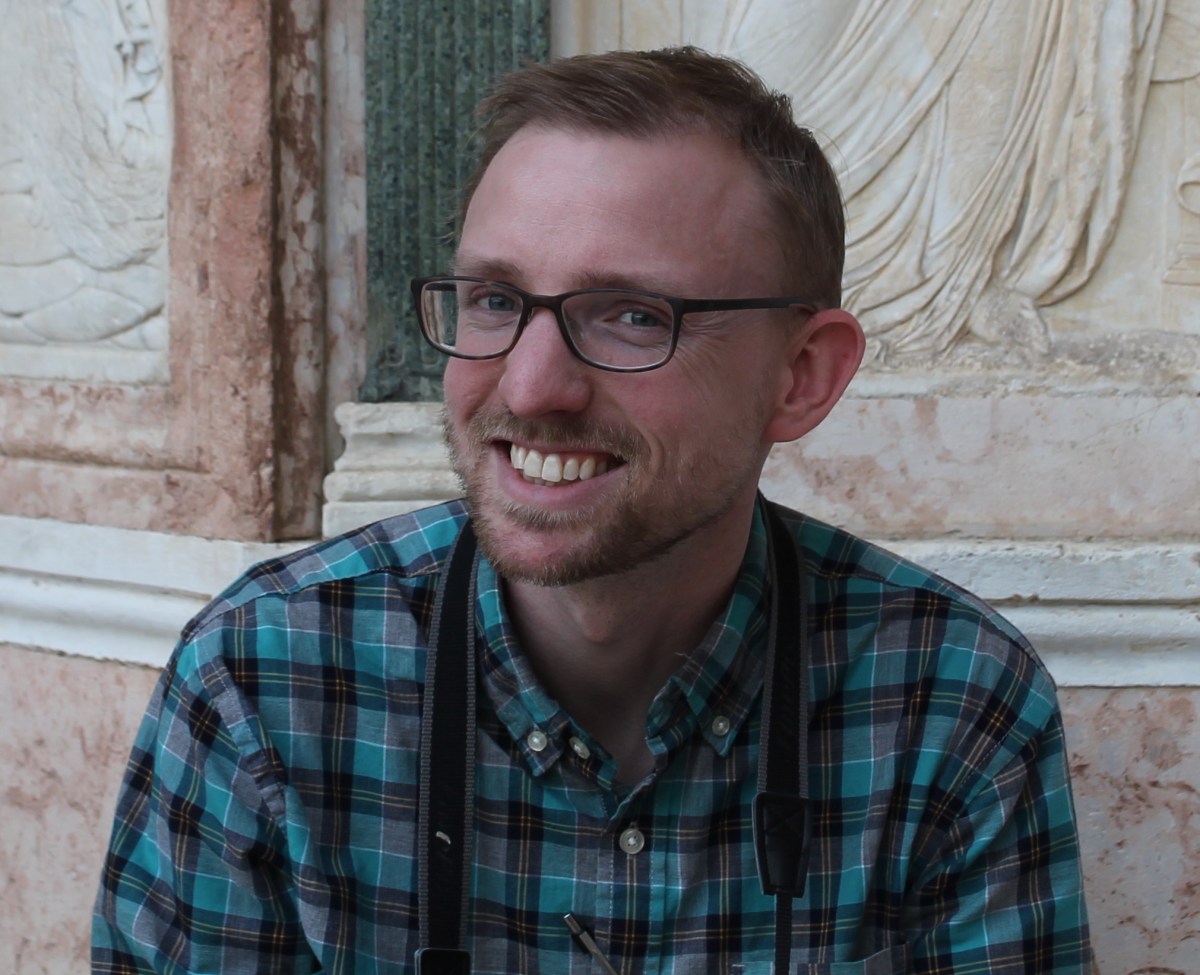
Get to know author and historian Stephen Case in this insightful interview that touches on space opera, good writing habits, and taking advice from Stephen King and Ursula K. LeGuin. Don’t miss Case’s latest Asimov’s story, “Sisters of the Lattice,” in our [July/August issue, on sale now!]
Asimov’s Editor: What is the story behind this piece?
Stephen Case: I’ve always loved space opera. I wanted to play with a galaxy-spanning narrative and wondered if I could capture an epic feel in a short story. I’m also fascinated by religious orders and how their members’ vows shape their lives. I wanted to explore that in a science fiction setting, somewhat along the lines of Marie Doria Russel’s The Sparrow.
AE: How did this story germinate? Was there a spark of inspiration, or did it come to you slowly?
SC: “Sisters of the Lattice” had a germination period significantly longer than most of my stories. I wrote an early draft pre-pandemic, which grew into a novel draft, which ultimately didn’t go anywhere. I ended up almost completely re-writing the original for this final version. It got taken apart and put back together several times, but I kept coming back to images of the sisters, the Lattice, and their planet of ice.
AE: Is this story part of a larger universe, or is it stand-alone?
SC: There’s more to tell. I’ve finished a story set on the Decalogue during the years of the Long Retreat, and hopefully readers will get a chance to see it soon.
AE: How much or little do current events impact your writing?
SC: At least consciously, I would say they don’t impact it much. It was a bit surreal, however, to be working on this piece as the COVID pandemic got underway. I was in the early phases of revision as everything was shutting down, which definitely lent poignancy to working through a story of the galaxy gradually going dark and planets being isolated from each other.
AE: What is your process?
SC: I tend to do most of my drafting longhand. My job has me at a screen most of the day, so I prefer to write first drafts of stories in notebooks. Usually I write in the mornings and evenings, with most revision happening in the mornings before I go to work. Writing longhand means the additional step of transcribing, but that becomes the first iteration of editing. I usually go through a piece four or five times before sending to markets.
AE: What other projects are you currently working on?
SC: My fiction usually comes in bursts; I just finished a few short stories, one of which is forthcoming in Clarkesworld. My larger projects at the moment are non-fiction: I’m revising a manuscript for a book about the nineteenth-century British polymath John Herschel that I wrote for University of Pittsburgh Press, and for the past year I’ve been working as co-editor for Cambridge University Press on the Cambridge Companion to John Herschel. An article I wrote on Herschel and why he’s so important is due out in the June issue of Physics Today.
AE: What are you reading right now?
SC: I just finished Shaun Bythell’s The Diary of a Bookseller and the two volumes that followed and couldn’t put them down. If you’re cranky and love books, I highly recommend.
AE: Do you have any advice for up-and-coming writers?
SC: Read and write a lot. Read some books on writing as well. Stephen King and Ursula LeGuin are particularly helpful.
AE: What other careers have you had, and how have they affected your writing?
SC: A writing mentor told me early on to find a career that could support the writing habit. I would add to that advice to make that a career that involves writing, if possible. I was writing my dissertation at the same time that I wrote my first novel, and almost every day I’m working on a book chapter, review, or article for my “real” job. As best as I can tell, this doesn’t exhaust the writing faculties but rather strengthens them. And teaching (I teach physics and astronomy) forces me think about how to explain things more simply or using analogies and to consider my audience, which I hope shapes how I write.
AE: How can our readers follow you and your writing?
SC: I’m fairly inactive on social media, though I tweet occasionally @StephenRCase and about my research projects @Herschels_Astro. The best place to find info on my writing is at www.stephenrcase.com. You can also join my mailing list there, where I send very occasional updates about new publications.
 From Earth to the Stars