
by Zack Be
Zack Be discusses the technology behind modern love and its future implications for human connection, two topics he also explores his his latest Asimov’s story. Read “Early Adopter,” in our [January/February issue, on sale now!]
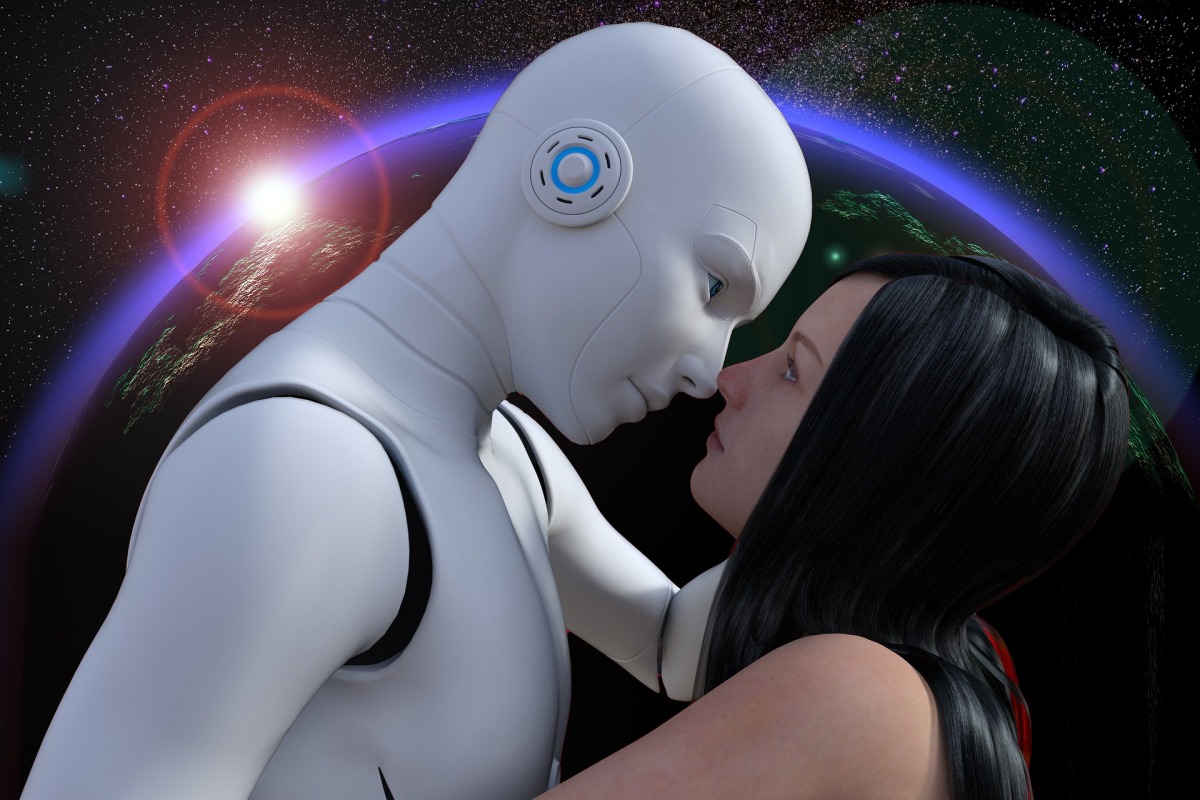
Do you remember your first kiss, first time on a date, or your first time being intimate with a partner? I am sure there was some mix of excitement, nervousness, doubt, and/or desire. Now ask yourself this—how might that experience have been different if it had occurred in virtual reality, or utilized an artificial intelligence, or been communicated wordlessly through neural implants? Technology is a powerful shaper of human social and political behavior, and as we inch toward a transhumanist world of human-computer integration, a major, and often over-looked question is: how will these advancements alter human dating and mating?
This is the question I was toying with when I wrote “Early Adopter,” my short story in the January/ February 2024 issue of Asimov’s. I had just heard about Neuralink—Elon Musk’s hypothetical implantable brain-computer interface company, now facing a accusations of past animal cruelty as it barrels toward FDA-approved human trials—and the description of the tech triggered me to start writing the story.
Musk’s mission for the project is multifaceted, and like many of his businesses, boarders into the realm of the once-science fictional. First, he hopes Neuralink will restore some autonomy to paralyzed individuals by allowing them to control simple computer interfaces with their minds. Second, and much more vaguely, he has expressed a hope that the technology will, per the mission statement on the Neuralink website “unlock human potential tomorrow.”
It was in this cloud of vagueness where I found the spark of an idea that would eventually become “Early Adopter.” The story follows the trials, tribulations, and unforeseen consequences of a souped-up, consumer-grade product similar to Neuralink that allows users to surf the web and engage in something like telepathy with other users.
While this idea is fairly boilerplate as far as sci-fi goes, the great reward of this genre is the opportunity to see all the different directions a diverse set of authors might take a basic idea. You never know what consequences a mechanic might see in a piece of hypothetical tech that a sociologist might not, and vice versa. My thoughts on new tech are filtered through my professional lens as a licensed couple and family therapist who provides sex therapy to a wide array of clientele. In the case of a technology like Neuralink, which promises a near-future where our minds will begin to integrate with computers, my first thought was: how will people use this for sexual pleasure and romance?
Sex is an intrinsic human need that drives much of our behavior, and there is always a huge demand in the market for new ways to find partners or engage in erotic pleasure. As such, we often find ways to sexualize new technology. The most recent available data suggests that 13% of web searches and 20% of mobile searches are for porn, and porn content may represent anywhere from 4% to 30% of all the data on the internet. Meanwhile, 30% of U.S. adults say they use or have used dating apps, including 53% of adults ages 18-29, 37% of adults ages 30-49, 28% of straight adults, and 51% of lesbian, gay, and bisexual (LGB) adults (more demographics available at: Pew Research).
Clearly, we are good at turning new tech into a tool for dating, mating, and sexual pleasure. There is no doubt that whatever the next big technological shift is, people will find a way to capitalize on its possible sexual and romantic appeals. If that new technology is a chip that goes in your brain so you can interface with the internet, then the possibilities are endless—good, bad, and weird.
You see, these types of advancements are a double-edged sword, especially when it comes to dating and mating. On the one hand, increasing the means of connection between people can benefit those who struggle to find the right partner. This likely explains the popularity of dating apps among LGB adults, for whom the internet has long provided more access to community and potential partners with less fear of harassment. Similarly, apps like Feeld provide a dating platform specifically targeted at people seeking polyamorous and/or consensually non-monogamous connections with others. Internet mainstay Fetlife.com is another example that offers a totally NSFW experience perhaps best described as “kinky Facebook.”
Clearly, we are good at turning new tech into a tool for dating, mating, and sexual pleasure. There is no doubt that whatever the next big technological shift is, people will find a way to capitalize on its possible sexual and romantic appeals.
Inevitably, this access leads to tradeoffs. At the beginning of “Early Adopter,” the narrator is fairly far down the rabbit hole of near-future online dating, sleepwalking through one-night stands and wondering, somewhat hopelessly, if he will ever find the right person in the virtual deck of suitors. As the story progresses, the various impacts of this lifestyle on his mental health, and some more radical concerns brought on by his newly-implanted Neuralink-esque technology, become increasingly complex.
The narrator’s plight reveals the dark side of our rapid advancements in online dating and mating. For every dating app success story, there are perhaps a hundred more stories of distance, detachment, loneliness, and ghosting (i.e. when someone you were talking to simply disappears, without a trace). Where some users face a “paradox of choice” that causes them to never invest too much in a single partner based on the promise of something better on the next swipe in their dating app, many others deal with the problem of having no prospects at all. Research has suggested that people will attempt to match with partners who are at least 25% more desirable than themselves (desirability is based on how many users try to match with them), which creates a gradient effect that leaves a large number of users with very few possible matches.
If you want to get even more dystopian, you should know that every major online dating app from Tinder to OKCupid to Hinge and beyond (except Bumble) is owned by the same massive, publicly traded company, Match Group. These apps are built more like dopamine-feeding slot-machines than effective match-making utilities, mostly focused on gaining and maintain daily active users, tracking their activity, showing ads, and funneling certain high-volume users toward paid Premium accounts that prey on desperation. Is it any wonder that the vast majority of Americans are either unsure (43%) or outright do not believe (35%) that dating app algorithms can predict love (Pew Research)?
Moreover, what do you suspect might be some of the mental health impacts of trying to find love in this environment? It’s easy to imagine hopelessness, shame, and other anxious or depressive symptoms stemming from interacting with this machine (although more research needs to be done to study this connection). Exhaustion, defeat, and reduced self-worth all appear to be reasonable expectations of swimming in this pool for too long.
In my therapy practice, I often find myself helping clients to navigate the pleasure and the pain of the interaction between their sexual and romantic needs and the unstoppable force of technological progress and economic process. For the most part, research and clinical work has not had time to study the short and long-term impacts of this technology on mating and dating, and given the exponential speed of tech, it’s likely we never will. This means evidenced-based practices for helping people navigate this new world does not exist, and many people—especially early adopters—will be on their own in trying to navigate the impacts of dating and mating technology in the 21st century.
As we continue toward this uncertain future, we will have to face many more questions about the impacts of new technology on dating and mating. Some issues are indirect, for example: how will the proliferation of artificial intelligence (AI) and virtual realities (e.g. Meta) improve dating and mating for some while dispossessing others? What will our relationship with AI entities be both sexually, romantically, and legally?
Elsewhere, other issues are more direct: what (if any) technologies will we invent to stop the spread of “forever chemicals” such as phthalates and PFAS, which may catastrophically reduce sperm counts to zero by 2045? And how will dating and mating be disrupted by potential reductions in human fertility? Inversely, how will dating and mating be impacted by the proliferation of gene editing technology such as CRISPR that may allow for designer babies? What types of changes will society see in dating and mating when we are able to grow babies in artificial wombs? How will climate change, including water shortages and mass migration, impact our sense of romance, sex, and community? And per “Early Adopter,” how will mating and dating change, for better or worse, when we can use cranial implants to get inside each other’s minds? Most of these hypotheticals would have seemed outlandish even 20 years ago, but now these possible futures rest right on our doorstep. Neuralink may be coming soon, and its integration into our sexual and romantic lives will premiere sometime after. In the meantime, I encourage you to consider for yourself the various trade-offs—consequences good, bad, and weird—that await those who adopt these new technologies.
 From Earth to the Stars