by Ian Baaske
Follow Ian Baaske’s writing career from its earliest beginnings in this deeply personal essay. Also, don’t forget to read Baaske’s latest story, “The Man in the Moon Is a Lady,” in our [March/April issue, on sale now!]
When I was a kid, I wrote whatever I wanted.
In my elementary school, we had a program called “Young Authors,” where we got to write and illustrate our own books. The teachers would help us apply professional(ish) bindings and at the end we’d have our own real book that we wrote.
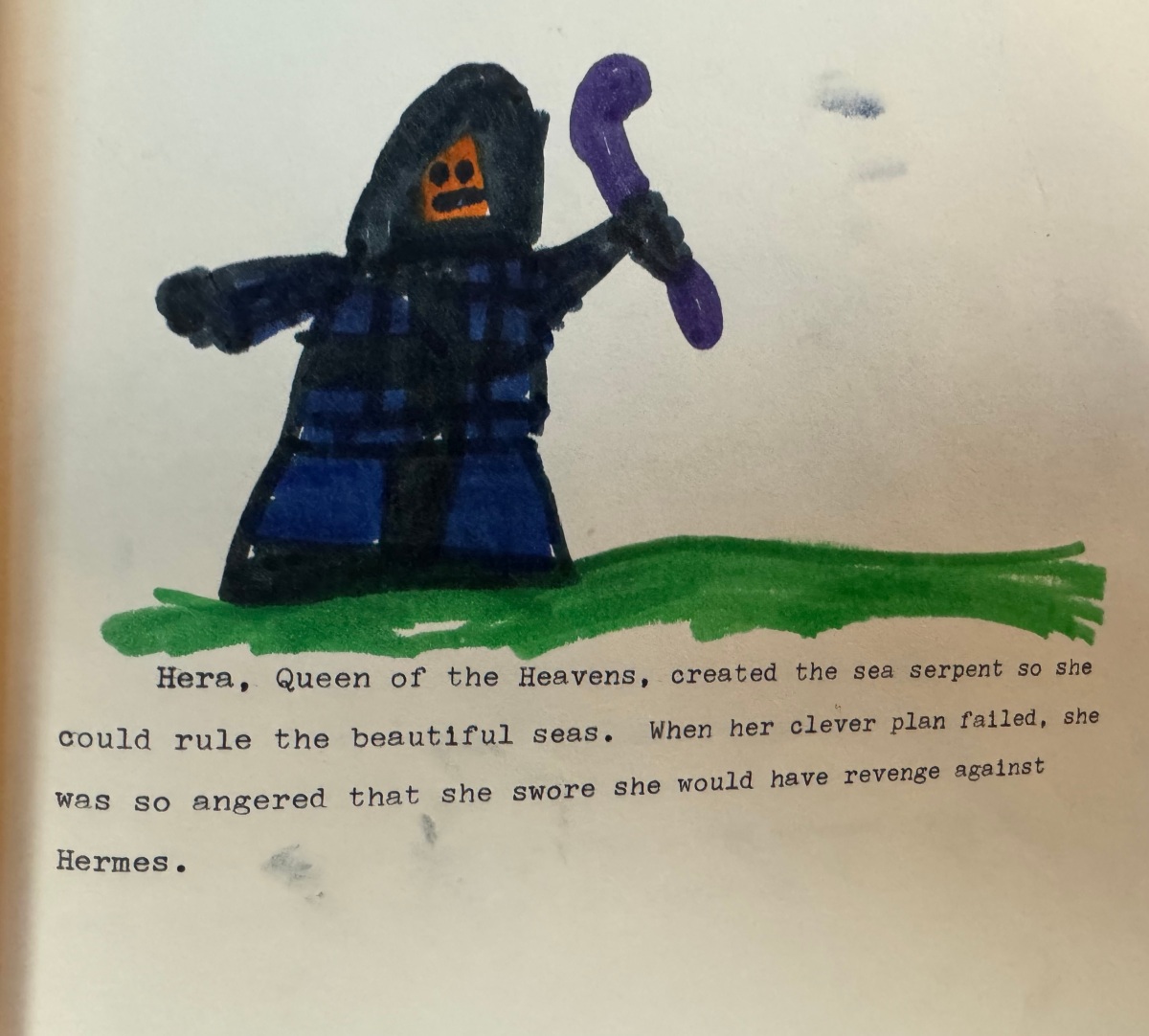
My submission in second grade was called “The Revenge of Hera,” and I still have it. I was way into Greek mythology then and I liked the idea of “revenge” because the title of the new Star Wars movie had been promoted as Revenge of the Jedi.
In the story, the goddess Hera tries to kill Poseidon and take control of the “beautiful seas.” When Hermes foils her plot, she takes revenge on him by sending him through time to World War III. Zeus then takes revenge on her by turning her into a green serpent-like monster called The Amanta.
I don’t remember much about writing it. But I do have a vague recollection of thinking as I went: This is cool. And I remember it being fun. And I remember it feeling free. Like anything could happen in this story.
My fellow students didn’t care for it very much, and, despite my silver-haired teacher Mrs. McKasson putting it up for consideration for the various Young Author awards, it didn’t win anything.
That didn’t bother me. In fact, I think if someone had complained that there was something unrealistic in the story, I wouldn’t have cared in the slightest. If someone had told me there was something that didn’t make sense, I’d have just shrugged. Who cares if it doesn’t make sense? I think I would have thought.
The following year I wrote a comedy called “Triple X.” (Triple X was the name of a planet. I’m sure I had no concept of any other meaning.) Reading it now, I’d say the plot defies any real summary. A pair of people meet and fall through an open manhole, only to fall through a second manhole in the sewer from which they end up in a flying saucer. From there it’s a series of introducing more and more characters who say things like, “They call me Alec, because I’m a smart Alec,” until mercifully it ends.
My class, which was a particularly nasty one, hated it. As did my teacher, who made no attempt to pretend not to hate it.
Looking back now I can see a clear difference between the two stories. The second was desperately trying to please while the first hadn’t any interest at all in how it was received. Put another way, the first was written for myself. The second was written hoping people who already didn’t like me would somehow like me. The first was always going to succeed, and the second wouldn’t ever.
The next few years I wrote fantasy books that were based largely on Dungeons and Dragons and The Lord of the Rings. Glorified fan fiction, really. All the rules and boundaries were already established and I didn’t push them at all. Everything existed safely in already created worlds. An orc was an orc. A sword was a sword—unless it was magical, then it was magical in the exact way swords are usually magical. As I got older, I tried creating my own worlds but they were so derivative as to be funny in retrospect. Instead of a ring, for example, it was a necklace and, instead of going east, the party headed south.
I was way into Greek mythology then and I liked the idea of “revenge” because the title of the new Star Wars movie had been promoted as Revenge of the Jedi.
As an adult, I stuck to writing in real worlds for a long time. I sometimes wrapped them in a neo-gothic cloak of nightmares and murders, but it was still the real world. Other times, I wrote and still write purely realistic fiction. I like it. I like reading it. It’s not a bad thing.
I felt like I would never have the time and vision to fully create a new world. I didn’t understand then that you don’t always have to. In fact, the parts of the world that are off the edges and just out of sight are some of the most interesting. Two works really drove this home for me.
The first was seeing 2001: A Space Odyssey for the first time. It was at the Music Box in Chicago. I remember this feeling of awe lasting throughout the viewing. It was the only movie I could remember that was about the sensation of wondering itself—instead of rushing to an explanation. I’ve since read a decent amount about what some of the mysterious aspects represent but to me at first sight I felt like there was no resolution at all. The final image of the Star Child deepened the mystery, it didn’t end it.
Similarly, Edgar Allan Poe’s novel, The Narrative of Arthur Gordon Pym of Nantucket, moves structurally in odd steps. (Spoilers here but you have had nearly 200 years to read it.)
The plot is a long strange sea adventure aboard several different ships, encompassing blood and mutiny and claustrophobia and shipwrecks and a tropical island south of the Cape of Good Hope, which was a theory at the time. There are some questionable depictions of race throughout, but especially on that island, which Mat Johnson explores brilliantly in his own book called Pym.
The novel comes to an abrupt and mystifying end when the narrator Pym and a couple others escape from the natives on the island and sail off, only to enter a thick fog. The fog suddenly opens and the sea turns milky white and a bunch of white birds fly from the fog and they approach a huge, shrouded human figure. Then . . . the novel ends. There’s a throwaway post-script, ostensibly from the editors, about Pym dying and the rest of his manuscript being lost. It reminds me of Poochie’s death in The Simpsons.
I had the same reaction to Poe’s ending as I did to the Star Child in 2001: this sense of awe and mystery. What on earth is this thing? Is it God? Is it something else? What does it mean in relation to everything else that happened? I found the utter lack of explanation more intriguing not less. A lot of people on the Internet (and probably everywhere else) say something to the effect of “Well, Poe didn’t know how to end it.” This may be true, who knows? But if that was the problem, a less enigmatic final image would have called a lot less attention to the problem.
Again I thought of this as proof that—at least as far as my taste goes—a world doesn’t have to be fully drawn out with everything explained. World building doesn’t have to mean building everything. It can mean building to the edges and then bleeding off out of sight and it can be really cool to think about what’s just out of view.
I’d seen the musical Mame a long time ago, and, at the time, there was one moment that really stood out to me: Mame’s best friend Vera (played by Bea Arthur on Broadway) describing a show within the show. She calls it “this terribly modern operetta about a lady astronomer who makes a universe-shaking discovery.” (When you Google it, most lyric sites get this line wrong with the same grammatical error!)
There was something about this phrasing. The sentence says so many things in a short number of words. This was what I wanted to be writing, I thought: the mix of the futuristic and the historical (Mame is set partly in the 1930’s). But I didn’t know how. I remember sitting in the dark theater, thinking: What? What could it be? What would be this universe-shaking discovery?
From there, Vera sings “The Man in the Moon,” which explains that her discovery is that the man in the Moon is actually a lady. It’s a good song, and I like it. It’s got some cool imagery and clever wordplay and a soothing cosmic vibe. But it doesn’t really go anywhere. It answers its own question, and it folds the sense of wonder in on itself in the same way that a punchline to a joke ends the joke. Nobody says “Well, what did the 12-inch pianist say to that?”
Over the years I sometimes thought about how I’d like to write this terribly modern operetta. I hadn’t a clue how to do it. I knew something about music and composition but certainly didn’t know how to write the full score to an operetta. Even if I did, that wasn’t exactly what I wanted to create anyway. It wasn’t just the operetta. It was the operetta and the context around the operetta. It couldn’t be “terribly modern” within itself. I’d have to somehow create both the show and the viewing of the show.
I decided to try it. I only had to paint the edges of the world anyway, like in the works I admired. I could do that with the music. I could do that with the audience. I could do that with the moon and its populace. It’s always been true for me when I write that if I can just figure out the direction to start in, the rest reveals itself as I go.
I don’t know where it all comes from. I really don’t. It’s hard to think of these fictional worlds we make up as fictional worlds we make up. Because it feels so much more like discovery than invention.
 From Earth to the Stars