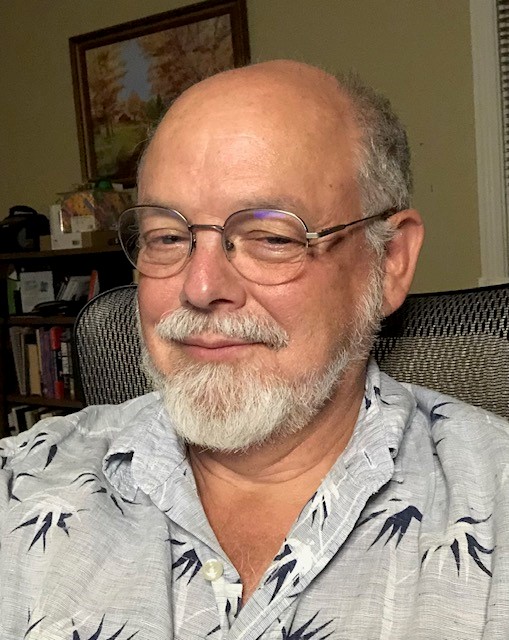
After thirty-three rejections, Ken Schneyer makes his Asimov’s debut with the story “Tamaza’s Future and Mine” in our [July/August issue, on sale now!]. In the following Q&A, discover more about Ken’s influences, his background, and why writing for his own enjoyment has been so important for his success
Asimov’s Editor: What is the story behind this piece?
Ken Schneyer: This story arose out of my dissatisfaction with various tropes I have seen (including some I have written) related to a common situation that arises in fiction, particularly adventure, military, and spy stories. I started making a list of those tropes and realized that I didn’t believe in any of them. It isn’t that I didn’t believe the characters would do such things, it’s that I didn’t believe they would ultimately react to them in the way they were portrayed to react.
AE: How did this story germinate? Was there a spark of inspiration, or did it come to you slowly?
KS: I wrote the entire first draft between May 31 and June 2 of 2023 at the Highlights Foundation Retreat Center in Boyds Mills, PA. That’s very fast for me; in ordinary times it can take me months or years to produce a draft. But once I decided that I wanted to interrogate these tropes, I realized I wanted my protagonist to actually know of the tropes herself. So she needed to be a big reader, which led to the notion that she’d be reading aloud to the child who is also central to this story. That the story is being published less than year after I finished the first draft is astonishing to me.
AE: How did the title for this piece come to you?
KS: My preliminary title was a line appearing near the end of the story, but I decided that it was too on-the-nose and telegraphed too much. Mentioning “futures” makes the reader speculate about how the futures of the two characters would differ, and why.
AE: What is your history with Asimov’s?
KS: This story is my first sale to Asimov’s but my 34th submission to it since 2008. It makes me proud of my own persistence and patience, and also grateful for the praise and encouragement I received from editor Sheila Williams in many of her kind rejection notes over the years.
AE: Who or what are your greatest influences and inspirations?
KS: In no particular order: Ursula Le Guin, John Varley, Marge Piercy, Greg Egan, Margaret Atwood, John Irving, Kage Baker, Robertson Davies, Alexander Jablokov, Robert Heinlein, Mary Renault, Sarah Pinsker, Amal El-Mohtar, Vandana Singh, David Gerrold, N. K. Jemisin, Alfred Bester, Robert Sheckley, Eugie Foster, Anton Chekhov, Dorothy Sayers, Kim Stanley Robinson, Robert Crais, Nancy Kress, Ted Chiang, Ken Liu, Adam-Troy Castro, Joan Slonczewski.
AE: How much or little do current events impact your writing?
KS: Since I’m such an introvert, almost all of my ideas come from within, and current events are, if anything, a distraction from what I’m trying to accomplish. In this particular story, I have to emphasize that current events had absolutely no influence. Although I knew, back in June of 2023, about the horrible events in the Artzakh (Nagorno-Karabakh), they were not in my mind when I was writing, and of course the October attacks in Israel hadn’t happened yet. There is ongoing oppression everywhere, but that’s an historical fact of life going back centuries, and it’s “current” only in the sense that things have not changed, or have not changed enough.
The more you write, the better you get. So, if the first story has trouble finding a home, write the second one and submit it. If the second one fails, write the third one. Write drafts you don’t like and can’t use. Write fragments that never turn into stories. Just keep writing.
AE: How do you deal with writers’ block?
KS: First I promise myself that I’m writing only for my own pleasure, without concern for the finished product or what anyone thinks of it. If I can do that, typically I can write just to play. (As I have received more attention, this necessary step has become harder; but without it, I freeze.) If I’m lacking a topic, I have an ongoing journal of “story ideas” (now over 47,000 words long) that I can refer to for prompts. Failing that, Larissa Lai taught me a brainstorming exercise that can typically get me started on a stream-of-consciousness narrative which sometimes yields surprising results.
AE: How did you break into writing?
KS: I was fortunate in making my first professional sale in 2008 (to the “Futures” feature of Nature Physics) only three months after my first submission. (No, I take that back; it wasn’t really my first submission. When I was fifteen, I submitted two stories (“Red Giant” and “Holy War” 😊) separately to Analog, F&SF, and Galaxy. They were both rejected at all three magazines, and they were my only pro submissions for over 30 years.) That 2008 sale, although it garnered almost no attention, was enough positive reinforcement to inspire me to keep writing and submitting through the many rejections that followed.
AE: What inspired you to start writing?
KS: I think I first fancied myself a writer when I was seven. (I wrote a 500-word story that was a rip-off of The Time Tunnel.) This ambition, in one form or another, lasted through high school and college (see the aforementioned teenage story submissions), and I even started a novelette on the train during my commute to my first “grown-up” job. But then I more-or-less forgot about being a writer for a quarter-century, expressing myself creatively through scholarly articles, faculty roasts, and weird exam questions. I got back into it through writing angst-ridden fan fiction in 2006-2007, which gave me the confidence to attempt an original story in the Fall of 2007. I attended the Clarion Writers Workshop in 2009. Clarion either convinces you that you don’t want to be a writer, or convinces you that you do.
AE: Do you have any advice for up-and-coming writers?
KS: Rejection is the nature of the beast. My overall acceptance ratio, which I think is a good one, is one acceptance for every eight submissions. I try not to wait more than 24 hours between a rejection and sending the story out again. If you’re going to be devastated (or, worse, feel the need to revise the story) every time you get a rejection, you will be miserable. If you made the work as good as you could before you submitted it, just keep submitting it.
Be conscious about the narrative voice; there is no such thing as a “transparent” or “neutral” narrator, and the right voice can make everything else in the story better.
The more you write, the better you get. So, if the first story has trouble finding a home, write the second one and submit it. If the second one fails, write the third one. Write drafts you don’t like and can’t use. Write fragments that never turn into stories. Just keep writing.
AE: How can our readers follow you and your writing? (IE: Social media handles, website URL…)
KS: I have a web site at kenschneyer.com, which contains my complete bibliography and clips to various videos and audio files. I’m on Facebook, Twitter/X, and Bluesky as Ken Schneyer.
 From Earth to the Stars