
by James Patrick Kelly
James Patrick Kelly discusses the dramatic beginnings of his latest Asimov’s novelette “In the Dark,” now available in our [September/October issue, on sale now!]
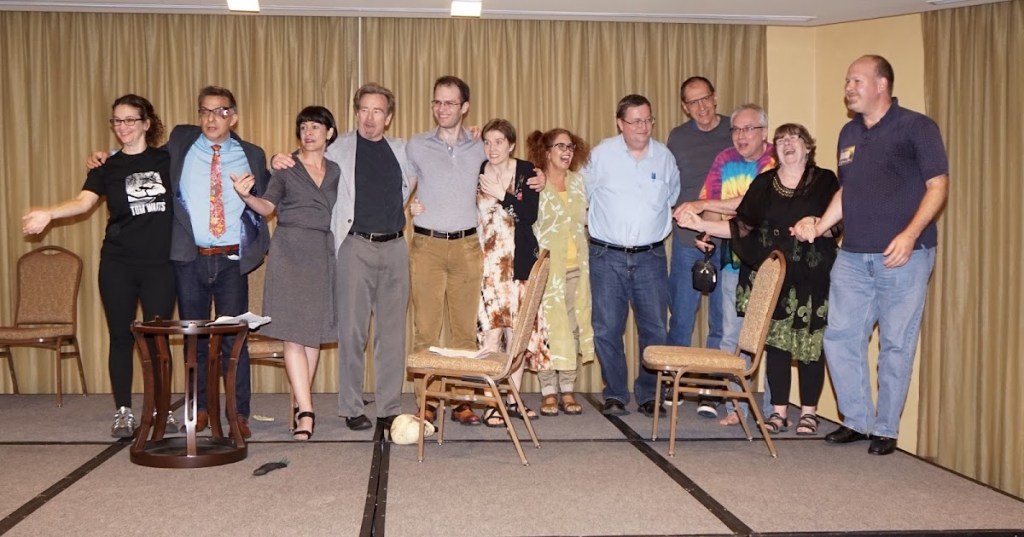
There’s an annual conference that I like to attend called the International Conference on the Fantastic (ICFA). It takes place in March in Orlando, Florida. While it started as an academic conference, over time the organizers began to welcome working science fiction and fantasy writers. Some of these worthies are the subjects of the learned papers presented there and some (like me) just enjoy spending a weekend with smart people who love our genre. Especially if it means I can escape frosty New Hampshire in March.
The acronym ICFA may ring a bell for Asimov’s readers. This is the conference where the annual Dell Magazines Awards for Undergraduate Excellence in Science Fiction and Fantasy Writing are given. They go to the best short-stories written in the fantastic genres by students in college. It was founded in 1992 by our own Editor Supreme Sheila Williams and frequent ‘Mov’s contributor and creative writing professor Rick Wilber (aka “the nicest man in science fiction”). You’ve probably read one of Sheila’s columns congratulating the winners. I have had many dinners at ICFA with the Dell Awards writers.
Wait, what does this have to do with the planning of “In The Dark?”
In addition to awards and academic papers, ICFA also features panels about the craft of writing and the culture of the fantastic. Also, readings by the writers. Lots of readings. You can often preview the next year’s ToC here by sitting in on ICFA readings. These readings used to be my favorite part of ICFA until Carrie J. Cole, a dramaturge (look it up), producing director and professor of Theater and Performance Studies founded the fiendish ICFA’s Flash Play Festival. Every year, a couple of weeks before the conference begins, she sends out a call for plays. She challenges us to write a ten-minute play (roughly ten pages of dialogue) with parts for no more than three actors which must include two specific elements: one of three props (which change every year) and a line of dialogue (which also changes every year).
And it must be written at the very last minute.
Then she picks the five or six best plays and casts them from her Flash Players, a motley group of writers and academics of varying thespian skills (as for instance myself, a shameless graduate of the Bill Shatner School of Scenery Chewing). On the first night of the conference, Carrie and the other professional directors rehearse the plays with their casts. Two nights later, scripts in hand, ready or not. the players attempt not to embarrass themselves or the playwrights by performing the plays. I have participated both as a playwright and an actor many times. Over the years, despite some silliness, or perhaps because of it, Carrie and I have become good friends. In fact, some of the plays I’ve written, thanks to her astute dramaturgy, have been performed by real actors on real stages of real theater companies.
A flash play is like flash fiction, right? I already had the dialogue, all I needed was some setting. Two or three thousand words tops! Done before Labor Day!
In 2017, Carrie’s challenge included these three props, a bat, a mechanical arm and a cursed map and the following line: “I think we can agree this did NOT go as planned.” Because my daughter Maura Kelly (more on her later) was a fan of escape rooms, I imagined a kind of horror VR escape room. My main character, a working class firefighter, would be going to this show carrying a baseball bat as a prop to fight vampires. He would have invited his ex-girlfriend to meet there in an attempt to get back together, but she would stand him up. So, “not as planned.” Instead he would fall in with a very special and strange someone who would be the embodiment of a wicked cool science fiction trope I had never tried to write about before. What trope? Well, if you’ve already read “In The Dark,” you know. And if you haven’t, I’m not going to spoil it for you. Go find the September/October issue of Asimov’s! Read!
So I wrote my ten-minute play and sent it off to Carrie. Right before the conference, she wrote to say that she was in the awkward position of turning it down. “I hope you understand why we have to pass on this one this year. I hope you’re still willing to tread the boards with us. And I really do hope you play with this script a bit more for future possibilities.” Did this sting? Of course! Every rejection stings. But I did act in that year’s festival. And I have written plays for the festival since. When Carrie and I talked about the play later, I could see her point. My little play didn’t really have an ending, just an opening and that wicked cool idea. And I hadn’t really had time to explore the idea in just ten pages of dialogue. I grumbled, put it in a drawer and chalked it up to experience.
Six years passed.
As I said, I’ve written a bunch of these little plays and some are pretty good. They’ve had other performances and a couple have actually been published. Last summer I got to feeling guilty about not sending Sheila a story and I wondered if maybe I could adapt one of them. A flash play is like flash fiction, right? I already had the dialogue, all I needed was some setting. Two or three thousand words tops! Done before Labor Day!
Only what play did I choose to adapt? The one with no ending, of course. The one with the wicked cool idea. But the more I thought about the idea, the more complicated it got. Then I got interested in the sociological background of it and so I consulted my daughter Maura, who happens to be a professor of sociology at Portland State University in Oregon. She was partly responsible for the VR escape room so why not ask her to help me think about the wicked cool idea? Which meant I needed a sociologist character to say some of the lines Maura fed me. Then I fell into a rabbit hole of research about the lives of firefighters. Alas, the ten page play did not turn into a three thousand word short story in mere weeks. It took several months to write the eleven-thousand-word novelette that finally became “In The Dark.” So I think we can agree this did NOT go as planned.
 From Earth to the Stars