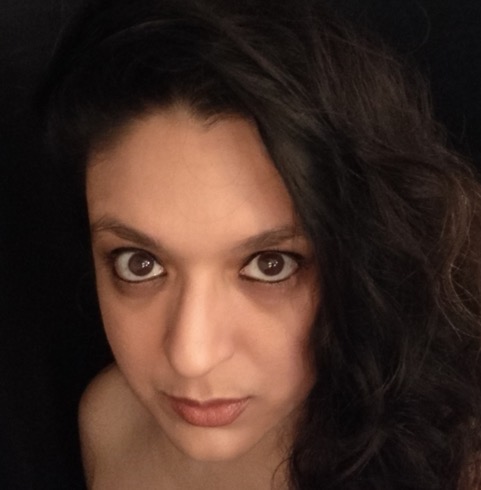
R. P. Sand makes her Asimov’s debut with her new piece “Eternity is Moments”, available to read in our [September/October issue, on sale now!]
Asimov’s Editor: How did this story germinate? Was there a spark of inspiration, or did it come to you slowly?
R. P. Sand: Writing this story was one of the very rare occasions for me where the story basically flowed from the initial spark. A few hours after my maternal grandfather died, I heard a line in my head: “I met my grandfather today.”
I couldn’t shake it, even though it felt like nonsense — of course I hadn’t met my grandfather that day! He died in a completely different city, far from me. I was bereft.
But the thought persisted, so I decided to write it down. And then I just kept writing. The words flowed and I had a first draft in my hands far quicker than I ever had before.
Working on this story over the span of the next week or so helped me process my own grief and the tangle of emotions that come along with the death of someone you loved very much but with whom you had a complicated relationship. As strange as this may sound, I feel he was with me in a way.
AE: Is this story part of a larger universe, or is it stand-alone?
RPS: This story is a piece of a larger future history I am mapping for Earth, and I have several stories in this universe both published and in the works.
My three far future novelettes in Clarkesworld are part of this universe. The stories “Ask the Fireflies” and “An Ode to Stardust” depict humans living in a consortium of planets called the Archipelago. The third story, “The Last Civilian,” is also a part of this far future, but tells the tale of a starship that was lost before the humans reached the Archipelago.
Those humans are the descendants of the humans who leave our dwindling Earth. “Eternity is Moments” is about those who are left behind.
AE: How did the title for this piece come to you?
RPS: Death was very much on my mind when titling this piece. It struck me how an entire life with a myriad complicated connections, experiences, and emotions can effectively disappear in the moments of death. In mere instants, a person shifts from actively engaging with this world and influencing things around them to becoming inert. All that’s left are passive memories in other people’s thoughts.
I’ve heard the phrase “eternity in moments” to describe a portrayal of vastness in a short span of time. I use a depiction like this in the story by essentially compressing an entire woman’s life into a few select scenes. However, as a title it still didn’t feel right.
Because, no, our own eternity is moments, really. What we perceive to be Big Eternal Things in our lives are just moments in the grand scheme of things.
AE: Are there any themes that you find yourself returning to throughout your writing? If yes, what and why?
RPS: I tend to use writing speculative fiction as a means to process and understand the world around me. So I veer more towards exploring connections and interactions through character-driven storytelling, at least that is my aim. Connections can be with the self or with others, including non-humans. Writing about non-human connections works equally well in helping me understand connections in our real world.
Thus, my through-lines include identity, mental health, and many different forms of love, not only romantic.
And a silly little challenge I gave myself at the start of my writing career was to insert a cat in every story, either literally or figuratively. Because I adore cats and am owned by three. In this story, the daughters of the protagonist wear pastel cat-eared gas masks. A tiny detail, but it tickled me nonetheless.
Because of this ebb and flow, creativity feels like an active, living, breathing entity to me. I view it as a lover of sorts, as cheesy as that may sound. It deserves to be nurtured just like any other relationship you want permanently in your life.
AE: If you could choose one science-fictional universe to live in, what universe would it be, and why?
RPS: The Star Trek universe, hands down. I yearn for a future like that, where humans have finally evolved beyond prejudice, hatred, and capitalism. No more wars, no more climate emergencies, amazing strides in medicine. Just an era of kindness, curiosity, and exploration.
AE: Do you have any advice for up-and-coming writers?
RPS: I would say take each piece of advice you hear with a pinch of salt. Adapt it to make it your own and see what works for you, without the pressure of comparing how it has helped other writers. Experiment as much as you can, and don’t hesitate to let go of systems that no longer serve you as your own process evolves.
Having said that, I will share something that helped me at the beginning of the publishing phase of my writing journey for anyone who may resonate: write short fiction! Even if your goal is longer fiction, you can experiment so beautifully within the realm of short fiction. You can play with styles and voices and other elements that may be otherwise tedious or difficult to commit to in longer forms. This type of play will help hone your craft, even if you don’t want to stick to short fiction.
I wrote with novels in mind for most of my life, but when I discovered the delights of short fiction I decided to stay in this realm for a while. I may still write a novel one day, but I’m in no hurry.
AE: How do you deal with writers’ block?
RPS: Well, my immediate, instinctive reaction is to curl up into a ball and question my existence. But! I eventually remember that being hard on myself will only make it worse. I then actively remind myself that I deserve the same grace I’d extend to any other artist struggling with their art. A writer friend of mine likes to say that creatives sometimes need to breathe in and sometimes they need to breathe out and that is perfectly okay.
Because of this ebb and flow, creativity feels like an active, living, breathing entity to me. I view it as a lover of sorts, as cheesy as that may sound. It deserves to be nurtured just like any other relationship you want permanently in your life.
So, I actively court creativity. Depending on what’s going on in my life, this may look different. But I essentially do creative things with my hands like crafts and builds without the pressure of the result needing to be good or for profit, or even shared with another human. And I immerse myself in stories, not only by consuming fiction in all its forms (prose, cinema, games, etc.) but by seeking out interesting people and experiences, learning about psychology and history and mythology, and more. And then inspiration strikes at an unexpected moment and I’m breathing out again.
AE: How can our readers follow you and your writing? (IE: Social media handles, website URL…)
RPS: You can find me at rpsand.com. I also occasionally appear on Twitter/X (https://x.com/RadhaPyari) and Bluesky (https://bsky.app/profile/radhapyari.bsky.social).
 From Earth to the Stars