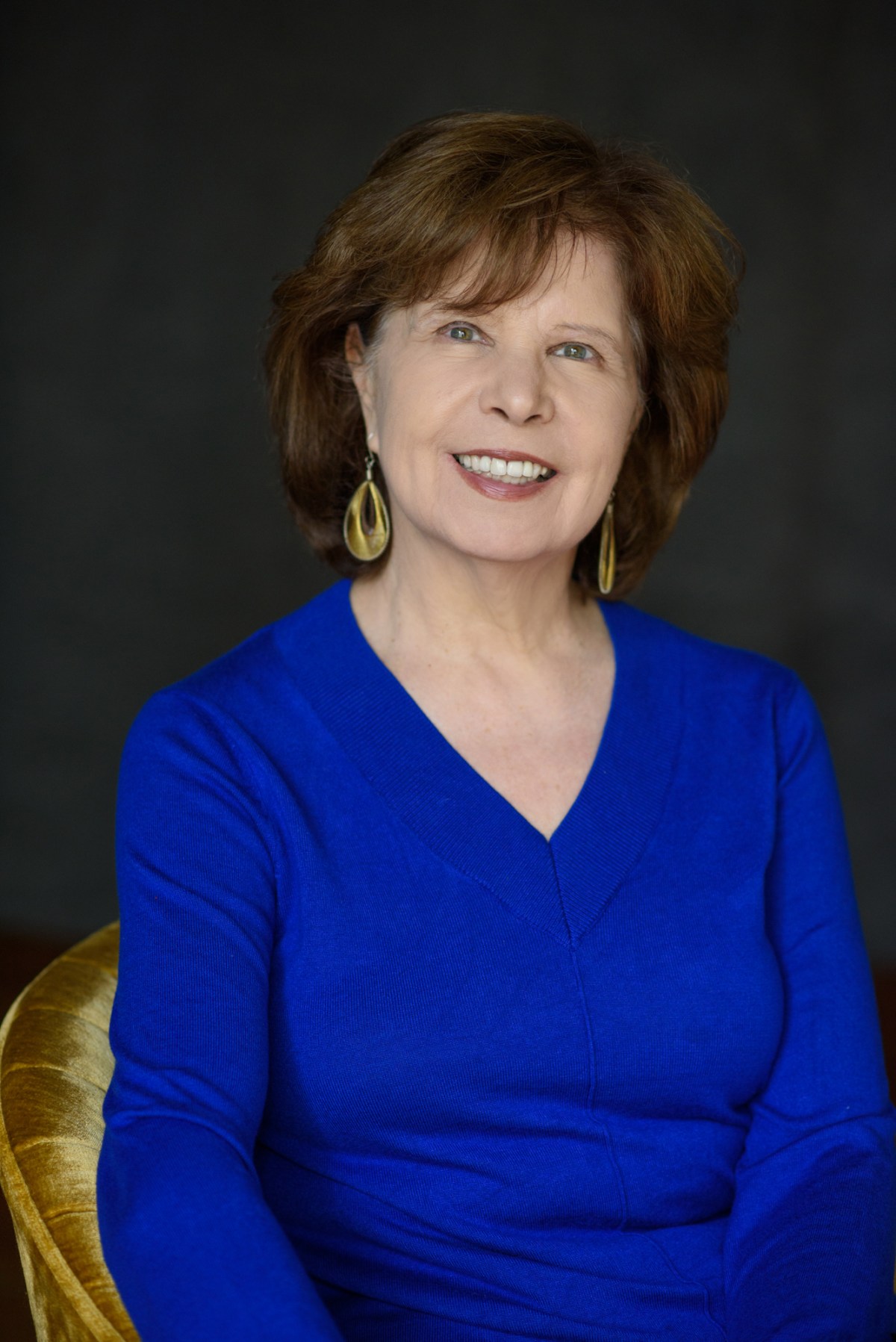
We’re thrilled to welcome back Nancy Kress (photo credit: Mary Grace Long) to Asimov’s, as the first part of her two-part novel Quantum Ghosts appears in our [March/April issue, on sale now!]. In this enlightening interview with Kress, we discuss the scientific inspiration behind Quantum Ghosts, her beginnings as a writer, and more.
Asimov’s Editor: What is the story behind this piece?
Nancy Kress: All my stories start the same way: with a character, a scientific idea, or both. For “Quantum Ghosts,” the scientific idea was the interaction between the magnetic shielding needed for a massive quantum computer and the magnetosphere of the Earth. The character was actually two characters I wanted to write about: a person who suddenly goes from financially cared for to destitute, and a character who is struggling to step out of their family’s expectations for them. The first of these is Kenda O’Malley, who came to me at the same time as the basic idea for the story. The second took more thought. Kenda is young, innocent, female; I decided she is destitute because her single-parent mother just died. I wanted my second protagonist to be a contrast to her, so Robert Dayson is male, older, and well off. Why is he still trying to live up to family expectations in his forties? I had to think about that, including the fact that some people never escape familial traditions. Both Kenda and Dayson have children to care for: Kenda’s little sister and Dayson’s difficult daughter.
The next step was to tie these two characters together, and both of them to the problem posed by the quantum computers. My original idea (and no, I don’t know where these things come from) included not just Kenda but also the quantum ghosts, electrical leakages that affect the human brain (a very real phenomenon from high-voltage wires, although not in the way I use them here.) Once I figured out how Kenda and Dayson were connected, the plot began to take shape in my mind.
This novella was actually planned first as a novel, with a great many more main characters with their own stories. The novel didn’t really work, so I pared it down to Kenda and Dayson, with other characters functioning mostly in connection to those two.
AE: Do you particularly relate to any of the characters in this story?
NK: A fan once remarked to me, not without a hint of exasperation, “Do all your stories revolve around pairs of sisters?” Well, no, not all, but a great many do, including my arguably most successful novel, Beggars in Spain. Sometimes the sisters are allies; sometimes rivals; sometimes, as in “Quantum Ghosts,” the elder is caretaker for a much younger sister. My sister is seven years younger than I, and when we were kids, I did indeed babysit her, teach her, mother her, even though we had a perfectly good mother. Some of this auxiliary mothering was not especially appreciated: I taught her to read by chasing her around the house and sitting on her until she learned. Anyway, Kenda is the character I most relate to.
AE: What is your history with Asimov’s?
NK: My second story published story appeared in Asimov’s in 1978. Since then, I sold stories steadily to editors George Scithers, Shawna McCarthy, Gardner Dozois, and Sheila Williams.
AE: What is your process?
NK: For any story with real science (or rather, real-to-a-point science; if it were all real it wouldn’t be science fiction), I research first. The characters, like Kenda and Dayson, might already be in my mind, but characters have to actually do things, and the majority of those things should be connected in some way to the science. So I begin with reading, note-taking, and playing with the concepts and details of the science, be it genetic engineering, stellar physics, or—in this case—the Earth’s geomagnetic sphere (which is not a sphere but an elongated shape that extends from the center of the Earth to several hundred miles into space.) Because I knew next-to-nothing about geomagnetism, this involved a lot of study, a lot of going “Huh?” and then “Huh!” Also a lot of cursing; I am not trained as a scientist. Research not only grounds a story in actual science, it can also suggest plot ideas, and I ended up with as many pages of story ideas as research facts.
Next all this gets reviewed and a loose outline emerges. Actually, to call it an “outline” is to vastly overstate. It’s one or two pages labeled MASTER SHEET which pretty much ends up mastering nothing, but at least it’s something to point out which direction I am hypothetically going and a few possible pathways to get there. Not so much GPS as a faded, dog-eared, slightly outdated Atlas roadmap that lacks all the new roads, collapsed bridges, and accidents on Interstate 90.
AE: How do you deal with writer’s block?
NK: I don’t actually have writer’s block, if by that you mean wanting to write but not being able to. I do have periods in which I am not writing, either because there is too much else going on in my life, good or bad, or because I am waiting for an idea to come to fruition in my mind. These fallow periods are full of reading, note making on odd bits of paper, seeing movies and analyzing their structure. For the most part, the fallow periods are serene. I know that eventually I will start writing again, and eventually I do.
Different from those periods are times I have a piece in progress but am reluctant to sit down and work on it. If this goes on for a few days, I know I’ve made a wrong turn somewhere in the story. So I go back to the last place I was excited and confident about the story, and replot from there.
AE: What inspired you to start writing?
NK: Boredom and isolation—not, I know, the usual answer. I was living way out in the country with a toddler and a difficult second pregnancy. My then-husband was working all day and taking an MBA at night. There were no other young women living on our road, and the older ones had all gone back to work. I was new to the entire city. Like all fiction writers, I had always read a lot of fiction, including science fiction. So when my toddler was napping, I started writing stories. They were all terrible and promptly rejected. But I enjoyed writing them, and gradually they got better. After a year, one of them sold.
AE: What other careers have you had, and how have they affected your writing?
NK: Two other careers. I was a corporate copy-writer for in-house copy, which means writing news letters, speeches for executives to give, non-technical training manuals. All these items must be gone over with the individual client, who then tells what corrections they want. From this process, I learned how not to write. Clients (not all, but most) wanted terrible prose: passive voice, pointless repetitions, bombastic diction (“It sounds more important.”)
I have also been a teacher of the fourth grade (liked it very much), of high school (lasted five months), of college (liked the graduate courses I taught, some of the undergraduate ones, but not freshman comp) and for the last several decades, at workshops like Clarion and Taos Toolbox, teaching committed adults who want to be SF writers (love it.) Teaching others forces one to articulate the principles of good writing, as well as seeing new techniques being worked out by talented aspiring writers. I always learn from my students.
NK: What other projects are you working on?
AE: I began in the early 1980’s by writing fantasy novels, not SF, and right now I am returning to fantasy with an historical novel, almost completed, called The Queen’s Witch. Tudor England has always fascinated me (as it does so many others), and my novel is about a witch bound to Anne Boleyn, a state of affairs neither likes. But they need each other and, as much enemies as allies, try to navigate the shifting currents of Heney VIII’s court. Everyone knows how that ends for Anne, but not the desperate twists my witch employs to try to save her, or why.
AE: Do you have any advice for upcoming writers?
NK: Yes, but none of it is new. Persevere: you are presumably in this for the long haul, and the fate of one story or one novel does not predict the rest of your career. Nor even two stories or novels, or three. Try to rein in both your elation at success and your despair at failure; any career contains a lot of both. Sometimes that isn’t evident to anyone but the writer, but it’s still true.
Read. Read good fiction and analyze why it’s good. Read bad fiction and try to determine why it got published, especially if it’s wildly popular. Read non-fiction. Stock the pond with ideas and details; that’s where ideas hatch.
Keep an open mind about criticism from beta readers, writing groups, agents, editors. The criticism might be not be useful, but consider it anyway until you are sure it isn’t useful to your particular work.
AE: What SFnal prediction would you like to see come true?
NK: SF doesn’t predict the future, it rehearses possible futures. Given a choice of those, I want benevolent aliens to make peaceful contact with us. It would be so lovely to know we are not alone in the universe. A bonus would be if they can help us straighten out the mess we are making of our planet, but that might be too much to ask for. Still, one can dream.
 From Earth to the Stars