
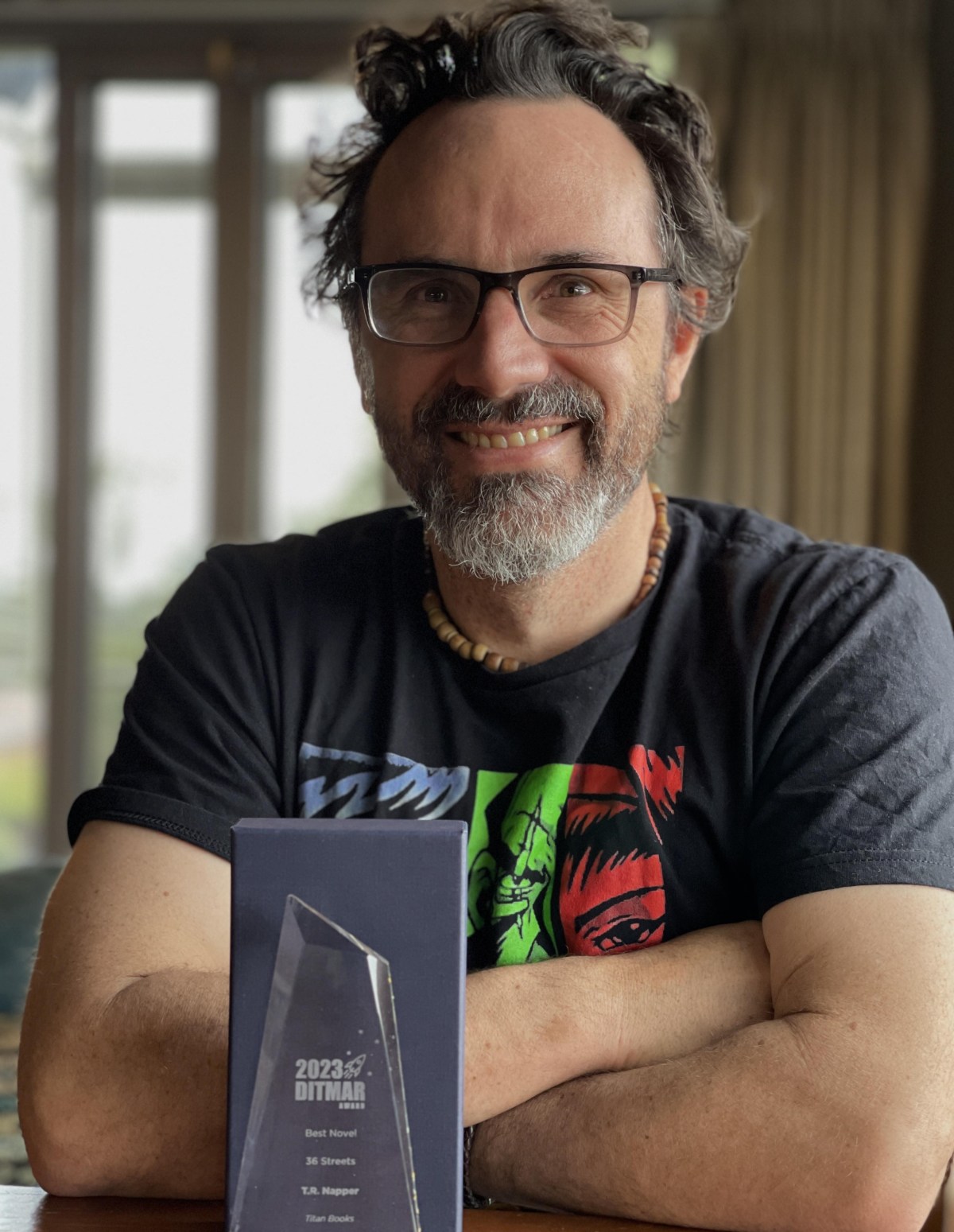
T.R. Napper wondered what might happen if some of the world’s worst billionaires somehow disappeared, and eventually came up with his latest story for Asimov’s, a novella called The Hidden God in our [March/April issue, on sale now!]
Asimov’s Editor: What is the story behind this piece?
T.R. Napper: I had just finished challenging edits on a very dark and morally complex novel, and decided I need a break from such creative intensity. I wanted to have some fun, so I thought: How about killing off the worst billionaires?
It was fun, at the start (creatively only, of course), but very quickly my mind yearned for something more. It’s actually a very good question for moral philosophy: if you had the power to kill off the worst billionaires, would you? What would be the consequences?
So instead of a simple and light short story, I found myself writing a dark, sometimes violent, and certainly morally complex novella. I can’t help myself, apparently.
The story also seems sadly prescient, given recent events in the US with your elections, with a growing oligarchy, and the influence of the billionaire class. I started writing The Hidden God two years ago, but it looks like I wrote it last week.
AE: Is this story part of a larger universe, or is it stand-alone?
TRN: Part of a larger universe. All my published works thus far, from my collection (Neon Leviathan), two novels (36 Streets and The Escher Man), and novella (Ghost of the Neon God) take place in the same future reality, ranging from the years 2080 to 2101. The Hidden God takes place earlier in the timeline (2063), and in a different country than I normally write—the Republic of California. All my other works are set in either Australia, Vietnam, or elsewhere in Southeast Asia.
I’d largely ignored the United States in my speculative future. This is because I’ve imagined a world where the US has collapsed and China remains the sole superpower. My fiction has sometime been called “post-Western” because, I assume, the US and Europe are no longer relevant (my intent was not to be deliberately “post-western” —my intent was simply to extrapolate the future I’d seen while living in Southeast Asia and Australia).
But I wanted to write about billionaires, and California has remained a functioning entity in my world, so I thought it might be a good place to start.
AE: What made you think of Asimov’s for this story?
TRN: Honestly, I didn’t think Sheila would take this, and was ecstatic when she did. My first story in Asimov’s was in 2015, right near the start of my writing career, and I’ve been submitting ever since. 15 stories over the past decade— some of which were held for a very long time, but none quite managing a spot.
I didn’t expect The Hidden God to succeed where the others had failed because it was a novella (and who I am to have a novella in Asimov’s?), and because it is so dark and violent. Not that Asimov’s doesn’t push boundaries—it does—but it didn’t seem typical for the magazine. Very pleased to have been proven wrong (and, as they say—never self-reject).
AE: Who or what are your greatest influences and inspirations?
TRN: Literature: Kazuo Ishiguro, Dashiell Hammett, Bao Ninh, Tim Winton, Ursula Le Guin, Philip K Dick, George Orwell, Kurt Vonnegut, Hilary St John Mandel, James M Cain, Vladimir Nabokov, Albert Camus.
Film: Blade Runner, Ghost in the Shell, Memento, Fury Road, Eternal Sunshine of the Spotless Mind, Gattaca.
AE: How much or little do current events impact your writing?
TRN: You’d be forgiven for thinking they do intensely, if you’d just read my novella in Asimov’s. But, on the other hand, not at all.
By this I mean: while I have a firm set of political beliefs, and draw on events in the present to inform my work, I’m also a writer. I’m not a polemicist or an essayist. The world is complex and humans are complex and I believe the best stories are, as well. What I want, ultimately, is to write stories that can be relevant to different times and different places. I suppose I want to try (even if I fail) to write something true about what it means to be human.
I do not like fiction that tries to spoon feed a particular morality—even if (especially if) it happens to match my own—or that is connected in an obvious way to the present. I want real people in real imagined worlds, living full three-dimensional lives, with all the messiness and uncertainty that this contains. I have themes I return to, of course—the dehumanizing effects of technology, rising corporate power and surveillance, new imperialisms, the relationship between memory and the soul, the consequences of violence—but themes need not be didactic.
As Hemingway said: “As a writer, you should not judge, you should understand.”
What I want, ultimately, is to write stories that can be relevant to different times and different places. I suppose I want to try (even if I fail) to write something true about what it means to be human.
AE: What is your process?
TRN: I’m disciplined. I try to write (or edit) every day, and I read every day. I have word count targets every month, and usually hit them (for those wondering, I write full time, I work half-time, and I have two young children, which is to say: I’m tired). I’m not a fast writer, but I’m consistent. Eking out words every day yields impressive results in the long term.
I tend towards the plotting end of the spectrum, do an enormous amount of research, obsesses over world building, write profiles for every important character in my stories and pin it to the wall in front of my writing desk. After a third draft I put aside stories to let them breathe. Weeks for short fiction, a year (or even more) for a novel. I can’t explain it, but it is intrinsic to my creative mind.
I’m a perfectionist. I obsess over edits, over words, over commas.
And, like I said: I read. Every night. Reading is part of the job of the writer. I read widely (outside my own genre), and aim to finish a book a week. It’s a great part of the job, yes, but in my view absolutely fundamental to being a better author.
AE: What other projects are you currently working on?
TRN: I’m about to start pitching a newly-completed novel, also set in my cyberpunk world, but a generation further into the future (approx. 2130). It’s more military SF than cyberpunk, and looks at the consequences of fully automatous warfare. With mechas.
But behind this, in the background, is a huge dark fantasy novel I’ve been working on and off for the past four years. Excited to get back to it.
AE: If you could choose one SFnal universe to live in, what universe would it be, and why? & What SFnal prediction would you like to see come true?
TRN: I’m reading The Player of Games right now actually by Iain M Banks, which takes place in the ‘Culture’. That universe has no possessions, ownership, or sickness, and lifespans are about 400 years (and yet Banks still finds ways to create conflict and tension).
So, yes, a world where I could create art and read myriad books (in 400 years I might be able to get through my TBR pile) and not have to worry about the mortgage, or the bills, yes that would be nice. Where my contribution would be valued, where I would still serve a purpose to society, where words and learning and ideas still mattered? Yeah. Wouldn’t mind that.
But I’m a punk, at heart, and punks like to fight. Maybe I wouldn’t be happy, after all.
AE: Do you have any advice for up-and-coming writers?
TRM:If you’re reading this you’re probably a writer of short stories. That’s a good thing. Short stories are great way to hone your craft, and, indeed, turbocharge it. I began writing short stories because I wanted to learn how to write, and because the cycle of drafting, critiquing, submission, and rejection was so much shorter compared to the novel.
But in the process I fell in love with the form. It’s a diabolical challenge to introduce a world, a story, create emotional resonance, and a satisfying character arc, all in 5000 words. There are many novelists who simply cannot do it. But I truly think going the other way is easier. If you can master the short form, you will have developed many of the crucial skills needed for the novel.
You also develop an audience. A small one, yes, but you’ve got to start somewhere. Industry professionals start to notice you, which doesn’t hurt, either. An old-school path to traditional publishing was the short-story, followed by the collection, followed by the full-length novel. This is the path I took, and it worked.
AE: What other careers have you had, and how have they affected your writing?
TRN: I started writing later in life, compared to my peers. I was in my mid-thirties when I took up the pen, after a career in foreign aid. Working overseas (mainly in Southeast Asia) for over a decade, implementing poverty alleviation programs in some of the poorest communities on Earth. This of course influenced my world view.
I think it’s good to start writing late, actually. While my craft was poor at the start, and I knew no-one, and didn’t understand how the industry worked, I nonetheless had a ‘voice’. I knew who I was, knew what I believed in, and had years of intense cultural, social, and political experiences that in turn influenced my work.
I never have writer’s block. In fact I have the opposite problem: a profusion of ideas for stories and series and situations. I think Iin part this is why I still try to write short stories, even though my main focus now is the novel. Short fiction is the perfect arena to experiment, get some new ideas onto the page.
AE: How can our readers follow you and your writing? (IE: Social media handles, website URL…)
TRN: On Bluesky, Instagram, and Facebook I’m trnapper. On Twitter I’m @TheEscherMan, and my website is: www.nappertime.com
 From Earth to the Stars