
by Zohar Jacobs
Zohar Jacobs explains the real events in NASA’s history that inspired her new story “On the Night Shift”, available in our [March/April issue, on sale now!]
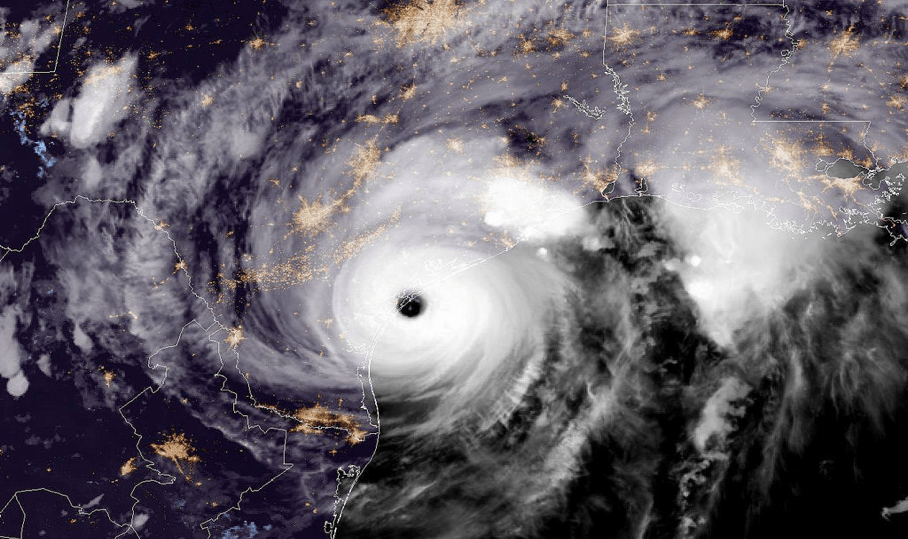
Climate change is coming for us all but there are some places where it feels painfully present already. For me, Houston is one of those places: something about the ever-present proximity of water, an industrial landscape of oil tanks and petrochemical plants and container ports and suburban sprawl superimposed on low-lying pasture and winding bayous, under regular threat from hurricanes rolling in from the Gulf of Mexico.
That contrast between the sprawl of modern industry and the inescapability of nature feels even more dramatic in Houston because it’s the nerve center of American spaceflight. Johnson Space Center, not much more than thirteen feet above sea level and practically on the shores of Galveston Bay, has always been vulnerable to flooding. Nearly forty years ago, NASA was already planning for a back-up control center to ride out a hurricane – but back in 1987 they would have had to fly three “portable… advanced computers” (as a contemporary article in the New York Times put it) to NASA’s White Sands Test Facility in a cargo plane to be able to control a mission from there.
Since then, JSC has had multiple close calls. During Hurricane Harvey in 2017, it closed due to flooding, but a skeleton crew of engineers slept on-site and worked twelve-hour shifts to keep the International Space Station supported. “I don’t think [the crew on the ISS] realized the Flight Control Team was riding out the storm,” said Ground Controller Dorothy Ruiz. “Not until they somehow found out we were sleeping in cots.” I highly recommend her interview on the Rocket Women blog, not only for the tales of blacked-out hallways and “looting” colleagues’ food from refrigerators, but also for the amazing story of how she came to work at NASA in the first place, after a childhood spent traveling between central Mexico and America as a migrant farmworker.
“On the Night Shift” was inspired by a throw-away line in a Verge article about how NASA dealt with Hurricane Harvey: “there’s the option of moving Mission Control temporarily to a hotel in Round Rock, Texas.” That sparked my imagination: what would it be like to control a space mission from a makeshift control center in a hotel, after a chaotic evacuation? And what if the people who were meant to be in charge didn’t make it there at all?
My protagonist, Maria, is in her late twenties, as many early-career flight controllers still are. Controlling human spaceflight requires specialist skills, so it remains a “learn on the job” role. During the Apollo program, most of the engineers at Johnson Space Center were recruited not from elite institutions like MIT or Caltech, but from midwestern and southern state universities. A B average was good enough. “Anyone who could spell Apollo,” one man recalled, “we took them.”
What would it be like to control a space mission from a makeshift control center in a hotel, after a chaotic evacuation? And what if the people who were meant to be in charge didn’t make it there at all?
But in the near-future dystopia I created in “On the Night Shift,” I wanted to highlight how American social mobility has taken a downturn since the post-war period. Maria has faced much stiffer competition to get on the career ladder. And while the men who moved to Houston in the 1960s could buy a house and support wives and families on one government salary, Maria is stuck living in a shared house in an area that she knows will flood. Economic precarity reinforces climate change vulnerability. Although the housing cost crisis isn’t such a present reality for Johnson Space Center’s engineers, it’s already becoming an issue for staff at the Jet Propulsion Lab in Los Angeles, where high housing prices are making some employees question whether they can afford an idealistic job in the public sector.
Writing a believable engineering crisis is always a challenge, if you’re not satisfied with resorting to technobabble along the lines of reversing the polarity of the neutron flow. I strongly believe it’s better to borrow than to invent. The high-stakes situation that forms the climax of “On the Night Shift” was inspired by the 1985 abort-to-orbit of the Shuttle mission STS-51F after one of its main engines shut down during launch. It was Booster Systems Officer Jenny Howard – one of the very first women to work in Mission Control – who guessed that this was a sensor problem and made the gutsy call to inhibit the sensors from commanding a shutdown on a second engine.
“This isn’t science fiction,” said a good friend of mine in response to an earlier draft of this story. Though I indignantly refuted Tim’s comment at the time, it may not be entirely wrong. A first human mission to Mars sadly seems a long way off, but climate change is here – now, already. Reports have highlighted how a major hurricane hitting the Gulf Coast in the wrong place could drive a storm surge up the Houston Ship Channel, inundating coastal refineries and resulting in a natural disaster that one expert says could be “America’s version of Chernobyl.”
But although Houston has so far escaped a major climate change disaster, the unprecedented wildfires in Los Angeles only a couple of months ago led to the evacuation of NASA’s Jet Propulsion Library, with hundreds of employees losing their homes. Climate change is coming for the space program. Let’s hope that our ability to imagine and envision the future helps us to live a better life on Earth even as we reach for the stars.
 From Earth to the Stars