
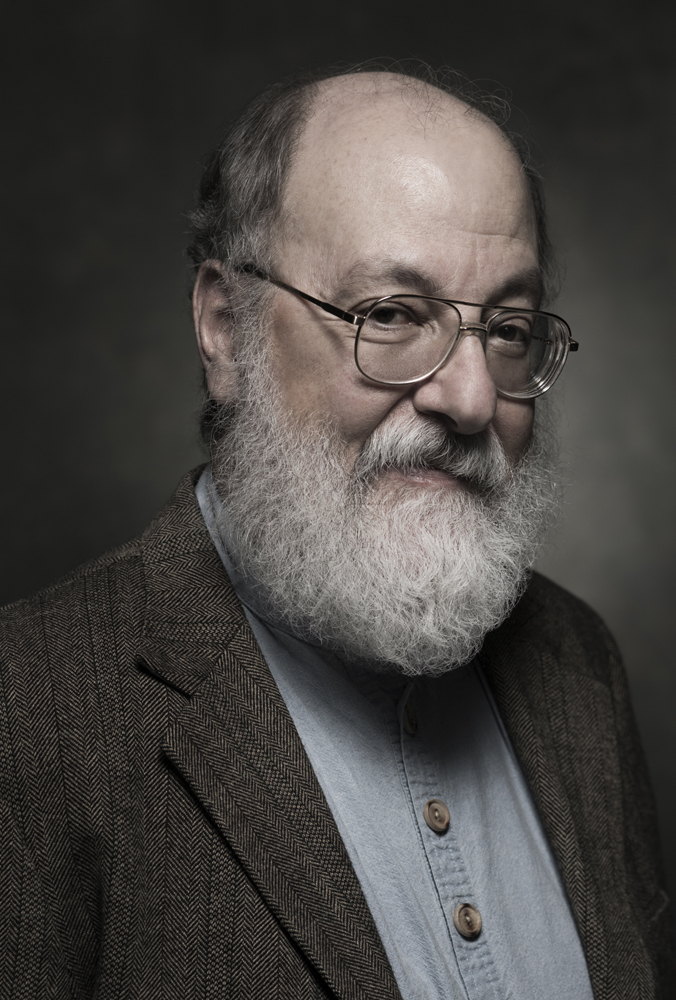
Legendary SF author Harry Turtledove returns to Asimov’s, where he was first published in 1981, with “The Fight Goes On,” his story in our [May/June issue, on sale now!]. Learn more about Harry’s influences and current projects in the our latest interview him
Asimov’s Editor: What is the story behind this piece?
Harry Turtledove: It’s a story that envisions a complication of time travel not many people have played with: namely, that as a people travel back to important events from further and further uptime, eventually, whole swarms of them will be there, all gawking at and trying to change those events. Robert Silverberg may have been the first to notice it, and used it in Up the Line in the late 1960s. Not many others have since then.
AE: How did the title for this piece come to you?
HT: When the past is mutable, when it can get changed, recharged, unchanged, changed back, and changed again, nothing is permanent and the fight always goes on.
AE: What is your history with Asimov’s?
HT: My first story in Asimov’s, “Death in Vesunna” (cowritten with my ex), appeared in the January 19, 1981 issue, when George Scithers was the editor. I’ve been lucky enough to have a good many in here since then.
AE: Who or what are your greatest influences and inspirations?
HT: If I hand’t discovered L. Sprague de Camp’s Lest Darkness Fall at an impressionable age, my whole life would be different now. It led me to study Byzantine history after I flunked out of Caltech, to have written most of what I’ve written (I would have written something anyway—I already hd the bug), to be married to my wife (whom I met while pinch-hitting for my prof at UCLA), have the kids I have….Other than that, it didn’t change my life a bit. Alternate history on the micro historical level!
When the past is mutable, when it can get changed, recharged, unchanged, changed back, and changed again, nothing is permanent and the fight always goes on.
AE: How much or little do current events impact your writing?
HT: Usually, not very much, because alternate history written about near-contemporary events quickly turns into a political tract. To steal from Ted Sturgeon, I don’t aim to sell my birthright for a pot of message. But I have had one or two sharp things to say in print about the fascist idiot currently infesting the White House.
AE: What other projects are you currently working on?
HT: I recently had a noirish urban fantasy, Twice As Dead, come out from Caezik. It’s set in a postwar L.A. with a hard-drinking detective, vampires, zombies, ghosts, the Central Avenue jazz scene, a bunch of corrupt cops, and a smartass talking cat. I’ve sold a couple of others in the same milieu, and am working on one more still. I’m also playing with an off-the-wall short piece.
AE: What are you reading right now?
HT: A bawdy diary by an Englishman who traveled in—i.e., drank, gambled, and whored his way through—the United States in 1884-85, made friends with Buffalo Bill, and was later instrumental in bringing Buffalo Bill’s Wild West show to England and Europe; and a Max Hastings book about the RAF’s 1943 effort to knock out German industry in the Ruhr using Barnes Wallis’ bouncing bombs against the dams on the rivers there.
AE: Do you have any advice for up-and-coming writers?
HT: Read a lot. Write. Imitate what you admire. Submit what you write. Keep submitting when it comes back, because it often will. Repeat endlessly. (This is related to and descended from Heinlein’s writing tips, but is not identical to them.)
AE: How can our readers follow you and your writing? (IE: Social media handles, website URL…)
HT: I’m @hntdove.bsky.social, and have been annoying people there for a few months now.
 From Earth to the Stars