by Carrie Vaughn
Carrie Vaughn leads a guided tour through the wide world of yarn on her way to explain how she came up with the idea for her short story “Woolly”, appearing in our [May/June issue, on sale now!]
I can tell you exactly where my story “Woolly” started. It started with a spindle.
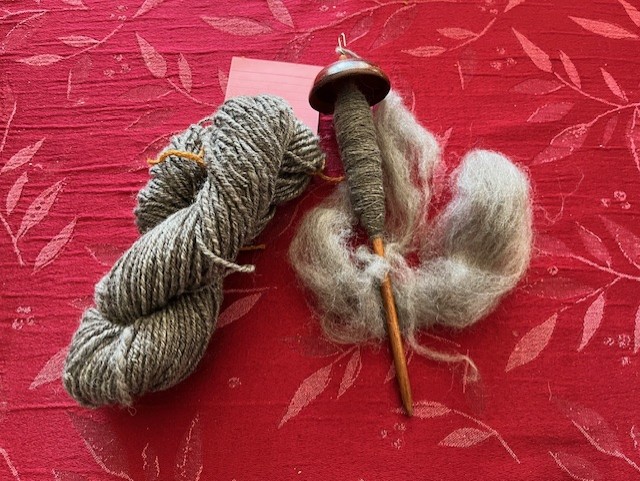
I learned to spin wool on a drop spindle maybe a dozen years ago. A thing I love about spindles is they’re one of the oldest technologies we have – probably around 15,000 to 20,000 years old. The spindle is older than agriculture. The first spindles were probably not much more complex than a stick that people would use to gather wool shed by wild sheep and goats, and wind it up for felting and early weaving. Spindles are portable. You can spin while waiting for the stew to cook, while watching the babies, or walking to the next camp. I love that I have this skill that’s been passed down for thousands of years and hasn’t changed much in all that time. It feels like a cosmic connection.
I sometimes think our ancestors would be shocked that these days, most of us do this for fun.
Spinning is very satisfying. For those of us who have trouble sitting still, this gives us something to do with our hands. The original fidget spinner. I learned to knit mostly because I was spinning all this yarn.
Once you start spinning, once you get confident at it, you start looking at the world a little differently. You start asking a big question: Can I spin that? Is there a big pile of fluff nearby? Yes, you can probably spin that. Any fiber I can get my hands on, I’ve spun. Sheep, alpaca, and angora rabbit are the obvious candidates. But I’ve also tried spinning camel fiber. Bison fiber? Yes. My miniature American Eskimo Dog Lily was maybe 80% fluff, and yes, I spun her fur into a very poofy yarn. I’ve seen Golden Retriever and Husky yarn. I’m currently spinning a 50% merino, 50% yak blend that is soft and divine.
How about… Mammoth?
Well. Wouldn’t it be lovely to find out?
The classic science fiction extrapolation, an exploration of the unintended consequences.
That’s the question I asked when the plans to clone woolly mammoths got underway. A number of preserved mammoth specimens show that they had thick, golden-brown coats with a relatively long staple. (This is the length of a fiber, which can tell you how well it will spin, and the quality of yarn it will produce. Longer staple tends to produce stronger, smoother yarns.)
I bet we could spin mammoth hair. I wonder if the folks working on the cloning would let me try.
I asked the group of spinners that meets at the local yarn shop about modern analogs that might give us some idea of what spinning mammoth would be like. What we came up with was yak, one of the survivors of ice age megafauna that features a coarse, shaggy outer coat and soft undercoat. Mammoths probably did as well. Wool can be harvested by plucking – gathering as it naturally sheds – rather than shearing.
Because I write science fiction, I can take this a couple of steps further. We clone mammoths – yes, wonderful! It turns out mammoth fiber makes excellent yarn– very good! Mammoths are very large and difficult to care for – unsurprising! So let’s miniaturize them! Uh… And sell them as pets! Wait a minute…
The minute someone starts breeding and selling animals, the next thing to come along will be animal rescue. Because someone, somewhere will screw it up. So while the story started with a spindle, it ended with miniature woolly mammoth rescue, because that’s the inevitable conclusion. The classic science fiction extrapolation, an exploration of the unintended consequences.
I still want to try to spin mammoth fiber.
 From Earth to the Stars