by Steve Rasnic Tem
Steve Rasnic Tem discusses the looming specter of climate change, what efforts are being made to fight it, and how this inspired him to write “In the Forest of Mechanical Trees”, available to read in our [May/June issue, on sale now!]
At this point I’ve published a little more than 530 short stories. To create that much fiction a writer takes inspiration from a wide variety of sources: news stories, art, folklore, historical events, hopes, dreams, and nightmares. Sometimes it’s difficult to pinpoint an exact source. I might start with a phrase, a character, or a setting, and by some mysterious means a narrative grows from those bare, often unpromising materials.
But this tale, “In the Forest of Mechanical Trees,” has some quite specific origins. I have a dear friend of almost 50 years, a former housewife, ex-social worker, mother of two, who has been an active volunteer for many years. She started with the Hunger Project, unable to tolerate the fact that in a world of so much abundance a great many people were still going to bed hungry every night. During her work combating hunger, she discovered that one of the key elements affecting food production around the world, especially in poorer countries, was climate change. Her volunteering shifted to climate change work with such organizations as the Citizens Climate Lobby (CCL), 2030orBust, and more recently—understanding that reducing emissions isn’t enough given the amount of carbon already in the air—F4CR, the Foundation for Climate Restoration, an organization dedicated to restoring a historically safe and stable climate. By “historically safe,” they mean the climate in which humans have thrived for millennia – the pre-industrial climate.
At one time climate change was a thorny issue. In some circles it still is. People believed it didn’t exist. Over the past couple of decades that has changed considerably. Even the local weather forecasters sometimes refer to climate change and its effect on the weather people are seeing in their hometowns and local regions. Climate change as a real phenomenon has become widely accepted.
But if you ask What can we do about climate change? you’re likely to see a lot of shrugs. Climate change creates feelings of helplessness in a great many people. Climate change belongs to a class of things sometimes referred to as hyperobjects (a term coined by the philosopher Timothy Morton). Hyperobjects are phenomena so massively distributed in time and space they defy traditional notions of what a thing is. They tend to be larger than any one state or nation and they exist beyond the bounds of a single person’s lifetime. Human beings naturally have a hard time with hyperobjects. We feel powerless in their presence.
But people who volunteer for climate change activism believe there are things we can do to remedy this, and I agree. We had the power to create this problem in the first place with our uncontrolled carbon emissions and fossil fuel usage. Our boundless invention and ingenuity created climate change. Perhaps invention and ingenuity, along with self-control, if applied soon enough, will fix it. Climate change activists talk about two different goals: reducing our carbon emissions so that we’re no longer poisoning our air and removing the carbon already in the atmosphere in the hopes of restoring it to what it was before the industrial revolution.
Our boundless invention and ingenuity created climate change. Perhaps invention and ingenuity, along with self-control, if applied soon enough, will fix it.
Organizations like CCL work on the first goal, reducing greenhouse emissions through such strategies as carbon fee and dividend. Organizations like F4CR focus on the second goal, pulling carbon out of the air using the proposed techniques of synthetic limestone manufacture, seaweed permaculture, accelerated natural methane oxidation, and ocean iron fertilization. These methods are discussed in detail in physicist Peter Fiekowsky’s book Climate Restoration: The Only Future That Will Sustain the Human Race. It is important that these methods be studied thoroughly through well-funded pilot projects while there’s still time so that they might be safely implemented on a larger scale.
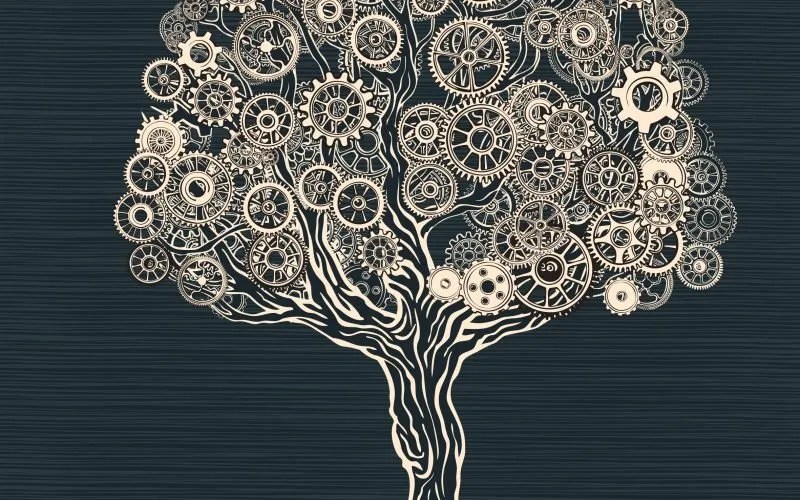
I’ve come to believe that no one solution is going to repair our world’s climate, but that many different solutions, working in concert, just might. There are a lot of proposals out there, large and small, including olivine beaches, planting more forests, and the solution I talk about in this particular story, mechanical trees. Whatever the method, they all require a fundamental shift in how we view our planet. We have always believed that the Earth and its systems were too big to break. Now we know better. What we do to the world we live in has effects far beyond what we once imagined.
In this story I focus on the grandparents. I’m a grandfather to seven, a great-grandfather to another two. Like many grandparents I worry about the world my generation is leaving behind for my grandchildren. If I live long enough to have to answer for what I did or didn’t do about climate change (which will affect them much more than it has me) what would I say? This aspect of the story was inspired in part by the F4CR-related project The Grandparents Fund for Climate Restoration, grandparents contributing something to help their grandchildren thrive by restoring a climate fit for humans.
I’ve been thinking about these climate-related issues for some time. But I still wasn’t ready to write a short story about it. That final bit of inspiration came one afternoon when my old friend took me on a walk through a neighborhood in Sebastopol, California. She wanted to show me something she knew I would enjoy. A lot of things, actually. I’m a fan of both sculpture and collage, especially sculpture which re-uses “junk” and turns it into art. In Sebastopol there is an artist by the name of Patrick Amiot (https://patrickamiot.com/) who creates sculptures from objects destined for the scrap heap. These large, intricate, often satirical works of art can be seen throughout the community—in a field by Highway 12, in front of the hardware store, the fire station, fronting office buildings, and on one particular street filling almost every yard—fashioned from hubcaps, lids, watering cans, water heaters, buckets, car hoods, barrels and barrows and oilers—all created by Patrick Amiot and brightly painted by his wife Brigitte Laurent.
Almost immediately I could see my destination, an entire attraction devoted to such sculptures, surrounded by the mechanical trees this artwork financially supported, in the desert somewhere south of an almost uninhabitable Phoenix Arizona. A defiant, creative outpost in a world ravaged by climate change.
 From Earth to the Stars