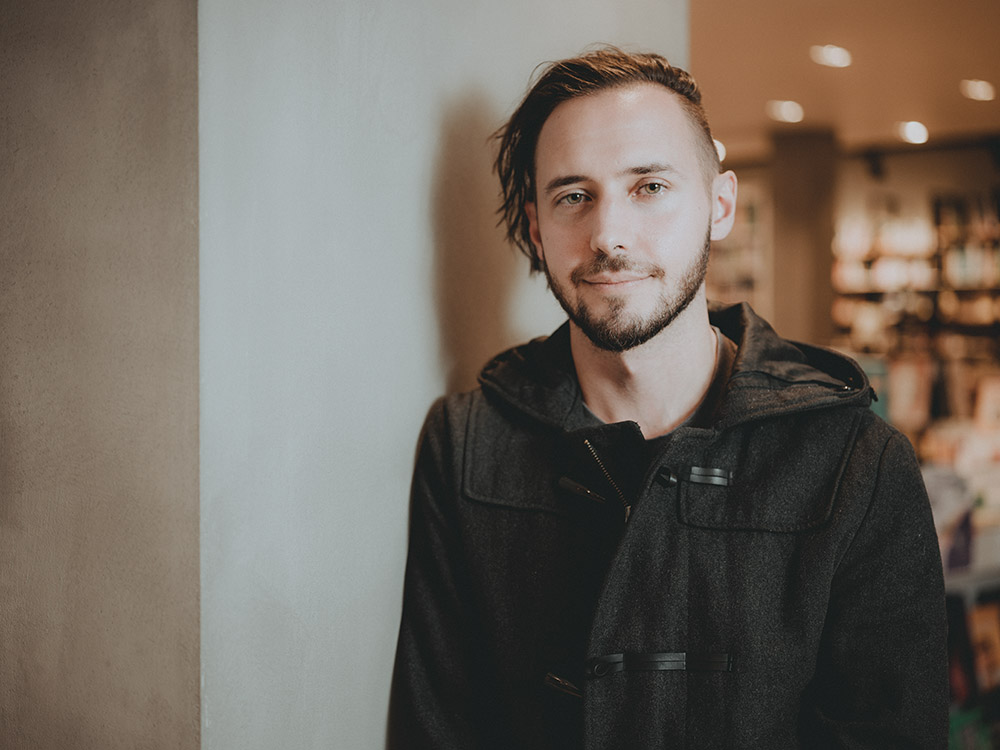
Rich Larson returns to Asimov’s in our July/August issue with “Most Things,” his latest story since the publication of his first novella, which appeared in our May/June 2024 issue. Catch up with Rich in our latest author interview about the dream that inspired “Most Things,” the writing contest that kicked-off Rich’s writing career, the merits of spa-day reading, and other surprising topics.
Asimov’s Editor: What is the story behind this piece?
Rich Larson: This story had a long gestation and synthesized many inspirations. The initial sparks came from 1) a vivid dream of a non-existent movie that opened with two middle-aged substance abusers (one played by a grizzled Matt Damon) crashing their car outside a fancy restaurant, bringing their multi-day bender to an abrupt halt 2) a vivid mid-morning high in the Crown & Anchor parking lot, produced by a particularly potent cocktail of weed, shrooms, coffee, and booze.
To elaborate: a friend had come through town to say goodbye before heading off to join the Navy, and he was talking to me about meth-head drywallers and ants being the earliest machine intelligence and how he hopes we eat the rich, and I was too high for it. I kept getting ideas and texting myself so as not to forget; some went on to inspire “Deathmatch” in Lightspeed and “Even If Such Ways Are Bad” in Reactor. The one most relevant to “Most Things” is transcribed below:
Different highs need different words, and for this one I need a word that is a poisonous yellow-black swamp whirling through space, aggressive in vacuum. I can feel the intent in its creepers and flowering tendrils.
That, combined with the aforementioned dream, got me underway. At some point I decided to incorporate the quantic lore from my Clarkesworld story “Carouseling,” creating a rare (for me) shared universe. The ending imagery at the beach came from both my own life and from another dream, in which an immortal being slept tethered to the sandy shallows, and before rising to the surface would carve themselves into a roughly human shape, shedding all the alien mass that would terrify onlookers.
AE: Do you particularly relate to any of the characters in this story?
RL: I can certainly relate to Mack’s fear of death, Arvo’s taste in poetry, and the way the two interact with each other—it’s based heavily on how I interact with old friends from Grande Prairie.
AE: How did the title for this piece come to you?
RL: The working title was “Stagger,” because I was originally going to open with Mack and Arvo staggering out from the wreckage of a car crash. Once the story was actually finished, I retitled it “Life After Heat Death”—but Sarah Pinsker had a better idea during the Sycamore Hill workshop. That’s how I ended up with the poem-referential “Most Things.”
AE: What is your history with Asimov’s?
RL: Long! Asimov’s has published twelve of my stories prior to this one, from “Bidding War” back in 2015 to my first-ever novella Barbarians just last year. Hopefully there are more to come.
AE: Are there any themes that you find yourself returning to throughout your writing?
RL: Fraught sibling relationships often appear in my work, and recently I’m prone to write stories involving memory, loss, and memory loss. Sometimes I get fixated on a certain motif that lasts for several projects—disembodied heads, for example, feature in my novel Ymir, my novella Barbarians, and, naturally, my Reactor story “Headhunting.” But I work hard to stretch myself and find new forms / themes / relationships, so I’m not too worried about repetition.
AE: How did you break into writing?
RL: Local library writing contest: once per year, two thousand words written to a specific theme, cash prizes. That created my early association between writing and getting paid / recognized, and then at eighteen I was a finalist for the long-defunct Amazon Breakthrough Novel Award, which cemented the idea I could write for a living. I sold some poems and a lot of short stories and eventually got my first novel contract when I was twenty-five. I’ve managed to survive as a full-time writer ever since.
AE: What other projects are you currently working on?
RL: I always have a bunch of irons in the fire. Right now I’m working on eight of my own stories, plus collaborating on a noir novella with another Canadian writer, plus doing some TV writing. I also have a new novel brewing in the back of my mind.
AE: What are you reading right now?
RL: Lately I’ve been doing a lot of spa reading—a book is a great distraction from the cold plunge, and a good companion in the sauna. I’m currently muddling through an Italian thriller, as a way to test my Italian comprehension, and before that I finished Karen Joy Fowler’s The Jane Austen Book Club.
AE: Do you have any advice for up-and-coming writers?
RL: Be kind to yourself. Write things that really interest you. Try flash fiction as a way to practice finishing things, which is its own skill.
AE: What is something we should know about you that we haven’t thought to ask?
RL: I’ve got some new books out! My self-illustrated flash collection, The Sky Didn’t Load Today and Other Glitches, and Changelog, the heftier follow-up to my debut collection Tomorrow Factory.
AE: How can our readers follow you and your writing?
RL: You can find free reads at richwlarson.tumblr.com, support my work at patreon.com/richlarson, and follow me on Instagram at @richlarsonwrites.
 From Earth to the Stars