John Kessel was first published in Asimov’s around 40 years ago. Now he returns with “The Ghost,” his latest novella in our [September/October issue, on sale now!]. Read on to find out how a turn-of-the century New Year’s Eve party hosted by H.G. Wells helped inspire this latest work.
Asimov’s Editor: How did this story germinate? Was there a spark of inspiration, or did it come to you slowly?
John Kessel: I’ve always been a fan of the science fiction of H.G. Wells, and became interested in his biography a long time ago. One of my most well-known stories, “Buffalo,” set in the 1930s, has the older Wells as one of the two major characters (the other is my father).
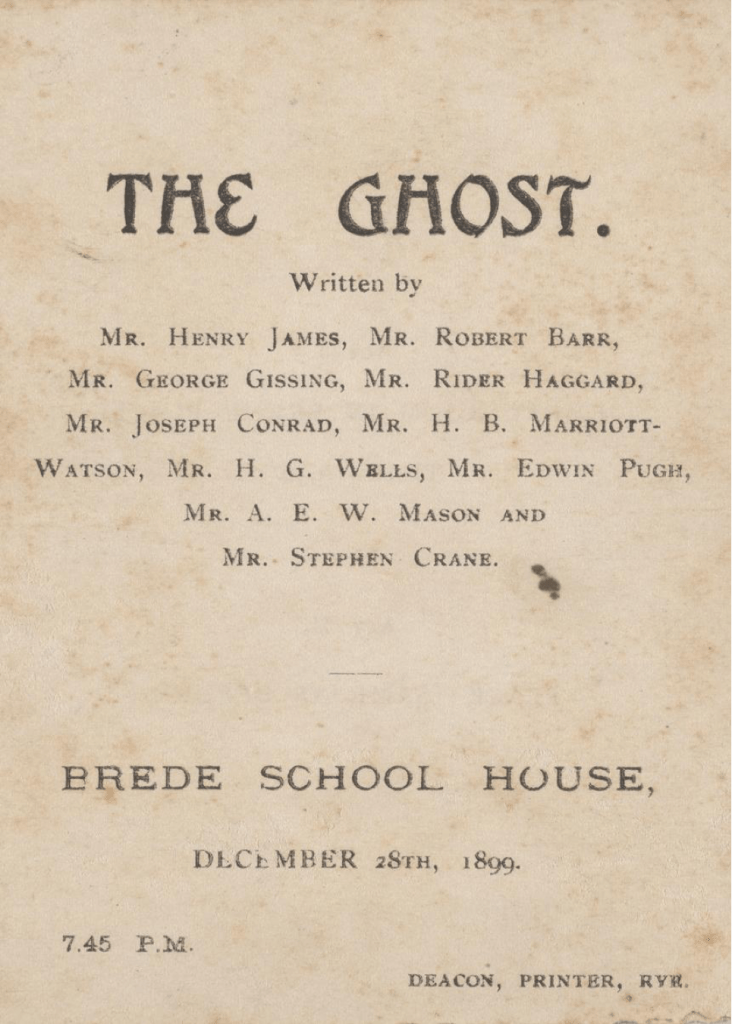
“The Ghost” started when I read that the American writer Stephen Crane, famous for The Red Badge of Courage, lived in England in the last years of his life, and that he and Wells were friends. They seemed like a real odd couple to me. Then I found out Crane threw a big multi-day New Year’s party at the end of 1899 to celebrate the start of the 20th century at a 500-year-old haunted manor house in the south of England. Crane persuaded a remarkable list of writers to contribute to a play, “The Ghost,” that the partygoers would perform for the people of a nearby town. Wells and his wife Jane were a part of all this; the more I learned about it the more I felt there was a story in it.
It took me a long time to find exactly the right story to tell, however. In what way was the house haunted, and who was at risk? It made me think about other stories set in an English manor house where a bunch of privileged people come together for a weekend and end up behaving badly.
Here’s the first page of the playbill that was printed for the play.
AE: Is this story part of a larger universe, or is it stand-alone?
JK: It’s one of a series of stories set in the first decade of the 20th century that I am writing. One of them, “The Dark Ride,” was the title story of my collection of 2022. All of the stories have some connection to the life and works of H.G. Wells, in particular his 1901 novel First Men in the Moon. I’m interested in the politics of that time, which reflect in some ways the politics of our own: vast inequalities between the rich and the poor, new technologies that were going to transform the next century, the personal struggles of individuals in this context, the efforts of artists like Wells to understand and affect the world. One of the other stories is set during a world’s fair, the Paris exposition of 1900; “The Dark Ride” describes a “Trip to the Moon” fair ride at the Pan-American Exhibition in Buffalo in 1901, based on Wells’s novel, where the anarchist Leon Czolgosz assassinated President William McKinley. Yet another concerns the French pioneer filmmaker Georges Melies’ 1902 movie “A Trip to the Moon,” which also draws from Wells’s novel.
Eventually I expect these stories to make a book.
AE: What is your history with Asimov’s?
JK: It goes back a ways. Early in my career, in 1984 and 85, I had stories in Asimov’s back when it was edited by Shawna McCarthy, and later by Gardner Dozois, and still later by Sheila Williams.
AE: Who or what are your greatest influences and inspirations?
JK: Among SF and fantasy writers I’ve been affected by a lot of older writers from H.G. Wells to Robert Heinlein to Alfred Bester to C.M. Kornbluth to Damon Knight to Carol Emshwiller to Thomas Disch to Gene Wolfe to Ursula K. Le Guin. A lot of writers who came into the field in the 1980s when I did have had great influence, among them James Patrick Kelly, Karen Joy Fowler, Bruce Sterling, Kim Stanley Robinson, and a dozen others I could name.
And then there are the many writers outside the genre whose work I’ve admired, from classics to contemporaries. I don’t necessarily try to write like them, but I have learned from them, and the work they did has been an inspiration. To name just a few: Jane Austen, Herman Melville, Karel Capek, Raymond Chandler, Nathanael West, Flannery O’Connor, Kurt Vonnegut, Tobias Wolff, Don DeLillo.
I should mention that I have been an avid movie fan since I was a kid, and there are great films and filmmakers that have stuck in my mind and heart. Orson Welles, Preston Sturges, Stanley Kubrick, Akira Kurosawa, Michael Haneke, the Coen Brothers; individual movies from The Day the Earth Stood Still and 2001: A Space Odyssey to The Third Man and Fargo.
I’ve always been a political person who cares a great deal about right and wrong even when those things are not easy to determine, and I think my beliefs have shown up in my work, either through satire or through the fundamental values the stories espouse.
AE: Are there any themes that you find yourself returning to throughout your writing? If yes, what and why?
JK: I’ve always been a political person who cares a great deal about right and wrong even when those things are not easy to determine, and I think my beliefs have shown up in my work, either through satire or through the fundamental values the stories espouse. I try not to write tracts, or to preach. I don’t think there are many characters in my stories who speak for me; in fact, if a character gives a political speech in some story of mine, you can pretty well count on it not to represent my own beliefs. I use a lot of not completely reliable viewpoint characters.
Another area, related to this, that comes up in my fiction a lot is male-female relationships. I try not to approach them from the point of view of a political agenda. I’m more interested in the ways that interpersonal dynamics reflect gender attitudes.
And connected to this are questions of masculinity, which comes up a lot in my stories. What is it that makes someone a man? To what degree are the behaviors that have typically been associated with men, and that society has encouraged—not to say forced—men to adopt, the result of inherent biological inclinations vs. culturally constructed expectations? I don’t necessarily know the answers to these questions. I look at this from a lot of different angles, ages, and circumstances. I think it’s there in “The Ghost” in the portrayals of Stephen and Cora, H.G. and Jane, though I’m not sure that is precisely what the story is about.
AE: What other projects are you currently working on?
JK: Most of my writing right now is taken up with the story series of which “The Ghost” is a part. I dabbled a bit in recent years in screenplays and writing for TV, but nothing has come of that yet.
AE: What are you reading right now?
JK: I recently read Gregory Frost’s trilogy Rhymer, Rhymer: Hoode, and Rhymer: Hel, and his separate historical horror novel The Secret House (set in the 1840s about the rise of John Tyler to the presidency, in a haunted White House). I like the way these books all use well researched historical material from which Frost creates fantasy and horror. And his characterization is great.
AE: Do you have any advice for up-and-coming writers?
JK: Read a lot, not just in your chosen genre, but every sort of fiction and non-fiction. Try to be a person who has both broad and deep interests. Follow them where they lead you. Be persistent. Try to have fun doing it. Find a way to fit your writing into your life in a humane way.
AE: What is something we should know about you that we haven’t thought to ask?
JK: I am very tall. This has had a significant effect on my life, mostly for good—as a teacher I suspect that I frequently received unearned respect from students just by walking into the room. But it has a downside that most people probably don’t think about, from the unintentional comedy of my using airplane restrooms to the astonishing number of times I have hit my head on things that most people never have to pay attention to: street signs, light fixtures, doorways, car hatches, tree limbs, stairwell ceilings. Ouch.
AE: What other careers have you had, and how have they affected your writing?
JK: For forty years I taught literature and fiction writing at North Carolina State University. It had a great effect. The works and writers that I taught offered me many examples of different ways to be excellent, in addition to exposing me to material that I have incorporated into my fiction. “The Ghost,” filled with real historical figures and based on real events, is one example of a story that I never would have written if I had not studied literature. And teaching creative writing forced me to think a lot about what makes a good story, the different kinds of good stories, how one constructs such a story, and the subjectivity of standards. Teaching a skill almost automatically hones that skill.
AE: How can our readers follow you and your writing?
JK: I have a (rather dormant) website at: https://johnjosephkessel.wixsite.com/kessel-website
You’re more likely to learn what I’m up to and what I’ve published at my facebook page: https://www.facebook.com/john.kessel3/
I also have a substack at: John Kessel
 From Earth to the Stars