by Susan Palwick
In this inspiring essay, Susan Palwick reflects on the cancer diagnosis that helped inspire not only her latest story, “The Greenway,” but a renewed appreciation for life and the beauty it contains
Writers are often asked where they get their ideas. Harlan Ellison is famously said to have responded, “A warehouse in Schenectady.” The truth is that often, we don’t know where our ideas come from. The process frequently feels mysterious and magical. But for “The Greenway,” my current story in Asimov’s, I can describe the process precisely.
In October 2022, my primary care doctor suggested that I have a Galleri blood test, which can provide early detection of over fifty kinds of cancer. Mine came back suspicious for lymphoma. The day I got the news, I went for a walk at dusk and stood on a hillside overlooking sunset in the Sierra foothills. The world is beautiful, I thought, and I’ve gotten to live in it. That gratitude became my mantra through everything that followed.
A PET scan showed that I had enlarged lymph nodes throughout my chest and abdomen. But none were accessible to biopsy, and I had no symptoms, so my medical team decided on a “watch and wait” strategy, with scans and bloodwork every few months to see if anything had changed.
For a long time, nothing did. “If anything’s going on,” my oncology nurse told me, “it’s really lazy.”
But lazy lymphomas often transform into energetic ones, and in early 2025, my illness began progressing. In increasing pain, I had a biopsy of an accessible (finally!) lymph node on March 18. I received a diagnosis of high-grade diffuse large B cell lymphoma (DLBCL) on March 20. On March 27, I was admitted to the hospital for pain control and my first of six rounds of DAR EPOCH, a challenging chemo regimen. My oncologist told me that my type of DLBCL was rare and aggressive, and estimated that the chemo had a 60% chance of curing it.
The world is beautiful, I thought, and I’ve gotten to live in it. That gratitude became my mantra through everything that followed.
Six weeks after my own diagnosis, on May 1, my husband was diagnosed with an even rarer and more aggressive type of bladder cancer.
I still found the world beautiful and was still grateful—am still grateful—that I’ve been granted the privilege of living in it. I hit on two strategies for weathering the following months. I tried to find something beautiful every day: spring flowers or autumn leaves, the astonishing generosity of friends who came forward to help us, the antics of our three cats, the quail and finches in the yard, the kindness of my oncology team. And every day, I tried to create something, to defy destruction and assert life, to maybe add my own bit of beauty to the world.
Sometimes my creations were tiny sketches, or a row of knitting, or an inch or two of weaving. Less often than I’d have liked, I wrote. But one series of conversations did draw a story out of me.
As soon as I was diagnosed, well-meaning friends began calling me a warrior, urging me to fight, to be brave and strong. Combat metaphors have become prevalent in cancer discourse, because they help many patients see themselves as heroes of a grand conflict rather than victims of singularly unpleasant cell mutations. In many ways the metaphor fits. Cancer is often (not always) clearly visible on scans as a series of front lines. Malignant cells are nothing if not mortal enemies, and treatment requires effort and stamina.
But many of us navigating cancer are uncomfortable with the language of battle, not least because it implies that anyone who dies has lost, has been somehow inadequate to a fight, rather than succumbing to a natural—if miserable and deeply regretted—process. Soon after my own diagnosis, I discussed this issue with a friend, another cancer survivor, who said, “My doctors are the ones fighting. I’m the battlefield.”
Antietem, c’est moi.
My own preferred metaphor quickly became the cancer patient as garden. Invaded by noxious pests, we rely on skilled, caring others to eradicate them, to tend and water and nourish us. During the lowest points of my treatment, as I lay marooned in bed, unable even to summon the energy to swing my legs to the floor, I could no more have fought anything than I could have flapped my arms and flown to the moon.
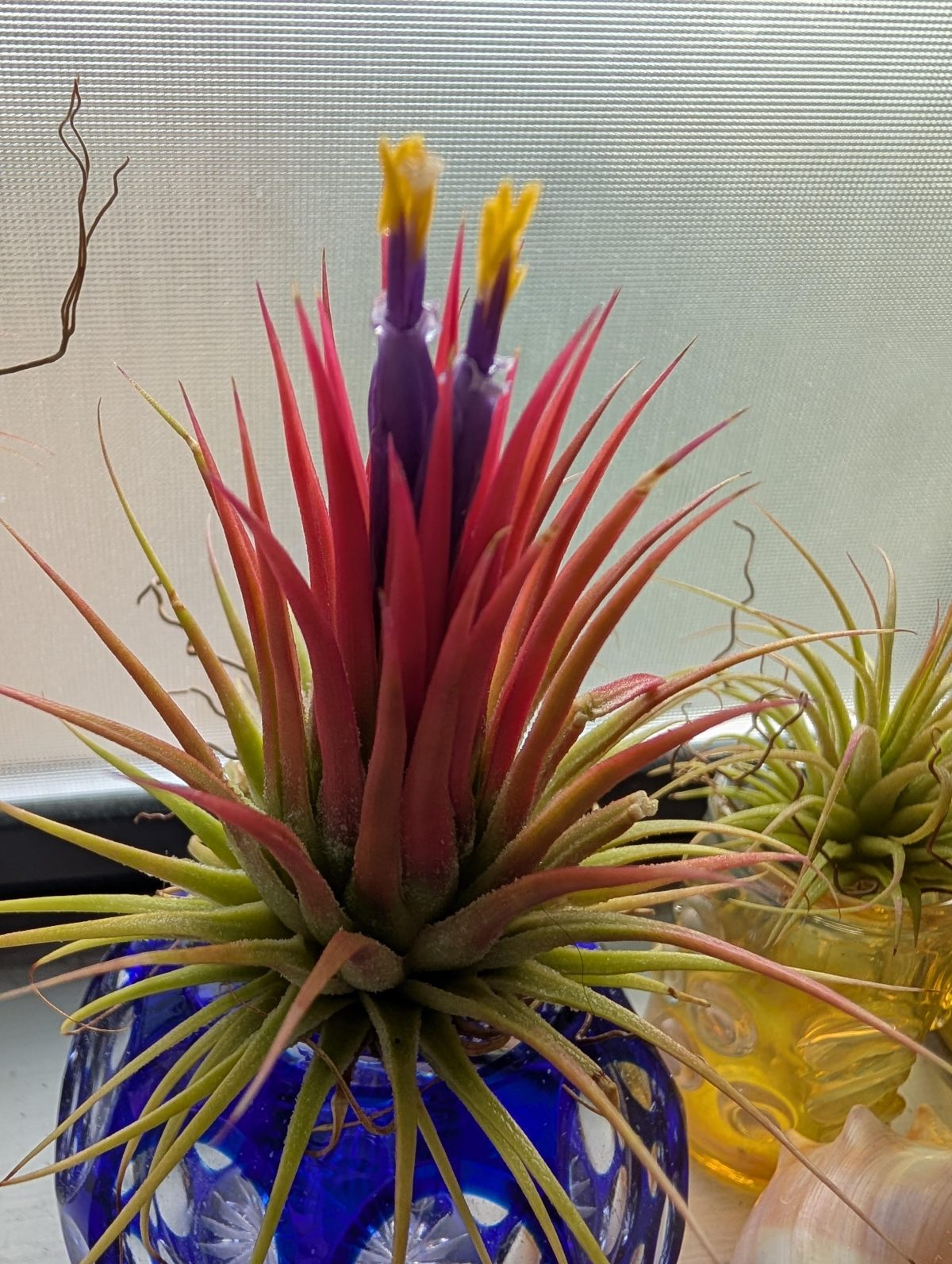
I’m not a gardener. Anything planted in dirt dies if I look at it, although I do all right with air plants (one of which, to my delight, has just bloomed: you can see it in the attached photo). During my treatment, I couldn’t even keep cut flowers friends sent me, because plants carry bacteria that can be dangerous to immunocompromised chemo patients. But after discovering the garden metaphor, I sought out botanical images. The screensaver on my laptop is a brilliantly colored image of a riotous garden. My bedspread is a print of plants. The quilt that hangs above my bed, a gift from a student’s mother many years ago, features flowers.
And because I’m a writer, plants and gardens found their way into narrative. Very soon after my diagnosis and before my husband’s, when chemo-induced brainfog hadn’t socked in yet, a story came to me, almost complete (which is, alas, not how my writing process usually works). It was a magical realist tale about a botanical plague bearing more than a passing resemblance to cancer, and writing it was a joy. As cliched as this sounds, writing the piece made me feel as if I was transforming my experience into something positive.
That story is “The Greenway,” and I’m delighted that you can read it in this issue of Asimov’s. “The Greenway,” in addition to its botanical theme, is also about movement and travel, fitting because another alternative to the battle trope is the conceit of illness as journey.
As I write this, my husband is cancer-free, but I am not. Two post-chemo scans have shown continuing disease, but—as in 2022—none that can yet be biopsied. I’ll have another scan in three months.
Physically I’m feeling fairly well, but like Devona in “The Greenway,” I’m on a journey with a very uncertain outcome. Like her, I crave color and nourishment. One moment at a time, I’ll continue to seek beauty.
 From Earth to the Stars