Why “In the Dark” Didn’t Go As Planned

by James Patrick Kelly

James Patrick Kelly discusses the dramatic beginnings of his latest Asimov’s novelette “In the Dark,” now available in our [September/October issue, on sale now!]

Credit: Bill Clemente

Thereโ€™s an annual conference that I like to attend called the International Conference on the Fantastic (ICFA). It takes place in March in Orlando, Florida. While it started as an academic conference, over time the organizers began to welcome working science fiction and fantasy writers.  Some of these worthies are the subjects of the learned papers presented there and some (like me) just enjoy spending a weekend with smart people who love our genre.  Especially if it means I can escape frosty New Hampshire in March.

The acronym ICFA may ring a bell for Asimovโ€™s readers.ย  This is the conference where the annual Dell Magazines Awards for Undergraduate Excellence in Science Fiction and Fantasy Writing are given.ย  They go to the best short-stories written in the fantastic genres by students in college.ย  It was founded in 1992 by our own Editor Supreme Sheila Williams and frequent โ€˜Movโ€™s contributor and creative writing professor Rick Wilber (aka โ€œthe nicest man in science fiction”).ย  Youโ€™ve probably read one of Sheilaโ€™s columns congratulating the winners.ย ย  I have had many dinners at ICFA with the Dell Awards writers.

Wait, what does this have to do with the planning of โ€œIn The Dark?โ€

In addition to awards and academic papers, ICFA also features panels about the craft of writing and the culture of the fantastic.  Also, readings by the writers.  Lots of readings.  You can often preview the next yearโ€™s ToC here by sitting in on ICFA readings.  These readings used to be my favorite part of ICFA until Carrie J. Cole, a dramaturge (look it up), producing director and professor of Theater and Performance Studies founded the fiendish ICFAโ€™s Flash Play Festival.  Every year, a couple of weeks before the conference begins, she sends out a call for plays.  She challenges us to write a ten-minute play (roughly ten pages of dialogue) with parts for no more than three actors which must include two specific elements: one of three props (which change every year) and a line of dialogue (which also changes every year).

And it must be written at the very last minute. 

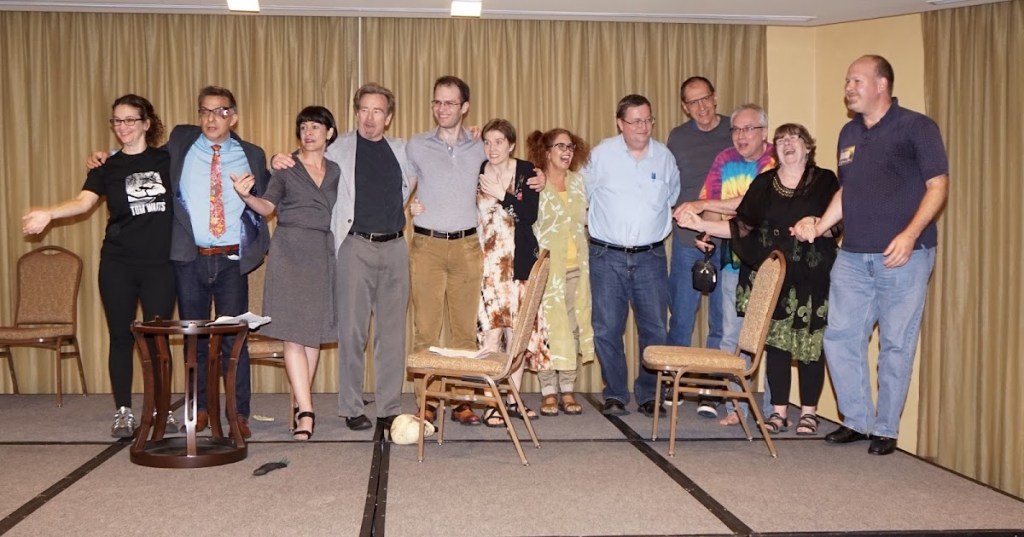
Then she picks the five or six best plays and casts them from her Flash Players, a motley group of writers and academics of varying thespian skills (as for instance myself, a shameless graduate of the Bill Shatner School of Scenery Chewing).  On the first night of the conference, Carrie and the other professional directors rehearse the plays with their casts.  Two nights later, scripts in hand, ready or not. the players attempt not to embarrass themselves or the playwrights by performing the plays. I have participated both as a playwright and an actor many times.   Over the years, despite some silliness, or perhaps because of it, Carrie and I have become good friends.  In fact, some of the plays Iโ€™ve written, thanks to her astute dramaturgy, have been performed by real actors on real stages of real theater companies. 


A flash play is like flash fiction, right?ย  I already had the dialogue, all I needed was some setting. ย Two or three thousand words tops!ย  ย Done before Labor Day!


In 2017, Carrieโ€™s challenge included these three props, a bat, a mechanical arm and a cursed map and the following line:  โ€œI think we can agree this did NOT go as planned.โ€  Because my daughter Maura Kelly (more on her later) was a fan of escape rooms, I imagined a kind of horror VR escape room.  My main character, a working class firefighter, would be going to this show carrying a baseball bat as a prop to fight vampires.  He would have invited his ex-girlfriend to meet there in an attempt to get back together, but she would stand him up.  So, โ€œnot as planned.โ€  Instead he would fall in with a very special and strange someone who would be the embodiment of a wicked cool science fiction trope I had never tried to write about before. What trope?  Well, if youโ€™ve already read โ€œIn The Dark,โ€ you know.  And if you havenโ€™t, Iโ€™m not going to spoil it for you.  Go find the September/October issue of Asimovโ€™s!  Read!

So I wrote my ten-minute play and sent it off to Carrie.  Right before the conference, she wrote to say that she was in the awkward position of turning it down.  โ€œI hope you understand why we have to pass on this one this year. I hope you’re still willing to tread the boards with us. And I really do hope you play with this script a bit more for future possibilities.โ€  Did this sting?  Of course!  Every rejection stings.  But I did act in that yearโ€™s festival.  And I have written plays for the festival since.  When Carrie and I talked about the play later, I could see her point.  My little play didnโ€™t really have an ending, just an opening and that wicked cool idea.  And I hadnโ€™t really had time to explore the idea in just ten pages of dialogue.  I grumbled, put it in a drawer and chalked it up to experience.

Six years passed. 

As I said, Iโ€™ve written a bunch of these little plays and some are pretty good.  Theyโ€™ve had other performances and a couple have actually been published.  Last summer I got to feeling guilty about not sending Sheila a story and I wondered if maybe I could adapt one of them.  A flash play is like flash fiction, right?  I already had the dialogue, all I needed was some setting.  Two or three thousand words tops!   Done before Labor Day!

Only what play did I choose to adapt?  The one with no ending, of course.  The one with the wicked cool idea.  But the more I thought about the idea, the more complicated it got.  Then I got interested in the sociological background of it and so I consulted my daughter Maura, who happens to be a professor of sociology at Portland State University in Oregon. She was partly responsible for the VR escape room so why not ask her to help me think about the wicked cool idea?  Which meant I needed a sociologist character to say some of the lines Maura fed me. Then I fell into a rabbit hole of research about the lives of firefighters.  Alas, the ten page play did not turn into a three thousand word short story in mere weeks. It took several months to write the eleven-thousand-word novelette that finally became โ€œIn The Dark.โ€   So I think we can agree this did NOT go as planned.

Q&A With Betsy Aoki

Betsy Aoki makes her Asimov’s fiction debut in our [September/October issue, on sale now!] In our interview with Betsy, find out why she believes community is so important for writers, and discover how this latest story pays homage to her Japanese-American family members who were interned during World War II

Asimov’s Editor: What is the story behind this piece?
Betsy Aoki: I was taking a few monthsโ€™ sabbatical from the game industry and set myself a challenge to write some new fiction. My Clarion West classmate, Cadwell Turnbull, had just started pitching the Many Worlds writers collective, with a shared multiverse framework and I was determined to write something for the collective as a member.
โ€œAnd To Their Shining Palaces Goโ€ was originally supposed to be a short story but, well, it got longer and longer the more I realized how complicated the setting was.
(Besides this story in Asimovโ€™s, and fiction published on the Many Worlds web site, Many World stories can be found in the 2023 anthology Many Worlds: Or, the Simulacra. Under the pen name Darkly Lem, several members have gone on to sell a Many Worlds multiverse novel to be published in 2025.)

AE: How did this story germinate? Was there a spark of inspiration, or did it come to you slowly?
BA: It began to germinate for me emotionally with the idea of the Shining Palacesโ€”the lure of being in a beautiful place working with beautiful/genius people and receiving the societal status to go along with that. The feeling that one is doing the most important and coolest creative work of oneโ€™s life, in a place where just being there as a worker bee gains you societal approval. ย And that work is done in a culture where it is expected you will spend all your time and juice to create worlds for others to believe in.
The Alariel simulationโ€™s resemblance to the game industry is of course, entirely coincidental . . .
The Alarielโ€™s brutal approach to productivity is more understandable when you realize they resemble giant, swarming praying mantises and donโ€™t really understand human psychology. ย Their interest in statistically proven behaviors is due to the fact I have worked as both a marketer and a technical program manager for Bing, the search engine. Search engines at that time did a lot of A/B testing where a feature would be killed if it failed to create the right clickthrough behaviors in a test segment of the audience. To keep the feature online you had to prove the correct behaviors were happening with statistical significance.
I also wanted to pay homage to the Japanese Americans sent to internment camps during World War II (members of my family, including my father, went to camp), so I made the main character and her family of that lineage. Being sent to a โ€œspecial place with walls around itโ€ hits differently with certain backgrounds and of course generations close to the historical event and farther away from it will react differently.ย 

AE: Is this story part of a larger universe, or is it stand-alone?
BA: This story is definitely standalone, but sits within the Many Worlds multiverse. My alien race, the Alariel, have misunderstood some of the things they learned about the Simulacrum from a wandering member of the Arcalumis, and, well, as a result they became obsessed with simulations as well as finding means to allow them to transit the multiverse. That obsession to swarm all the things leads them to a history of taking over places like Earth, and this story is what happens after that conquest.


โ€œAnd To Their Shining Palaces Goโ€ was originally supposed to be a short story but, well, it got longer and longer the more I realized how complicated the setting was.


AE: What is your process?
BA: Because I have always a busy day job (tech or games), writing tends to happen weekends and vacations (or if very lucky, a writing residency). I donโ€™t strive for a specific word count though I know some folks have had success with that.

AE: How do you deal with writersโ€™ block?
BA: The pandemic and then the death of my mom meant I just wasnโ€™t up to writing at various points. In this case, mental health/grief processing has to come first before you can โ€œdealโ€ with the block. Your brain is a wonderful thing, and can grind on, but it will start wearing down and smoking and burning out if not careful. I think if the writing block is because of life events, you have to roll with that and trust your psyche will come back to the writing.

AE: What other projects are you currently working on?
BA: After my debut poetry collection, Breakpoint, launched in 2022 I did a lot of book promotion and am glad to now be in more of a writing phase. I have a second poetry manuscript I need to flesh out, and I continue to try and improve my short fiction writing.
Projects with others include helping out with the Many Worlds collective, and also serving as poetry editor for Uncanny Magazine. My household also recently adopted two quasi-teleporting kittens who will serve to be a project in and of themselves.

AE: What are you reading right now?
BA: Just finished these three:

Shigidi and the Brass Head of Obalufon byย Wole Talabi (fantastic sexy caper novel)

The Saint of Bright Doors byย Vajra Chandrasekera (complex worldbuilding, amazing characters and sense of magic behind every door)

Someone You Can Build a Nest In byย John Wiswell (Cozy horror and love story all in one)

Now I am rereading for prose craft: This Is How You Lose The Time War, by Amal El-Mohtar and Max Gladstone

I am about to read these two for poetry craft:

The Selected Shepherd: Poems By Reginald Shepherd

Modern Poetry by Diane Seuss

AE: Do you have any advice for up-and-coming writers?
BA: You donโ€™t have to go so far as to join a collective but itโ€™s good to have a communityโ€”a critique group, a bunch of writer friends interested in the same writing you are, and of course that essential friend group to have: non-writers. Let yourself be dorky and reach out to create with others.
In fiction or in poetry, study the form, and read widely to understand how people are making authorial choices they do. Are they taking risks you want to take? Are they creating space for you to spread your wings and fly there? Study how they do it. Do it.

AE: How can our readers follow you and your writing?
BA: Folks can best reach me directly via the web form at https://www.betsyaoki.com . I am on twitter, Bluesky, and Mastodon but erratically across each.


Betsy Aoki is a poet, game producer, and graduate of the Clarion West Writers Workshop. A Rhysling Award nominee, she won the Auburn Witness Poetry Prize Honoring Jake Adam York, selected by Pulitzer Prize-winning poet Jericho Brown. Her debut poetry collection, Breakpoint was a National Poetry Series Finalist and winner of the Patricia Bibby First Book Award. Aokiโ€™s work has appeared in Strange Horizons, Uncanny, Fireside Magazine, The Deadlands, Translunar Travellers Lounge, and anthologized in Climbing Lightly Through Forests (a Ursula K. Le Guin tribute poetry anthology).

Q&A With Marisca Pichette

Marisca Pichette makes her Asimov’s debut with two poems in our [September/October issue, on sale now!] Where one poem deals with “transcendence and eternal connection,” the other “looks at apocalypse in miniature.”

Asimov’s Editor: What is the story behind these poems?
Marisca Pichette: “All the space you have left” is a poem about love and loss. While these themes could be tragic, I find a deep comfort in this piece. The narrator isn’t looking for acceptance or forgiveness. Rather, it’s a poem aboutย transcendenceย and eternal connection.
“In a vial on the windowsill you’ll find it” looks at apocalypse in miniature. The small things, the everyday changes, the mundanity of grief. Part nostalgia, part letter to a love that never was, it’s a poem to hold and be held, to remember and wonder andโ€”despite everythingโ€”hope.

    AE: How did these poems germinate? Was there a spark of inspiration, or did it come to you slowly?ย 
    MP: “All the space you have left” appears here almost exactly as I initially drafted it. For this poem, the body came first as a story, and I titled it at the end. This isn’t always the case with my work. Many of my poems are shaped by the title first. This piece, though, has muchย to say about beginnings and endings.
    “In a vial on the windowsill you’ll find it”ย took a long time to form. It was initially two stanzas shorter, and lacked a clear focus for a long time. I sensed what I was trying to do, but it took several rounds of re-reading and revision to finally arrive at the story that appears here.

      AE: How did the titles for these poems come to you?
      MP: “All the space you have left” can be read in two ways. It could be the narrator speaking to the departed, as in the body of the piece. Orโ€”and I like this moreโ€”it can be read as a final goodbye from their ghost:ย Here is my body: changed, dwindled, and all that now remains of what we once had.
      I don’t really remember how the title for “In a vial on the windowsill you’ll find it” came about. I think I wrote it at the beginning, followed by the poem. In this way, it acted like the vial of letters lost: a vessel of words to explore.

        AE: What is your history withย Asimovโ€™s?
        MP: This is my first appearance inย Asimov’s!

        AE: Who or what are your greatest influences and inspirations?
        MP: From the time I began writing, I’ve been especially inspired by the natural landscape and its history. Many hours have been spent wandering the woods with a journal and a heart full of wonder. Some authors who continue to inspire me are: Anne McCaffrey, VE Schwab, Ocean Vuong, Aimee Nezhukumatathil, Erin Morgenstern, Theodora Goss, and many more.

        AE: Are there any themes that you find yourself returning to throughout your writing? If yes, what and why?
        MP: Themes of loss, isolation, wonder, and absurdity pervade my work, often interwoven with climate concerns and an animate naturalย landscape. In poetry in particular, I deal a lot with my own anger at injustice, straying frequently into body horror and the weird. I think poetry is a useful tool for addressing issues directly and succinctly, free from the veil of fiction.


        From the time I began writing, I’ve been especially inspired by the natural landscape and its history. Many hours have been spent wandering the woods with a journal and a heart full of wonder.


        AE: What is your process?
        MP: My process with poetry is amorphous. I am fascinated with etymology and keep a list of words and phrases that intrigue me. When I go to write a poem, I consult this list and see what grabs me. Usually, I’m able to collect a few of my target words into a single piece. As I write, a narrative emerges from the mix.

        AE: What are you reading right now?
        MP: I am currently reading KT Bryski’sย novella,ย Lovely Creatures, which was published by Psychopomp this spring.

        AE: Do you have any advice for up-and-coming writers?
        MP: Don’t give in. Seriously. Whatever your threshold for rejection, double or quadruple it. This business is finicky and everything is in constant flux. You can’t judge your work based on form rejections and long wait times. The best you can do for yourself is write what you want to write and put your whole will behind your work. Trust meโ€”whether it takes a year or a decadeโ€”your writing will find its intended home.

        AE: What other careers have you had, and how have they affected your writing?
        MP: I’ve worked a lot in educationโ€”particularly with museums and independent schoolsโ€”and these have continued to kindle my curiosity in a range of subjects. If you find a day job that fuels your creativity rather than draining it, seize that chance. Your writing might have to get squeezed into off-hours, but as long as you have energy and inspiration to continue, your work will find a way.

        AE: How can our readers follow you and your writing? (IE: Social media handles, website URL . . .)
        MP: Find links to my work, readings, interviews, and subscribe to my newsletter at:ย www.mariscapichette.com. I can also be found on Twitter/X (@MariscaPichette), Bluesky (@marisca.bsky.social), and Instagram (@marisca_write).


        Marisca Pichette is a queer author based in Massachusetts, on Pocumtuck and Abenaki land.ย Find her work inย Strange Horizons, Clarkesworld, Vastarien, The Magazine of Fantasy & Science Fiction, Fantasy Magazine, The Deadlands, Nightmare Magazine,ย and others. She is the flash winner of the 2022ย F(r)ictionย Spring Literary Contest and has been nominated for the Bram Stoker, Pushcart, Best of the Net,ย Elgin,ย Utopia, Rhysling, and Dwarf Stars awards. Her debut collection,ย Rivers in Your Skin, Sirens in Your Hair, was a finalist for the Bram Stoker and Elgin Awards.ย 

        A Bright, Shattered Cosmos

        by Stephen R. Case

        Stephen R. Case lays out the ideas that inspired the universe in his story “Sisters of the Flare,” now available in our [July/August issue, on sale now!]

        A few years ago I began drafting a story about a religious order, ships that were huge cathedrals in space, and a super-luminal Lattice that allowed them to travel from one end of the galaxy to the other. It was a sort of mirror image to the grimdark future of fictions like the Warhammer 40,000 universe. I wanted a galactic empire of humanity, which I called the Instrumentatum, that was bright, ordered, and at peace. In my universe, the empress (who may or may not be a god but is worshipped as one) rules from Holy Hearth, and her sisters of mercy travel the stars as emissaries, traders, and sometimes enforcers of her will. Like the galactic empire of Asimovโ€™s Foundation, itโ€™s an anthropo-exclusive cosmos: though humanity has spread across millions of worlds, it has encountered no other intelligent life recognized as such.

        The key to this empire, and to the empressโ€™s control over it, is the super-luminal system of travel: the Lattice, a network of conduits carved beneath space (so legends say) by the empress herself at the dawn of the Instrumentatum, before Earth became Hearth. Those who travel the Lattice donโ€™t understand the technology behind it, but pilots on each cathedral-ship know how to steer their vast vessels down these corridors of light. The Lattice stitches together all the worlds of the galaxy. For a hundred generations the sisterhood has traveled up and down the Lattice, recruiting novices from the worlds they call upon.

        Each of the empressโ€™s cathedral-ship is a vast honeycomb of sacristies, libraries, chapels, workstations, and mosaiced landing bays built around a core that houses a cluster of miniature, tethered stars powering each ship. Gravity on these huge vessels is partially artificial, referred to by the sisters as โ€œguiding hands,โ€ providing inertial stability and in the bowels of each ship tightly binding the coiled star-heart fusion cores. Hundreds of different specialties of sisters go about their work under the direction of each shipโ€™s Mother Superior, from the venerated pilots to the gardeners (genetically modified to walk the hulls tending the delicate sensor-gardens) to the eremites living in the caverns of the interior tending the fires of the fusion cores to sisters who pass their lives in study, contemplation, or prayer.

        Two gifts make the sisterhoodโ€™s work in this universe possible. The first is the Lattice, which it seems is theirs alone to traverse. The second is the chemical known as the Calm, which sisters begin to take when they have been fully inducted into the order. The Calm deadens emotions and passion, thus (the sisters claim) opening the path to true prayer and contemplation. It also extends life so that a sister becomes effectively immortal, an eternal passenger on a cathedral-shipโ€™s centuries-long travels. On worlds across the galaxy, children imagine a cathedral-ship coasting into their system from a Lattice terminal and offering to a handful of their planetโ€™s best and brightest the gift of dispassion and immortality.

        It was a bright, ordered cosmos, but my stories focus on characters trying to make sense of their universe after this ordered structure has been shattered. At some point, shortly before my stories begin, the Instrumentatum makes contact with a new kind of life at the fringes of the galaxy. Not an alien race, not an invasion, but rather an infection: a catalytic process that attacks planets themselves as a virus attacks cells, reducing entire worlds to dust-like spores. The galaxy, the sisterhood has realized, is diseased.


        It was a bright, ordered cosmos, but my stories focus on characters trying to make sense of their universe after this ordered structure has been shattered.


        In response, the empress orders the Long Retreat, calling all cathedral-ships back to Hearth. If the spreading infection, which may naturally take millions of years to spread from system to system, reaches the Lattice, it could allow the infection to quickly jump from inhabited world to inhabited world, like a cancer metastasizing. To slow its spread, the empress waits as long as possible and then does the unthinkable and erases the Lattice from space.

        For the sisters on the Hearth-bound cathedral-ships, this is as unimaginable as losing the sky itself. Ships en route fall from the Lattice back into normal space, possibly trillions of miles from any star or habitable planet. Where there had been an Instrumentatum linking the galaxy, now there are only planets isolated by light-years and cathedral-ships marooned in space with no means of super-luminal travel.

        My storiesโ€”the first, โ€œDaughters of the Lattice,โ€ appearing in Asimovโ€™s a year ago and the second, โ€œSisters of the Flare,โ€ in this issuesโ€”are set on the cathedral-ship Decalogue, which finds itself marooned when the Lattice disappears. The characters on board find themselves asking difficult questions in this new reality: Whatโ€™s the point of living forever if you may not reach a habitable planet for a hundred thousand years? And even if you do, is immortality on a single world anything but a prison sentence? What do the virtues of prayer and obedience mean when your god has abandoned you? How do you create a new life when your vocation no longer has any meaning? If it was possible, would you bring children into such a radically transformed world?

        โ€œDaughters of the Latticeโ€ picked up the story once the Decalogue had found and settled a marginally habitable planet, following a set of characters who realize there might be a way to re-open the Lattice, though at the potential cost of whatever tentative safety they have found. The story in this issue, โ€œSisters of the Flare,โ€ steps backward in time to tell the story of life on the Decalogue in the immediate wake of the Latticeโ€™s collapse. A rebellious sister and an ancient nun who tends the fusion cores deep within the ship form an unlikely friendship, which may be key to finding a new home for the Decalogue. Itโ€™s also a story about storiesโ€”the ones we tell and how they shape the worlds we inhabit.

        Iโ€™m drawn to space operaโ€”huge galactic vistas and god-level technologiesโ€”told with (I hope) literary sensibility and a sense of wonder. Iโ€™ve enjoyed developing the universe in these stories, and I hope you enjoy inhabiting it for a time through the characters Iโ€™ve created. Iโ€™d love to hear your thoughts on โ€œSisters of the Flare.โ€ Find me at www.stephenrcase.com or reach out on X @StephenRCase.


        Stephen Case is an author, professor, and historian of science. His work has appeared in places like Clarkesworld, Physics Today, Beneath Ceaseless Skies, American Scientist, and Aeon, and he reviews fiction for Strange Horizons. Stephen is coeditor of the Cambridge Companion to John Herschel (Cambridge University Press) and author of Creatures of Reason: John Herschel and the Invention of Science, forthcoming from University of Pittsburgh Press.

        Q&A With Ken Schneyer

        After thirty-three rejections, Ken Schneyer makes his Asimov’s debut with the story “Tamaza’s Future and Mine” in our [July/August issue, on sale now!]. In the following Q&A, discover more about Ken’s influences, his background, and why writing for his own enjoyment has been so important for his success

        Asimov’s Editor: What is the story behind this piece?
        Ken Schneyer: This story arose out of my dissatisfaction with various tropes I have seen (including some I have written) related to a common situation that arises in fiction, particularly adventure, military, and spy stories.ย  I started making a list of those tropes and realized that I didn’t believe in any of them.ย  It isn’t that I didn’t believe the characters would do such things, it’s that I didn’t believe they would ultimately react to them in the way they were portrayed to react.

        AE: How did this story germinate? Was there a spark of inspiration, or did it come to you slowly?ย 
        KS: I wrote the entire first draft between May 31 and June 2 of 2023 at the Highlights Foundation Retreat Center in Boyds Mills, PA.ย  That’s very fast for me; in ordinary times it can take me months or years to produce a draft.ย  But once I decided that I wanted to interrogate these tropes, I realized I wanted my protagonist to actually know of the tropes herself.ย  So she needed to be a big reader, which led to the notion that she’d be reading aloud to the child who is also central to this story.ย  That the story is being published less than year after I finished the first draft is astonishing to me.

        AE: How did the title for this piece come to you?
        KS: My preliminary title was a line appearing near the end of the story, but I decided that it was too on-the-nose and telegraphed too much.ย  Mentioning “futures” makes the reader speculate about how the futures of the two characters would differ, and why. ย 

        AE: What is your history with Asimovโ€™s?
        KS: This story is my first sale to Asimov’s but my 34th submission to it since 2008.ย  It makes me proud of my own persistence and patience, and also grateful for the praise and encouragement I received from editor Sheila Williams in many of her kind rejection notes over the years.

        AE: Who or what are your greatest influences and inspirations?
        KS: In no particular order: Ursula Le Guin, John Varley, Marge Piercy, Greg Egan, Margaret Atwood, John Irving, Kage Baker, Robertson Davies, Alexander Jablokov, Robert Heinlein, Mary Renault, Sarah Pinsker, Amal El-Mohtar, Vandana Singh, David Gerrold, N. K. Jemisin, Alfred Bester, Robert Sheckley, Eugie Foster, Anton Chekhov, Dorothy Sayers, Kim Stanley Robinson, Robert Crais, Nancy Kress, Ted Chiang, Ken Liu, Adam-Troy Castro, Joan Slonczewski.

        AE: How much or little do current events impact your writing?
        KS: Since I’m such an introvert, almost all of my ideas come from within, and current events are, if anything, a distraction from what I’m trying to accomplish.ย  In this particular story, I have to emphasize that current events had absolutely no influence.ย  Although I knew, back in June of 2023, about the horrible events in the Artzakh (Nagorno-Karabakh), they were not in my mind when I was writing, and of course the October attacks in Israel hadn’t happened yet.ย  There is ongoing oppression everywhere, but that’s an historical fact of life going back centuries, and it’s “current” only in the sense that things have not changed, or have not changed enough.


        The more you write, the better you get.ย  So, if the first story has trouble finding a home, write the second one and submit it.ย  If the second one fails, write the third one.ย  Write drafts you don’t like and can’t use.ย  Write fragments that never turn into stories.ย  Just keep writing.


        AE: How do you deal with writersโ€™ block?
        KS: First I promise myself that I’m writing only for my own pleasure, without concern for the finished product or what anyone thinks of it.ย  If I can do that, typically I can write just to play.ย  (As I have received more attention, this necessary step has become harder; but without it, I freeze.)ย  If I’m lacking a topic, I have an ongoing journal of “story ideas” (now over 47,000 words long) that I can refer to for prompts.ย  Failing that, Larissa Lai taught me a brainstorming exercise that can typically get me started on a stream-of-consciousness narrative which sometimes yields surprising results.

        AE: How did you break into writing?
        KS: I was fortunate in making my first professional sale in 2008 (to the “Futures” feature of Nature Physics) only three months after my first submission.ย  (No, I take that back; it wasn’t really my first submission.ย  When I was fifteen, I submitted two stories (“Red Giant” and “Holy War” ๐Ÿ˜Š) separately to Analog, F&SF, and Galaxy.ย  They were both rejected at all three magazines, and they were my only pro submissions for over 30 years.)ย  That 2008 sale, although it garnered almost no attention, was enough positive reinforcement to inspire me to keep writing and submitting through the many rejections that followed.

        AE: What inspired you to start writing?
        KS: I think I first fancied myself a writer when I was seven.ย  (I wrote a 500-word story that was a rip-off of The Time Tunnel.)ย  This ambition, in one form or another, lasted through high school and college (see the aforementioned teenage story submissions), and I even started a novelette on the train during my commute to my first โ€œgrown-upโ€ job.ย  But then I more-or-less forgot about being a writer for a quarter-century, expressing myself creatively through scholarly articles, faculty roasts, and weird exam questions.ย  I got back into it through writing angst-ridden fan fiction in 2006-2007, which gave me the confidence to attempt an original story in the Fall of 2007.ย  I attended the Clarion Writers Workshop in 2009.ย  Clarion either convinces you that you don’t want to be a writer, or convinces you that you do.

        AE: Do you have any advice for up-and-coming writers?
        KS: Rejection is the nature of the beast.ย  My overall acceptance ratio, which I think is a good one, is one acceptance for every eight submissions.ย  I try not to wait more than 24 hours between a rejection and sending the story out again.ย  If you’re going to be devastated (or, worse, feel the need to revise the story) every time you get a rejection, you will be miserable.ย  If you made the work as good as you could before you submitted it, just keep submitting it.
        Be conscious about the narrative voice; there is no such thing as a โ€œtransparentโ€ or โ€œneutralโ€ narrator, and the right voice can make everything else in the story better.
        The more you write, the better you get.ย  So, if the first story has trouble finding a home, write the second one and submit it.ย  If the second one fails, write the third one.ย  Write drafts you don’t like and can’t use.ย  Write fragments that never turn into stories.ย  Just keep writing.

        AE: How can our readers follow you and your writing? (IE: Social media handles, website URLโ€ฆ)
        KS: I have a web site at kenschneyer.com, which contains my complete bibliography and clips to various videos and audio files.ย  I’m on Facebook, Twitter/X, and Bluesky as Ken Schneyer.


        Ken Schneyer is a humanities professor, a lawyer, an IT project manager, an actor, an amateur astronomer and genealogist, and a political junkie who lives in Rhode Island. His stories appear in Uncanny, Lightspeed, Analog, Strange Horizons, Beneath Ceaseless Skies, Nature Physics, Escape Pod, Podcastle, Pseudopod, and elsewhere. Theyโ€™ve been honored with Nebula and Sturgeon nominations, translated into five languages, and found their way into a few Yearโ€™s Best anthologies. In 2020 Fairwood Press released his second collection, Anthems Outside Time and Other Strange Voices.

        Q&A With Genevieve Valentine

        Author Genevieve Valentine discusses her writing process, her interest in the psychology of artists, and the thoughts surrounding performance art that inspired her story “Future Perfect,” now available in our [July/August issue, on sale now!]

        Asimov’s Editor: What is the story behind this piece?
        Genevieve Valentine: “Future Perfect” comes from my complicated feelings about performance artโ€”the definition of it, who decides what qualifies as art, where “real art” is experienced, and the limitations to art’s power, especially against the power of the state.ย  Despite the space in the museum dedicated to “Adaptive Memory”โ€”in which artist Cora repeatedly cooks and serves a dinner she claims her grandmother once madeโ€”the space around her is claustrophobic; she’s surrounded by physical reminders of art that came before it, and we’re surrounded by the curator’s memories of other art exhibits, and how they did, or didn’t, reach their intended audience.ย  (Whoever the actual intended audience might beโ€”another complicated feeling.)

        AV: How did this story germinate? Was there a spark of inspiration, or did it come to you slowly?
        GV: This story arrived fully formed; I know what I was thinking about in terms of a story about performance art, and looking back, I can point to a lot of the individual elements that I had come across at very different times, all of which informed what the story ended up beingโ€”research I had done on hideous ’50s foods, experiences with anonymous comment sectionsโ€”but the story itself happened quickly.

        AE: Is this story part of a larger universe, or is it stand-alone?
        GV: Technically this is a stand-alone story; however, at some point I must admit that there’s a Genevieve Valentine Five Minutes From Now Cinematic Universe where a lot of my science fiction seems to take placeโ€”my novels Persona and Icon as well as several of my short stories, like “The Nearest Thing” and “Small Medicine”โ€”and this story is certainly located there. (This universe used to be a little farther in the future than that, but the future is barreling towards us increasingly fast.)

        AE: How did the title for this piece come to you?
        GV: Generally with titles, I either agonize for weeks about it, or I know what it is before I even begin. “Future Perfect” is the title of a piece of performance art that plays continuously in the museumโ€”a short video clip from another performance-art piece hosted there years before, in which two sisters (one of whom is now dead) reminisce about something that happened long ago in high school, while one of them brushes the other’s hair. It hangs heavy over the museum; Cora’s “Adaptive Memory” exhibit is sometimes drowned out by it. Future perfect is the verb tense used when describing something that may or may not have begun yet, and will be completed sometime in the future. Grammatically, that’s a fascinating tension between uncertainty and predestination, and it’s why “Future Perfect” was always the title of that art piece, and of this story.


        “Future Perfect” comes from my complicated feelings about performance artโ€” the definition of it, who decides what qualifies as art, where “real art” is experienced, and the limitations to art’s power, especially against the power of the state.


        AE: How much or little do current events impact your writing?
        GV: If I could look directly into the camera here, I would. Let’s just say that for those who’ve read “Future Perfect,” I think this question will handily answer itself.

        AE: Are there any themes that you find yourself returning to throughout your writing? If yes, what and why?
        GV: There are very few genre trappings I’m wedded to; I write in several of them. However, if we mean themes in terms of obsessions, I’ve given up trying to avoid my ongoing fascination with performance, artifice, branding, ritual, the perception of art, the psychology of artists, the maintenance of the state, and narrators who know far more information than they’re able to meaningfully act on.ย  I’m sure so long as I never examine why I’m drawn to all those things, I’ll be fine.

        AE: What is your process?
        GV: Generally my process is to think about something for a while until it feels ready to commit to paper, write a draft in a fugue state, be consumed with self-loathing for an unspecified and variable length of time, and then return to the draft to begin the actual crafting.

        AE: What other careers have you had, and how have they affected your writing?
        GV: I’ve had many, and they’ve all affected my writing; not every job has been good, but all the effects on my writing have been.ย  “Future Perfect” draws in particular on my time in event management, which involves being in a lot of places at liminal hours, during which they take on a very specific quality that isn’t present when they’re open for business. The night watch shift always knows.

        AE: What are you reading right now?
        GV: Recent and current books include Katy Simpson Smith’s The Weeds, A Woman of Pleasure by Kiyoko Murata (translated by Juliet Winters Carpenter), Kate Strasdin’s The Dress Diary: Secrets from a Victorian Woman’s Wardrobe, and Wake: The Hidden History of Women-Led Slave Revolts, written by Rebecca Hall and illustrated by Hugo Martรญnez.

        AE: How can our readers follow you and your writing?
        GV: I’ve largely retreated from social media, though I occasionally emerge to shout into the wastelands of Twitter at @glvalentine and the fog of Bluesky at @glvalentine. The most reliable place to check for new work is actually genevievevalentine.com, which is fairly regularly updated, and doesn’t require you to sign up for anything at all!


        Genevieve Valentine is the author of Mechanique: A Tale of the Circus Tresaulti, The Girls at the Kingfisher Club, Persona, and Icon; she is the recipient of the Crawford Award, and has been shortlisted for the Nebula, Locus, Shirley Jackson, and World Fantasy. Her comics work includes Catwoman and Ghost in the Shell. Her short work has appeared in over a dozen Best of the Year anthologies, including Best American Science Fiction and Fantasy. Her most recent book is the graphic novel Two Graves, alongside artists Ming Doyle and Annie Wu.

        Q&A With Robert Morrell Jr.

        Robert Morrell Jr. discusses how his family history and journeys around South Carolina helped inspire his latest story,”A Family Matter.” Read it in our [July/August issue, on sale now!]

        Asimov’s Editor: What is the story behind this piece?
        Robert Morrell Jr.: Last year I went to the Isle of Palms near Charleston. Along the way, I stopped to visit various relatives across South Carolina. A cousin had recently moved into the Francis Marion National Forest, her house actually bordering on federally protected swamp land. She showed me where her son had shot a charging feral hog (and told me about the neighbor who grills all such kills in the area). Then she took me on an ATV ride to a pitcher plant field, passing by an abandoned trailer that looked like it had fallen from the sky.

        AE: Wow, so you had the setting. What sparked the story?
        RMJ: Well, after visiting the old places, and reminiscing with relatives, I felt the urge to lean into family history. I wrote the first paragraph thinking of my father, who always regretted getting out of fighter pilot school just as the Korean War ended. What if? That led to genetic identification of remains, which got me to my own DNA report, with its surprises, and the swamp explanation of state multi-racial statistics. I added a little something extra, and we were off! My cousin, hearing what I was up to, pointed to Hell Hole and its beauty pageant. Then she sent me a link to a local TV story about a hunter that got lost there for a night. The story wrote itself after that. It was all I could do to hang on.

        AE: Do you particularly relate to any of the characters in this story?
        RMJ: All the characters of this story are people I have known, which may surprise those who believe the country has been homogenized by mass media. In my experience, the deeper you go into rural areas, the more the old stereotypes come alive, for better or worse. You could meet all the characters in “A Family Matter” just by driving north on 41 from Charleston. You would have to go down some dirt roads to find them, though.

        AE: What made you think of Asimov’s for this story?
        RMJ: I’ve enjoyed Asimov’s for many years, and one thing I believe it does well are stories where new technologies affect us in ways we did not expect. At its core, “A Family Matter” is about genetic testing. Across the world, people are getting DNA ancestry reports and learning about their past in ways the old-style DAR genealogists never could (or would!). But how do we process the surprises without some kind of reference? What does it mean when you find family history you never knew about? How do you think about connections to cultures that were forgotten or hidden? Sometimes, we need Science Fiction to go a step further, giving us perspective on the nearer new thing.ย 

        AE: Who or what are your greatest influences and inspirations?
        RMJ: I listen to a lot of podcasts, mostly history and science. Science Fiction related, I really enjoy “Hugos There” (nominated for a Hugo this year), and got to guest host for its December 2023 episode. Another podcast that has given me a whole fresh spin on Science Fiction is “Hugo Girl!”, (which “won” a Hugo last year). It is a fun and forgiving look at Science Fiction through a feminist lens. There are scenes in “A Family Matter” where I imagined the Hugo Girls reading over my shoulder, and I think the story is better for it. ย 


        You could meet all the characters in “A Family Matter” just by driving north on 41 from Charleston. You would have to go down some dirt roads to find them, though.


        AE: Are there any themes that you find yourself returning to throughout your writing? If yes, what and why?
        RMJ: Yes. I usually write one remove from “earth-shaking events” and involve characters not normally considered heroes. They are not the hyper-competent astronaut making first contact, or the genius scientist making an important discovery. They are everyday people finding their daily lives being altered in big or little ways by a larger story. Their actions may have significant effects on the world, but their focus is on the personal: family, friends, and home. I think this comes from my hospital career, which was behind the scenes from the doctors and nurses (first in microbiology, then in oncology research computing). I don’t begrudge the hero their story, but think there are things to see away from the spotlight.

        AE: What is your process?
        RMJ: Having been a chess player and computer programmer, you would think I plan everything out, but I do the opposite. I start without knowing, and sometime intentionally write myself into corners. Then I wake up at four in the morning and the solution is there, fully formed. It’s a magical experience, and I enjoy it so much that itโ€™s a letdown when I finally understand the whole story. After that it is all just typing.

        AE: What other projects are you currently working on?
        RMJ: I am six chapters into my fourth novel, a space opera. The one I most recently finished, a first contact novel, has the same humor and tone as “A Family Matter”, and is under consideration at Angry Robot. (I view the first two as practice novels and are safely hidden away.) My current habit is to write a chapter, then do a short piece. I used to skydive, and am helping an old BASE jumper (BASE# 37!) edit his autobiography. There is a prequel story to the space opera novel in the works which involves BASE jumping and some stories about my late brother, who was also an early BASE jumper. (I myself only jumped out of airplanes; the way God intended.)

        AE: What Science Fiction prediction would you like to see come true?
        RMJ: First contact, without a doubt. I am worried it is going to happen right after I die. If so, I will demand a refund.

        AE: What are you reading right now?
        RMJ: Dangerously Funny by David Bianculli, about the Smothers Brothers: history is just true Science Fiction. Red Team Blues by Cory Doctorow: I could not resist the idea of a forensic accountant.

        AE: What in the story did you leave out?
        RMJ: I am so glad you asked that! It has been bothering me since I finished the story. Most people, when they think of swamps, picture massive ancient trees. Sadly, Hell Hole and the entire Francis Marion National Forest are not like that anymore. In 1989 Hurricane Hugo levelled the Forest. Today all the trees are uniformly thirty-five years old, mostly pines. Tall, but not behemoths. Any house built since then is on stilts. Lyle would have sprained his ankle jumping out that window. How Great Granny’s house survived and never got to code, I left unsaid.

        AE: How can our readers follow you and your writing?
        RMJ: @Wallet55 on Bluesky, Mastodon and “Twitter” in descending order of frequency. Warning: there are a lot of cat photos. Squeaky, the cat in “A Family Matter” is there, but don’t tell him I changed his gender. He is sensitive about that since we took him to the vet.


        Bob Morrell is a South Carolina native living in the frozen wastes of North Carolina. He is husband to a retired librarian and servant to four formerly feral felines. โ€œA Family Matterโ€ is his first science fiction publication in decades, after a distracting career in medical research computing.

        Q&A With John Richard Trtek

        John Richard Trtek returns to the pages of Asimov’s with another story featuring his protagonist M. Picot. In this enlightening interview, learn more about what inspired Trtek’s new story, “The Sixteenth Circumstance” in our [July/August issue, on sale now!], and find out how the author uses an improvisational writing process to his advantage.

        Asimov’s Editor: What is the story behind this piece?
        John Richard Trtek: โ€œLa Terrienneโ€ was the first story to feature M. Picot, and the intention was always to continue his story arc, with the character evolving as time went on. โ€œThe Sixteenth Circumtanceโ€ is the second installment in this saga.

        AE: How did this story germinate? Was there a spark of inspiration, or did it come to you slowly?
        JRT: As suggested by the previous answer, the story itself was always going to be written at some point. Its actual creation was by accretion of various elements, some of them not initially related. In the previous Picot story, for example, I had made mention of the Phastines and the Phastine Emptiness without explaining either, other than suggesting that the former was a quasi-religious group and the latter an intragalactic void of some sort. Meanwhile, I already had in hand the notion of beings who were trying to give every piece of matter life by eating them, and when I began this story I attached the Phastine name to them, realizing that the Emptiness fit right in with that move. In similar fashion, I appropriated other ideas, names and plot elements I had sitting around in order to flesh out the setting and plot as I wrote the tale.

        AE: Is this story part of a larger universe, or is it stand-alone?
        JRT: Well, itโ€™s meant to be both. My hope is that there is sufficient background, character development and plot to allow the story to stand by itself, while leaving room open for further exploration of both Picot and the Farther Reach.

        AE: How did the title for this piece come to you?
        JRT: The title popped into my head as my wife and I were driving home from having lunch out. Initially, it featured a different ordinal number; I donโ€™t remember which one. Eventually, I settled on โ€œsixteenthโ€ because it sounded the best. It was only later that it was attached to the storyโ€”another example of composing by accretion.


        I make it up, revise it, and then make up more as I go along, having a rough idea of where Iโ€™m going but not necessarily sure of what path I will be taking.


        AE: How much or little do current events impact your writing?
        JRT: Specific current events themselves play virtually no role in my writing, though occasionally the human emotions and reactions that arise as a result of them may influence the directions I take in certain pieces. I am one of those who believes fiction in whatever formโ€”novels, short stories, plays, film and televisionโ€”is a very poor vehicle for the promotion of specific public policies or personal philosophies. Particular human traits may be illuminated quite well by political events, and that itself may inspire a story, but the politics and fiction in general just donโ€™t mix well, in my view.

        AE: What is your process?
        JRT: I donโ€™t have a fixed process as such, but, looking back, I realize that most of the fiction I write springs from one particular elementโ€”a title, a scene, a characterโ€”and my subsequent efforts to create an entire story around that element is largely improvisational. I make it up, revise it, and then make up more as I go along, having a rough idea of where Iโ€™m going but not necessarily sure of what path I will be taking.

        AE: What inspired you to start writing?
        JRT: I donโ€™t know; I suppose the desire may be intrinsic to my character. I am one of those who made up entire countries, continents and histories as a child. Early on in grade school, I wrote and illustrated a short story about a character visiting the Moon and, growing up during the Silver Age of super-heroes, I thought for a time of becoming a comic book writer and artist, though later, as an adult, I never seriously considered writing as a career. I did dabble now and then, but it was only after retiring from teaching that I had enough time to make a stab at serious composition.

        AE: What other projects are you currently working on?
        JRT: Iโ€™m writing a holiday play to offer to a local theater group, plus an alternate history novella set in the 19th century, as well as a third M. Picot tale and a short story about that hoariest of cliches: alien invasion.

        AE: If you could choose one SFnal universe to live in, what universe would it be, and why?
        JRT: Perhaps any non-dystopian future in which interstellar travel is a working option. When one begins to think on a truly long-term scale, matters seem a bit hopeless what with the Sun eventually expanding into red giant phase and taking the terrestrial planets with it. Humanityโ€™s going to be in need of a ride, and it would be nice knowing that itโ€™s on its way.

        AE:What are you reading right now?
        JRT: I am doing my usual mix of non-fiction, short fiction and a novel. In that order, my current reading list is Bernal Diazโ€™s The Conquest of Mexico, The Collected Stories of Stefan Zweig, and The Getaway by Jim Thompson.

        AE: Do you have any advice for up-and-coming writers?
        JRT: Be patient, but donโ€™t use patience as an excuse for nonaction.


        John Richard Trtek is an Oregon native and grew up as an only child on land that had originally been his grandparentsโ€™ farm, and so he had wide spaces that could be filled with imagination. Originally intending to become an astrophysicist, Trtek decided in graduate school that he had neither the talent nor the temperament for it, and so he became a high school physics teacher instead. Upon retirement, Trtek volunteered for ten years at a classical radio station. He’s had an interest in writing since grade school, though as an adult Trtek never intended to make his living from it. However, with a little more free time available than before, Trtek is able to make a modest try at it. Trtek and his wife live in the Laddโ€™s Addition neighborhood of Portland.

        Afro-Cosmicism: On the Craft of Racial Consciousness Within Cosmic Horror

        by Chris Campbell

        Chris Campbell discusses cosmic horror while pointing to a few examples of how Black authors are pushing the genre forward. Grab a copy of our [May/June issue, on sale now] to read Campbell’s novelette In the Palace of Science

        My novelette In the Palace of Science, published in the (May/June 2024) issue of Asimov’s magazine, joins a rapidly growing body of literature by Black writers ostensibly working within the subgenre of cosmic horror. I use the term ostensibly because while these works sit comfortably within the framework of the Afrofuturist movement, their relationship with cosmic horror is considerably more complex. Afro-futurism is a movement that centers on the significance of black people, our history, and our stories. Cosmic horror, at its core, is about the absolute insignificance of humanity and the indifference of the universe to us. As defined, these modes of storytelling, while not incompatible, are clearly in conflict.

        There is, of course, another conflict that is readily apparent to those with more than a passing familiarity with the history of cosmic horror: the virulent racism of H.P. Lovecraft, the father of the subgenre. Wrestling with Lovecraft’s more troublesome beliefs is a matter of perennial debate within speculative fiction circles. This debate has spawned numerous essays that do a fine job explaining why so many fans and writers are unwilling to sweep Lovecraft’s work along with his problematic legacy into the dustbin of history. There are also numerous essays and scholarly papers that explore aspects of Lovecraft’s racism, as it appears in his works, in terms of its cultural impact and in the context of the ever-expanding role that BIPOC writers are playing in modern cosmic horror. For the most part, the ongoing discussion about the deconstruction of racism within cosmic horror has been about who is doing it and why it is essential. This essay is not about that, at least not directly. For the few thousand words I have here, I want to explore some examples of how it is being done.

        For this discussion of Afro-cosmicism, I’ll explore some of the tools employed by Victor LaValle in his Shirley Jackson award-winning novella The Ballad of Black Tom, Zin Rocklin in their Shirley Jackson award-winning novella Flowers For the Sea, and my story In the Palace of Science.

        LaValle wrote The Ballad of Black Tom as a direct response to one of HP Lovecraft’s more openly racist stories, The Horror at Red Hook. Lavelle also dedicates the piece “for H.P. Lovecraft, with all my conflicted feelings.” Within the text of The Ballad of Black Tom LaValle puts his finger on the crux of the conflict Afro-cosmicism has with cosmic horror. A deep and indescribable dread at the notion of an indifferent universe is a luxury only afforded to a person who has not experienced the malice of structural racism.

        The prose in The Ballad of Black Tom notably sets it apart from Lovecraft’s work. Lovecraft takes considerable inspiration from gothic writers, specifically Poe. While the quality of Lovecraft’s prose is somewhat contentious, there is no doubt that his style is closely identified with how cosmic horror should feel, evoking an almost otherworldly dream space for the narratives to take place in. In Black Tom, LaValle eschews any indulgence in favor of prose that brings a story set in the Jazz Age into an urgent and present now.

        This restraint allows a nuanced approach to characterizing the narrative’s protagonist, Tom, by enabling the reader to notice how Tom employs diction as a method of agency and subterfugeโ€”code-switching at critical moments to adapt to different circumstances and challenges he faces throughout the narrative.

        This use of unadorned prose also bridges the Harlem Renaissance with the modern Black Lives Matter era in a manner that offers a damning commentary on America’s progress towards racial conciliation over the previous century.

        Tom’s journey highlights this with how it mirrors the Harlem Renaissanceโ€”beginning fueled by the optimism of the roaring twenties and ending with a sense of disenfranchisement that uproots him from his hostile native soil. This is a progression similar to the many prominent figures during the Harlem Renaissance who eventually found a greater sense of belonging as ex-pats living in Paris.

        Another notable feature of the way the piece engages with the Harlem Renaissance is how it integrates the great migration and the ensuing cultural disconnect between formerly enslaved people and their descendants into the narrative, including how some of the intergenerational divide was bridged, allowing much of the African American oral tradition to survive when it was at the brink of being lost forever. During the Harlem Renaissance, the cultural anthropologist Zora Neale Hurston and the folklorist Thomas Washington Talley were part of a movement to catalog the folklore of the last generation of freed people before it was too late, as they were already well into their advancing years. This persistence of cultural memory after the great migration in a tenuous link in an almost broken chain is replicated in Tom’s relationship with his father, who undertook the great migration. When we meet Tom, he has very little interest in music, a defining feature of his parents. To him, the guitar is little more than another bit of useful camouflage. However, after Tom experiences an awakening, he forms a deep connection with his father through the sharing of music, culminating with the transmission of powerful ancestral conjure music to Tom from his father.


        Afro-futurism is a movement that centers on the significance of black people, our history, and our stories. Cosmic horror, at its core, is about the absolute insignificance of humanity and the indifference of the universe to us. As defined, these modes of storytelling, while not incompatible, are clearly in conflict.


        The Ballad of Black Tom is a deeply layered work, so a full accounting of its themes and symbols is beyond the scope of a short essay. However, I want to draw attention to two layers we can use to explore the work’s relationship with cosmic horror.

        The first is the representation of unrestrained violence the racial caste system encourages and enables. The turning point of the story takes place in the aftermath of a senseless shooting where the victim represents every black person ever shot while holding something harmless. The malevolence of the act is emphasized by the casual way the gun is emptied into the man, only to be reloaded and emptied again. This use of unrestrained violence is returned to in the climax when an entire block of buildings is razed through the use of militarized weaponry. Invoking not only outrages like the Tulsa Massacre, which occurred only a few years prior to the date the book is set in but also more recent atrocities like the MOVE bombing. The two significant acts of violence, along with many of the smaller indignities Tom experiences at the hands of the police, are the real source of horror in the story, not the eldritch abomination that lay just beyond the threshold. Or, as Tananarive Due puts it, “Black History is Black Horror.”

        The other layers of symbols that I want to draw attention to are the ones surrounding Tom. He is a trickster who travels freely, often using his clothing/garments as a key to allow safe passage. He is connected with music, and in his first iteration, he is at his most powerful when he learns ancestral conjure magic from his father. These identifying markers associate him with the traditional African American folk hero High John the Conqueror. Zora Neale Hurston is generally recognized as the first person to write about High John the Conqueror, pulling him out of the oral tradition and into print.

        High John himself is a complicated figure with numerous interpretations. However, in the United States, he embraces cunning over violence, spiritual transcendence as revolutionary, and remains unconquered and unbroken even when chained. Regardless of his cunning and ability to adapt to shifting circumstances, Tom does not remain unbroken, and when he breaks, he turns to the other form of power his father left in his hands. In this transformation, we see Tom begin to resemble the Orisha. High John is identified with Eshu, a trickster who shares many of High John’s features but whose nature also vacillates between a benign trickster guide and a baneful, bloody-handed force of devastation.

        The use of Tom’s experience to give the reader a personal story that echoes the historical context and links us not only with African American oral tradition but reaches back to its deeper African roots throughout the narrative is a masterclass in the principles of Afro-futurism. Doing all of this within a story that uses Lovecraft’s mythos and worldbuilding with an eye to his complicated legacy allows this accomplishment and the story’s themes to shine all the brighter.

        Zin Rocklyn’s Flowers for the Sea is a work that was inspired directly by The Ballad of Black Tom. Set in an unknowable time and place in some other world during the aftermath of an endless flood. The Intradiluvian backdrop for the story also makes it a spiritual successor to Black Tom, wrestling with and embracing the previous work’s eventual outcome. Like LaValle, Rocklyn uses the story’s dedication to orient us as readers, “To Courtney, for teaching me that my anger is a gift.” This message was bound to resonate with and comfort many Black people during the post-Obama era and the rising tide of white nationalism that came with it. When facing betrayal, anger can be a gift because, unlike sadness, it pushes outward against the world rather than inward against the heart.

        In Flowers, Rocklyn turns this core of anger into a tool for building a work of art that captures the imagination and recontextualizes unimaginable, untamable anger as something that can sustain just as easily as it can destroy

        When I asked Rocklyn how they interact with the problematic legacy of cosmic horror, the answer was simple: “I’ll read something and know I can do it better.”

        This well-earned confidence is fully displayed in the piece’s lyrical and haunting prose. Prose that, like Lovecraft’s, emphasizes the alien and dreamlike state the novella uses to great effect as we shift between past, present, and oracular visions of the future. Flower’s prose also brings it right up against, if not directly into, the tradition of epic poetry. Like Byron, Rocklyn weaves together anger, violence, eroticism, and liberation. “I kinda want to scare my readers and then make them horney.” Rocklyn is comfortable wearing the mantle of a modern-day Black Byronist, linking their work to a literary tradition in African American poetry inspired by Byron during the eighteen hundreds.

        Thematically, Flower’s is a piece in deep conversation with intersectionality, aiming its rage at the patriarchy and systemic racism, two systems of oppression that feed off and support each other. Using the mythic space the story occupies, Rocklyn takes the reader through an inversion of the primeval history of the Book of Genesis, forging a new cosmology where Iraxi, in the role of Eve, step by step unwinds the fall and returns to paradise, removing herself from the clutches of the patriarchy and the tools it used to oppressor her like shame.

        Right alongside their use of the flood as a means of contending with the patriarchy, Rocklyn also uses this setting to weave in themes of the middle passage and race-based oppression. Iraxi is forced to remain below deck for extended periods, valued only as a body, not a person, and is a victim of genocide. Like LeValle, Rocklyn also uses their commentary on history to show the persistence of violence within America’s racial caste system, with symbols that directly evoke the recent uptick of church burning with the resurgence of the white power movement.

        This exploration of intersectionality extends to the characters within the narrative who represent the many faces of oppression. A physically dominating misogynist, a passive bystander, and an insidious female misogynoir who assures Iraxi she is an ally when, in fact, she is anything but.

        Rocklyn’s method of blending biblical patriarchy, the colonial trade in human bondage with the many-tentacled creatures that lurk beneath the waves to deliver a piece that revels in celebrating the very thing that traditional cosmic horror fears is an astounding accomplishment.

        I won’t be unpacking In the Palace of Science like I did these two other works of Afro-Cosmicism; with new work, it’s best to step back and hold that place of discovery for the readers. However, I will share the two men whose lives most inspired the piece.

        The first is โ€‹โ€‹Lewis Latimer, the often-overlooked designer of the improved carbon filaments for light bulbs. His work on the light bulbโ€™s design produced a dramatic increase in luminosity along with a sizable extension of lifetime hours. These practical and functional improvements were absolutely necessary for their mass market adoption.

        The second is Thomas Washington Talley, the first Black chemistry professor to teach at a major American university and the collector of two formative volumes of African American oral folktales. I used Talley’s work, specifically the forwards to his volume The Negro Traditions, in the development of the narrator’s voice as a scientist and scholar with a keen sense of race and class consciousness informing his oral performance.

        Both Latimer and Talley are men with noteworthy accomplishments who nonetheless faded into insignificance because they lived within a dominant culture that made no room for their excellence to be celebrated. The mythologizing of Edison erased Latimerโ€™s contributions, while Talleyโ€™s achievements as a folklorist disappeared into the shadow of Chandler Harris.

        The power of Afro-cosmicism comes from an understanding that beneath the apparent conflict between Afro-futurism and cosmic horror, there is a deeper truth. Lovecraftโ€™s fears, as explored in cosmic horror, often boiled down to the possibility that someone like him would become a victim of something akin to the horrors and degradations that the global majority faced as a result of Western imperialism. That Lovecraft could be rendered as insignificant as Latimer and Talley were to the history books by forces far beyond his control. In this, the writers of Afro-Cosmicism have found a deep well of resonance to draw from that uses the symbols and concepts from both of the traditions they are working in to enhance rather than diminish when deployed within the same narrative.

        While the sub-genre of Afro-Cosmisicm is not exactly new, tracing its roots to the work of the mother of Afro-futurism, Octavia Butler, it has assuredly picked up steam in recent years. With writers like N.K. Jemisin, Victor LaValle, Donyae Coles, P. Djรฉli Clark, and Zin Rocklyn leading the charge, it is quickly becoming one of the most exciting spaces within the speculative fiction landscape.


        Chris Campbell <@chriscampbell.bsky.social> is a speculative fiction writer whose words have appeared in FIYAH, Nightlight, and khลrรฉล. His first story for Asimovโ€™s is an homage to Lewis Latimer, the often overlooked designer of the improved carbon filaments that made light bulbs both practical and functional, and Thomas Washington Talley, the first Black chemistry professor to teach at a major American university and the collector of two formative volumes of African American oral folktales.

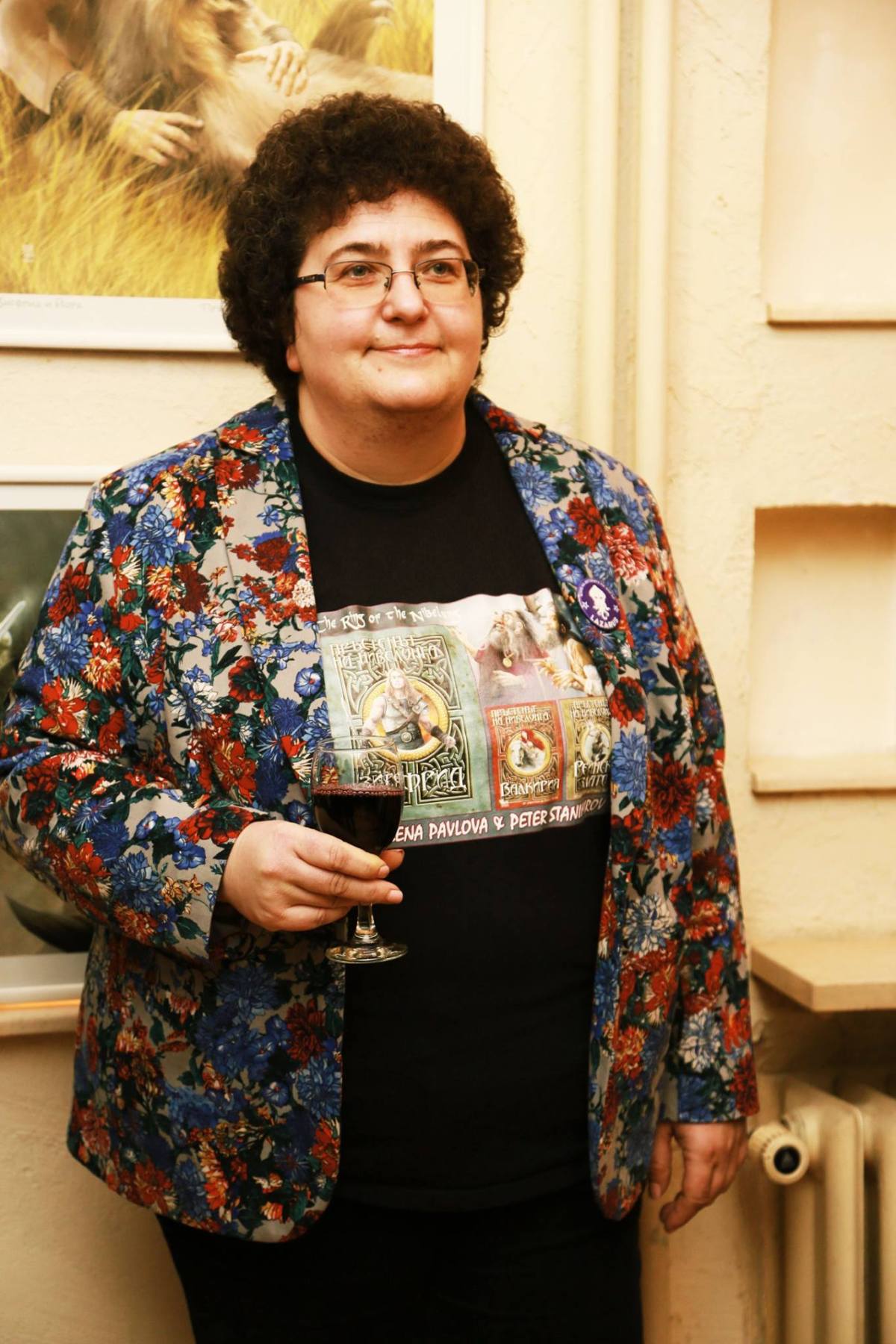
        Q&A With Elena Pavlova

        Elena Pavlova has realized her dream of getting a story published in Asimov’s with her latest work, “Renting to Killers,” available in [May/June issue, on sale now!] Get to know the Bulgarian author in this insightful Q&A that discusses writers block, the hopefulness of modern SF, and more.

        Asimov’s Editor: Is this story part of a larger universe, or is it stand-alone?
        Elena Pavlova: The story is part of a Hellverse, containing 2 game-books, 1 novel and a few short stories, most of them published in Bulgarian in different anthologies during the years. All of these describe a post-apocalyptic world where the reality had been turned inside-out and parallel timelines collided but people still have hope and fight to keep civilization on the mend.

        AE: Do you particularly relate to any of the characters in this story?
        EP: In a way, Iโ€™m Davis: completely out of place in the city and between people, but well versed for my other habitat, and willing to write about it. At the time this story was written, I too was โ€œbetween livesโ€ and in a limbo of sorts.

        AE: How did the title for this piece come to you?
        EP: The Bulgarian title can be translated as “The Killer Lives Downstairs” but the English variant of the story is revamped and has lots of changes (the perks of self-translatingโ€”you can change and rewrite, and make a new story out of it.) This revamped story needed a new and better title, and here it is.

        AE: What is your history with Asimovโ€™s?
        EP: Having a story published in Asimovโ€™s Magazine is a childhood dream of mine and so Iโ€™ve sent a couple of pieces its way, hoping they will be worthy of publishing. Now my dream has come true!

        AE: Who or what are your greatest influences and inspirations?
        EP: I try to read a lotโ€”at least 100 books yearly or moreโ€”and to constantly learn new tricks; still Iโ€™d say my greatest influences and inspirations come from the SF of the 80s and 90s, with its gorgeous, grand flights of imagination; and todayโ€™s SF&F teaches us (me, at least) to imagine not only with the head but also with the heart.

        AE: How much or little do current events impact your writing?
        EP: A lot, in fact. One cannot just go and write without taking into account the Real Life(โ„ข) all around us. So bits and pieces of reality make their way into my stories, and vice versa. There is a novelette I had written for a Bulgarian SF contest, and it had almost half of the world wiped out in a pandemic; then Covid-19 happened and I pulled the novelette out for, well, it was an RL(โ„ข) pandemic going on. Iโ€™m still thinking of how to better revamp this story, 4 years later.


        Thatโ€™s the true writerโ€™s block for me: a peaceful, luring moment of emptiness. The best advice on that is to sit and write through that emptiness. Just write, with time 1000 monkeys will recreate Shakespeareโ€™s masterpieces and if they can do it, so can I.


        AE: What is your process?
        EP: For me, itโ€™s about the story, the journeyโ€”Iโ€™m curious to see where the idea will take me and I donโ€™t plan beforehand. Which is funny, because Life had placed me as a writer for a computer game (Scars of Honor MMORPG) and thatโ€™s all about planning and meticulous worldbuilding and storybuilding.
        Sometimes ideas are coming, crying so loud in my head that I have to put away everything else and just write that story; this was for example the case with “Renting to Killers.”

        AE: How do you deal with writersโ€™ block?
        EP: Iโ€™ve come to realize that, if a story is stuck, then probably Iโ€™ve messed something up, so I go back and do revisions to try and find out the point I left the tracks of the story. It usually helps. But this is more a case of writing oneself in a corner.
        Then, sometimes, itโ€™s the mind that is stuckโ€”there are simply no stories to tell. Not ideas. Thatโ€™s the true writerโ€™s block for me: a peaceful, luring moment of emptiness. The best advice on that is to sit and write through that emptiness. Just write, with time 1000 monkeys will recreate Shakespeareโ€™s masterpieces and if they can do it, so can I ๐Ÿ™‚

        AE: What SFnal prediction would you like to see come true?
        EP: The hopeful futures, most of all: that we can still save Earth; save ourselves and redeem a worthy, comfortable way of living for everybodyโ€”and go colonizing other worlds.
        Iโ€™ll all for the Galaxy-wide Cosmic Empires. Glory to the heroes, peace to all worlds!

        AE: What are you reading right now?
        EP: Children of Time by Adrian Tchaikovsky. Nona the Ninth by Tamsin Muir follows on the TBR list but Iโ€™ll most probably be reading my way through the Hugo nominations in the next months. The Hugo vote requires responsible decisions.

        AE: What other careers have you had, and how have they affected your writing?
        EP: Iโ€™m an all round cynological judge (cynology is a science about dogs) and I have always loved and was owned by dogs. For more than 10 years Iโ€™ve been a secretary for a Cynology federation and dogs (and sometimes cats) often sneak into my stories.

        AE: How can our readers follow you and your writing? (IE: Social media handles, website URLโ€ฆ)
        EP: https://www.facebook.com/pisatelskoe.kafe โ€” but it is kept mostly in Bulgarian. Nice pics of dogs though ๐Ÿ™‚
        And here I am on BlueSky: @hellena.bsky.socialย  โ€” less dogs and kept mostly in English.


        Elenaย Pavlovaย livesย in Montana, Bulgaria. Her short stories have appeared in various Bulgarian anthologies and magazines, winning awards from national competitions. In 2021, her novel Christmas Carolers vs Hallus Beasts won the ESFS Best Work for Children award. Also in 2021 she was awarded the SLF’s Diverse Worlds grant. Most recently a story of hers, translated by her and D.Sivilova, made it to the shortlist of BSFA awards in 2024.

        Her short stories “Love in the Time of Con Crud”, “Two Moons” and โ€œA Pilgrimage to Memories Tattooedโ€appeared in Future Science Fiction Digest #3 in 2019 and Compelling Science Fiction #15 in 2020 and in Samovar issue 26 in 2023, respectively.