Mark D. Jacobsen history with Asimov’s stretches back 22 years, when he was the first runner-up for the Isaac Asimov Award for Undergraduate Excellence in Science Fiction. The following year, Jacobsen won that award, and eventually moved on to a career in the U.S. Air Force. Now “The Repair,” his first story for Asimov’s, appears in our [March/April issue, on sale now!]
Asimov’s Editor: How did this story germinate? Was there a spark of inspiration, or did it come to you slowly? MDJ: I sometimes deliberately experiment with different types of stories to stretch my abilities. These typically begin as stream-of-consciousness freewrites, with no expectation they will turn into full-blown stories. “The Repair” was born when I decided to try writing a cyberpunk story. It was a beautiful sunny day, and I was at a remote lake with my wife and children, hardly the setting in which to find cyberpunk inspiration. I wrote with a pen and notebook. I had no characters or plot in mind, only a mental picture of pouring rain outside an abandoned hotel that took its inspiration from Blade Runner. In that first session I followed my protagonist into the building, up the stairs, and through his first meeting with a haunted, paranoid client who hired him for an illegal job. I continued to write blindly, trusting my unconscious. I find the writing experience wildly different when I write this way, as opposed to my more usual process of meticulously developing characters and a plot. It is disorienting and a little scary, but I find these stories typically hold more creative power. It’s telling that “The Repair” was my first sale to Asimov’s. The theme of “cancellation” emerged organically as I wrote. I had no intent to write a story about this topic, but it was something I’d been grappling with for a long time. I think it was Asimov who developed the three postulates of science fiction: “if only,” “what if,” and “if this goes on . . .” In retrospect, I can say this story explores the latter.
AE: Do you particularly relate to any of the characters in this story? MDJ: The protagonist, Joel, is a disgraced robot repairman who survives on illegal work for desperate clients. In this story he grapples with whether to keep working for a lonely and slightly crazy woman who was cancelled after sending a Tweet judged to be racist. She has spent the years since living under the exploitive protection of an insurance company. Joel embodies the tensions that many of us feel around online discourse, contempt, and cancellation. Joel’s client is not a likable character and yet we sense that even she, imperfect as is, does not deserve her fate. The story hinges on Joel’s empathy for her humanity. That is an aspirational value for me.
AE: What is your history with Asimov’s? MDJ: Twenty-two years ago, as a college sophomore, I took 1st runner up in the Asimov/Dell Award for Undergraduate Excellence in Science Fiction and Fantasy Writing. Sheila Williams and Rick Wilber flew me and the other finalists out to a writing conference, where I sat by the pool and talked writing with Joe Haldeman, Sean Stewart, Kelly Link, Charles Sheffield, Nancy Kress, Daniel Keyes, Ted Chiang, Octavia Butler, Brian Aldiss, and many others. The next year, I won the contest and went back. These were life-changing experiences for a young person with only distant dreams of being a writer. I realized that “making it” was well within reach and began submitting stories, without success. I got busy after that, with an Air Force career and a young family. Writing came and went. In 2020, amidst the pandemic and a transition into a teaching job, I committed to writing more seriously. It has only taken 22 years, but with “The Repair,” I finally made it into Asimov’s.
In frequent moments of doubt, I wonder if I should give it up and focus on the “real” world. But I can’t help myself; I need to write.
AE: How much or little do current events impact your writing? MDJ: Almost everything I write, no matter how dressed up in SF or fantasy, is rooted in our modern world. I’m a career Air Force officer with a PhD in political science. My professional life is devoted to understanding and managing complex political problems. That is what compels me to write fiction. Academia generally breaks complex problems down into narrow constituent parts, but fiction is a big enough medium to explore the scale and complexity of the whole. The SF writer who has influenced me the most is Kim Stanley Robinson, largely because his writing reflects his love for and commitment to our own world.
AE: What inspired you to start writing? MDJ: I’ve been writing since I learned how to read. My dad owned hundreds of SF paperbacks, which gave me abundant inspiration when I was young. I’m not sure why I feel such a deep need to write. Writing fiction is difficult for me, and from a pragmatic perspective, the returns aren’t great. In frequent moments of doubt, I wonder if I should give it up and focus on the “real” world. But I can’t help myself; I need to write. My studies of foreign affairs feel dry if they stay in the abstract; I’m most interested in individual human beings and their lived experiences. Fiction is where I can explore that.
AE: What other projects are you currently working on? MDJ: I am slowly chipping away at a novel based on the two years I spent studying Arabic and Conflict Resolution in Jordan. It features a Jordanian-American woman and her daughter, who are trying to cross Jordan and reach safety after a biologically engineered weapon begins killing anyone who speaks Arabic. It’s an ambitious novel about the consequences of unchecked reciprocal hatreds, and about the longing of a woman with multiple sources of identity to find a sense of belonging in a collapsing world. It’s a difficult novel to write, and I can’t tell yet if it will be terrible or brilliant or somewhere in between. I’m also trying to write, finish, and submit more short work. I’ve been developing a world that will support multiple stories, set multiple generations after a nuclear apocalypse, in which professional “reinventors” who rely on the patronage of warlords aim to reinvent technologies that they know once existed.
AE: What are you reading right now? MDJ: I just finished Cormac McCarthy’s two new novels, The Passengerand Stella Maris. Much of my academic work involves complexity theory, so I’ve long been fascinated by the fact that the reclusive McCarthy spent years hanging out with complexity scientists at the Santa Fe Institute (SFI). That influence shows in these novels. Coincidentally, it was fantastic to see that Ted Chiang just joined SFI as a visiting scholar. It gives me hope for aligning my academic work and fiction. On the SF front, I just finished Ray Nayler’s wonderful debut novel The Mountain in the Sea. I discovered Nayler through his short work and fell in love with his writing. Like me, he works on U.S. foreign policy and has spent extensive time outside the U.S., so I felt an immediate kinship with him and his writing. I’m also revisiting the SF books from my college years that most influenced my writing. I just listened to Dan Simmons’ Hyperion Cantos and am now listening to Kim Stanley Robinson’s Mars trilogy.
AE: What other careers have you had, and how have they affected your writing? MDJ: I was a C-17 cargo pilot, flew 200 missions in Afghanistan and Iraq, and have spent much of my career studying international relations. That included two years of graduate study in Jordan. Much of my fiction reflects my fascination—and disillusionment—with U.S. foreign policy. My novel The Lords of Harambee embodies my decade-long effort to grapple with questions of intervention and responsibility raised by the Rwandan genocide.
AE: Do you have any advice for up-and-coming writers? MDJ: It took me 22 years to get published in Asimov’s. Don’t give up!
AE: What’s the best way to follow you and your work? MDJ: The best way to find me is through my website and mailing list at www.markdjacobsen.com.
Mark D. Jacobsen is an Assistant Professor of Strategic Studies in the United States Air Force, where he tries to instill wisdom and humility in future leaders navigating global challenges. He enjoys writing humanistic fiction about characters grappling with political, social, and technological change. His short fiction has appeared in War Stories,Derelict, and Inkstick Media. He is the author of one military SF novel, The Lords of Harambee, and a memoir titled Eating Glass. He was a Dell Award winner more years ago than he would care to recount. “The Repair” is his first story published in Asimov’s.
In this post, longtime Asimov’s contributor Bruce Sterling talks about his interest in the Italian renaissance as well as his thoughts on the importance of short form science fiction. Read his latest story “The Queen of Rhode Island,” co-written with Paul Di Filippo, in our [March/April issue, on sale now!]
Asimov’s Editor: What is the story behind this piece? Bruce Sterling:It’s a collaboration with my long-time pal, Paul Di Filippo.
AE: How did this story germinate? Was there a spark of inspiration, or did it come to you slowly? BS: I’d have to admit that the story seemed to literally germinate out of a swamp. It kinda oozed into being, much like our other SF collaboration, “The Scab’s Progress.”
AE: What made you think of Asimov’s for this story? BS: Who else? I can’t help but adore them!
AE: What is your history with Asimov’s? BS: I don’t want to boast about my extensive survival to date, but my “history with Asimov’s” is extensive. For decades on end, the mag has bravely published some of the weirdest stuff I ever wrote. Stories like “The Little Magic Shop” and “Sword of Damocles.” People who succeeded in reading those stories probably still remember them.
AE: Who or what are your greatest influences and inspirations? BS: I like science fiction. I tend to like other people’s science fiction quite a lot, such as Italian fantascienza and nineteenth-century French science fiction. The general history of science fiction inspires me. It’s great that it refuses to just give up and go away, and that it keeps sprouting up in new places, like crabgrass among cobblestones.
AE: How much or little do current events impact your writing? BS: I’m a tech journalist and I’m quite the eager trendspotter, but I like events that haven’t happened yet.
AE: What is your process? BS: I tend to really pile stuff on. I like organic profusion, baroque extravaganza, too many moving parts. I tend to throw in the kitchen sink and then the sink’s full of take-out cartons from some country where they eat a lot of squid.
The general history of science fiction inspires me. It’s great that it refuses to just give up and go away, and that it keeps sprouting up in new places, like crabgrass among cobblestones
AE: How do you deal with writers’ block? BS: Pretty simple; I only write fiction when I feel like it.
AE: How did you break into writing? BS: I wrote a couple of novels first, but I want to seize this opportunity to say that writing and reading short stories in magazines is really important. In my career I did a lot of my best and most innovative thinking in short forms. A literature of ideas needs to keep things moving, it can’t live off trilogies and endless series all the time; that gets top-heavy. By contrast, one really good issue of one science fiction magazine has the potential to light up the whole genre.
AE: If you could choose one SFnal universe to live in, what universe would it be, and why? BS: I tend to travel really a lot, so I’m thinking that an omnibus SF Best of the Year Collection would be more my speed. I like to change scenes and topics.
AE: What SFnal prediction would you like to see come true? BS: Worldwide nuclear disarmament would be interesting.
AE: What are you reading right now? BS: I’m doing some research about a minor figure in the Italian Renaissance. He was a diplomat, but he was best-known for writing an etiquette book about how decent people ought to behave. Of course he had his own life, which wasn’t much like his moralizing book. How people adapt to their cultural circumstances, that’s of a lot of interest to me.
AE: Do you have any advice for up-and-coming writers? BS: Everybody in the business will tell you how hard you have to work, but really, if you’re not entertained by it, nobody’s gonna be entertained by it. Also, try and put the cork in the bottle—alcohol is the only thing common in the fiction-writing life that is truly dangerous.
AE: What other careers have you had, and how have they affected your writing? BS: Science fiction has been my career, but I’ve been known to trifle with futurism, travel writing, popular science, true crime, art criticism and teaching design school. “Where do science fiction writers get all those weird ideas?” Well, you should scheme up some situations where you can go out and find some.
AE: How can our readers follow you and your writing? (IE: Social media handles, website URL . . . BS: I’m on Twitter, Mastodon, Tumblr, Pinterest, I have a lot of writing on Medium . . . If you’re interested in technology art, I’m the art director for an Italian media art festival. It’s more a trendspotting blog than something meant to entertain, but there’s some genuinely unusual stuff in the “Share Festival Artmaker Blog.”
Bruce Sterling’s most recent book is Robot Artists and Black Swans, a collection of Italian fantascienza stories. He spends a lot of time wandering Europe and encountering artists and robots.
David Cleary discusses the memories, from dancing to David Bowie, to discovering P.G. Wodehouse, that helped spark inspiration for “My Year as a Boy,” his latest story for Asimov’s, in our [January/February issue, on sale now!].
Asimov’s Editor: How did this story germinate? Was there a spark of inspiration, or did it come to you slowly? David Cleary: As an eight-year old boy, I obsessed about David Bowie and liked to put on my mother’s makeup and dance in front of the bathroom mirror. As a forty-five year-old man, I obsessed about climate change and thought it would be funny to make an island from the Great Pacific Garbage Patch. Sometime in the Nineties, I became a fan of P.G. Wodehouse. All these ingredients went into the mix that became this story.
DC: Is this story part of a larger universe, or is it stand-alone? AE: This story is set in the same near-future Earth as that of “The Kewlest Thing of All,” (Asimov’s, March, 2006), about thirty years after the events of that story. My yet-as-unpublished novel Carbon Manifesto foregrounds the environmental concerns that are more grace notes in “My Year as a Boy.”
AE: Do you particularly relate to any of the characters in this story? DC: I relate most to Taggie, the narrator: I can be self-conscious and awkward, and have committed some embarrassing faux pas when trying to be gallant.
AE: Who or what are your greatest influences and inspirations? DC: My influences: first, the SF writers I read growing up, especially Robert Silverberg, Philip K. Dick, Harlan Ellison, and Ursula K. Le Guin. Then the writers who taught me at the ’87 Clarion workshop: Lucius Shepard, Karen Joy Fowler, Algis Budrys, Damon Knight, Kate Wilhelm, and Suzy McKee Charnas. (I’m very sad to learn that Suzy passed away at the beginning of this year.) Next the writers who have twisted my brain over the years, among them: William Gibson, Michael Swanwick, Greg Bear, Christopher Priest, China Mieville, and Greg Egan. Next, fiction writers outside the field: Martin Cruz Smith, Richard Powers, Cormac McCarthy, and David Mitchell. Finally these non-fiction writers: Daniel C. Dennett and Richard Hofstadter for philosophy of mind, Stephen Jay Gould and E.O. Wilson for biology, John Gribbin for physics, Paul Theroux for travel.
As an eight-year old boy, I obsessed about David Bowie and liked to put on my mother’s makeup and dance in front of the bathroom mirror. As a forty-five year-old man, I obsessed about climate change and thought it would be funny to make an island from the Great Pacific Garbage Patch.
AE: How much or little do current events impact your writing? DC: We are blessed—or cursed—to live in interesting times, and, as a news junkie, I fear that current events may affect my writing—and my psyche—to a greater extent than is healthy for me.
AE: How did you break into writing? DC: When I was a little boy, I wrote plays to be performed by my stuffed animals and Star Trek action figures. As a teen, I began typing up “serious” stories on my dad’s manual typewriter, sending them off to Asimov’s or Analog to be summarily rejected. 1987 was my breakthrough year; I went to the Clarion workshop in East Lansing, Michigan, and, through some alchemy I’ve never understood—Was it the rigor of the coursework? The excitement of meeting actual published writers?—I transformed into something like a professional writer: I eventually published four of the stories I wrote while at Clarion.
AE: What other projects are you currently working on? DC: I’m working on an historical fantasy\alternate history set in ancient Greece and Rome, an expansion of my story “How Long the Night, Awake,” (appeared in The Colored Lens, Autumn 2019.) I’m also planning to put together a collection of my steampunk stories this year.
AE: What SFnal prediction would you like to see come true? DC: I’d like to see some combination of genetic engineering and nanotechnology finally end disease.
AE: What are you reading right now? DC: In December I read Cloud Cuckoo Land, by Anthony Doerr—which was fascinating. Part historical romance, part eco-terrorist thriller, part multi-generational starship SF, compelling enough that I read it in a day. I liked it enough that I’m reading his entire oeuvre; right now I’m reading his collection The Memory Wall.
AE: Do you have any advice for up-and-coming writers? DC: As somebody who is easily distracted I cannot recommend too highly a) noise cancelling headphones, and b) browser web-site blocker software. Both help me focus. There’s also something to be said for the standard recommendations: write every day, join a writers’ workshop, read as much as you can both within the genre and outside it, submit your stories and submit them somewhere else if they are rejected. And also go out and have fun with people sometimes.
AE: How can our readers follow you and your writing? DC: I occasionally post on Facebook (https://www.facebook.com/david.cleary.908). There’s also my website (www.davidiracleary.com) but it is sorely in need of updating.
I was born in Wyoming and raised in Colorado, but have spent most of my adult life in California, writing manuals for software companies, and science fiction stories when I have the time. After several years, first in San Francisco, and then in the quaint seaside town of Pacifica, I moved to Oakland, where I live with my wife Cheryl (a talented actress) and two cats and a dog. I’ve been published in Asimov’s, Interzone, Persistent Visions, The Year’s Best Science Fiction and Fantasy, as well as in other magazines and anthologies. My first published story (“All Our Sins Forgotten”) was made into an episode of the Sci-Fi Channel’s series Welcome to Paradox. With Lisa Goldstein and Martha Soukup I founded a writer’s workshop that has continued to meet sporadically for three decades. I was a runner until I wore out my right foot. Lately I’ve been learning to kayak, and trying to make myself swim.
To build the world living inside her latest story for Asimov’s, T.K. Rex devoured books about California’s natural history. This post, featuring photos taken by the author herself, discusses some of what she found and how she incorporated it into her fiction. Read Rex’s “The Roots in the Box and the Roots in the Bones,” available in in our [January/February 2023 issue, on sale now!]
The world of The Roots in the Box and the Roots in the Bones was born on a train. I was fresh out of my first ecology class and looking forward to an environmentally friendly, days-long ride down the Atlantic coast from Baltimore to Florida. I found my assigned seat, at the end of a crowded car, in a corner with no windows.
No windows.
How . . . why? What? After a year of commuting between Baltimore, New York, and Philadelphia I’d ridden so many trains they literally let me board this one for free, and never, once, had I seen a seat with no window. I was about to be trapped in the dark for days, staring at a nondescript wall.
After a few minutes of rising panic, I stood up, grabbed my notebook, and went to the cafe car. I stayed at that table for the rest of the trip. I accumulated a pile of Amtrak coffee cups like a rodent padding my den for the winter. I gazed out the big bright windows at the endless, flat deciduous forest outside, vaguely missed the more dramatic scenery of my western home states, and thought about the unknown future out in front of me.
That first ecology class would probably be my last. I’d gone broke leaving my advertising career for a second degree in earth science. My life felt like that seat with no window: the claustrophobic dead end of a well-intentioned aspiration.
There was a spark of optimism that stuck with me, though. Not even a year’s worth of for-profit undergrad debt could rob me of the real-life stories from that ecology class, of all the activists and scientists who’d worked their butts off over the course of the past century to make sure the climate crisis was wasn’t even worse. Real people had cleaned up the Ohio River after it got so polluted that it caught on fire, limited vehicle emissions so the air in Los Angeles wasn’t giving kids asthma, and fixed the hole in the ozone layer. Real people had accomplished thousands of little, local victories — watersheds protected from agricultural runoff, dams redesigned so salmon could spawn, oysters grown in the Chesapeake to keep the water clear — all those things we never hear about because they’re not disastrous or spectacular enough for cable news. If all of that had already been accomplished, what else was possible?
I imagined a future where everyone lived in beautiful cities, and the land between them was a dense food forest that ended hunger and sequestered carbon all at once. If there weren’t any people out there, it wouldn’t need roads, and if fruits and nuts could be picked from the air by, say, drones, then nothing would need to be planted in rows, and it could be so much denser, more efficient, more sustainable than our current destructive industrial agriculture.
The Wildcraft Drones
As the sycamores succumbed to palms outside the cafe car window, I gave the thing I wrote a title: The Wildcraft Drones. It’s still around, if you go looking for it, but it’s not very good, and more than a little problematic (if you don’t see why yet, no worries, the entire rest of this essay is about that), so I’ll summarize: An unnamed narrator gets the munchies, and summons a single apple from the AI-managed food forest surrounding her city. A small drone delivers it to her, and she takes a bite, all while musing at how much her world has changed, and how only a few select humans are allowed into the food forest for research expeditions. She briefly acknowledges that this new techno-wilderness—which stretches across the entire North American continent—has its detractors. There are people who lament the loss of desert landscapes, for example. Everything is forest now, but she lives in a sparkling utopia and never goes hungry, and the seas have stopped rising, so it was worth the cost.
The Wildcraft Drones didn’t have much of a plot, but it was never meant as more than a vignette to illustrate a concept. I sent it to my mom for her thoughts as an environmentalist. She’s an author in her own right and the “editrix” of Coreopsis: Journal of Myth and Theatre (and, yes, that kind of nerd) (love you, Mom). She had concerns about the steps my world took to get to its utopia, but invited me to submit it to the environment-themed issue of Coreopsis the following year.
It wasn’t exactly Asimov’s, and . . . you know . . . my mom kinda got me in, but hey! My little window to a better world had actually made it off the train, into the wide open internet, for anyone to gaze through. For the first time in my life, I had written science fiction that at least one or two unsolicited strangers had read. Sometimes it can be hard to tell when a story is finished, but, surely, this met all definitions.
Except, of course, I couldn’t stop thinking about it. The techno-wilderness called to me. I wanted to explore it, to be one of those few allowed in for research purposes, to open the window I’d found on the train and stick my head out and breathe the wind. My mom suggested robot steeds, and the minimal footprint of artificial hooves on the soil was all the convincing I needed. I yearned to ride in on the back of one, past flocks of wildcraft drones harvesting apples, or walnuts, or . . . something.
An interlude for bleeding hearts
My grandmother was an herbalist. When I was a kid, we’d spend long summer afternoons wandering dirt logging roads on the Olympic Peninsula, while she pointed out miner’s lettuce, Pacific bleeding hearts, skunk cabbage and salmonberry. She knew the scientific name of every plant we saw, how our pioneer ancestors used it, and how her Quileute and Salish neighbors and extended family had used it for millennia. Some were medicine—her passion—and some were food, which always piqued my interest slightly more.
When Grandma’s landlord gave her an eviction notice so he could sell the land for lumber money, I had just moved back to California, and my mom, her partner and I decided to find her a new home here, closer to us. We had all those good intentions people have when they care about someone who can’t care for themselves quite as well anymore. Grandma saw the logic of it, but she also didn’t have a choice. And when she got to the house we’d found for her in Mendocino County, she missed her friends, who had been helping her much more than we realized, and she missed the landscape she’d been part of for eighty years. She didn’t know the names of the plants here, and no matter how many wheelchair-accessible trails we explored in the redwoods, or books about our native oaks I added to her bookshelf, she was homesick and displaced, and everything that had been keeping her together mentally began to slip, and then slip more . . . and then she was gone.
(I’m finding it hard, for a lot of reasons, to describe the direct connection between my grandmother’s death and the first draft of the novel I started writing later that fall. It sounds a little like her voice, telling me the bright pink flowers at her fingertips are bleeding hearts, Dicentra formosa, and it feels a little like her standing just behind my shoulder, four feet and eleven inches tall, leaning over my laptop, wondering what those cute little wildcraft drones are up to now.)
I cracked my knuckles and saddled up a Google doc. The character I’d live vicariously through should be a Ranger, I thought, one of an elite group trained to patrol the wilderness on low-impact robotic steeds. I named her Macara, and I gave the techno-wilderness a name, too, something that I thought the people in Macara’s world might come up with, a slang term that evolved from “agricultural jungle” to just “grungle.” I liked how “grungle” sounded wild and a little bit derogatory. The Grungle was a place, I figured, that some people were afraid of, even hated, because they could never go there. Just like in cities today, there would be those drawn to the wilderness, and those who recoil from it.
To ground it in our world’s future, I chose the real-life setting I now had the easiest access to, and knew the most about: Northern California. A food forest here would have to be drought and fire friendly, so what if all the plants were native California species? I knew about acorns, huckleberries, miner’s lettuce, nopales . . . what else would future denizens of San Francisco Citystate find in their produce aisle?
I had a lot of reading to do.
Research kinda broke everything
Research for fiction was new to me, and a little intimidating. I hadn’t exactly set out to write hard science fiction, but I wanted this world to be believable. I wanted to do what my grandmother would have done, and introduce people to real plants and their real uses. I wanted the landscapes to be vivid and detailed, the foods appealing.
As I read, I learned that the native species of California could, indeed, provide city-dwelling humans with not just food, but medicine, clothing, building material, ink, paper, decor, felt for yurts to combat homelessness. There could be craft and industrial uses even for the remains of animals washed up on shore. California has thousands of edible native fruits, seeds, berries, corms, herbs, nuts, roots, mushrooms, seaweeds, tree bark, shellfish, leaves. On and on. An AI-manged utility-forest was more intricately possible than I ever imagined.
My research very quickly led me to California’s Indigenous peoples. California has been populated continuously for at least 14,000 years, and there were over 500 distinct groups when the Spanish arrived, living in every single part of the region. They spoke hundreds of languages, as distinct as those from one end of Eurasia to the other.
The story of California’s native foods cannot be separated from the people who have always cultivated them. Growing up in Sonoma County, I’d heard stories of the local Miwok eating acorns, and tending oak trees. The true relationship was much deeper. Nearly every full grown oak tree was tended by many generations of the same family, who considered it a relative. This was common across cultures, in every landscape where oaks grew. (Their reverence for oaks was shared by my own European ancestors—just look up the origins of the words dryad and druid—before colonialism decimated their forests for shipbuilding.)
Native readers will already know all of this, but it was revelatory to me, coming from a hard lean into Western science: fourteen thousand years of trial and error, exploration and ideas, ingenuity and observation—everything that makes good science—gave the Ohlone, Karuk, Tongva, Miwok, Pomo and those 500 other groups of Indigenous Californians an incredibly detailed understanding of the environment. Controlled burns were timed to optimize the productivity of desired species. Meadows were seeded with huge patches of the same flower, to make their seeds easier to harvest in bulk. Hunts and harvests and fires were all planned according to conditional rules determined by cues in the environment. Everyone held knowledge about every species they encountered, in every season. Today, thousands of Indigenous Californians still use and pass on this knowledge as part of their modern, living cultures.
Growing up in Sonoma County, I’d heard stories of the local Miwok eating acorns, and tending oak trees. The true relationship was much deeper.
The easily-accessible literature on the use and edibility of California native plants is based, often second or third hand, entirely on this traditional knowledge. The people I found most active in educating the non-native public on California native foods today included Vincent Medina and Louis Trevino of Cafe Ohlone in Berkeley (highly recommend if you’re in the Bay Area); and Nicholas Hummingbird, the Indigenous educator behind @california_native_plants on Instagram (who gave me feedback on a later draft of the novel).
I made a spreadsheet of edible species that might grow in the Grungle, and it’s 353 rows long and largely limited to the coast redwoods and adjacent biomes where the novel took place. It barely touches the deserts, the Sierras, the chaparral, the prairies, the pine forests — each of which have volumes I’ve only skimmed, each of which have been meticulously tended by the families who’ve been part of them for fourteen thousand years.
This intensive system of care and tending meant the land was so productive before colonization that herds of elk and pronghorn filled the valleys. Flocks of geese darkened the sky. The Russian River would have been so thick with salmon, when it was called Ashokawna, that you could reach into the water and grab one with your eyes closed. (Many of these scenes are lusciously illustrated in Laura Cunningham’s A State of Change: Forgotten Landscapes of California, my most-bookmarked source of visual inspiration.)
A hard truth set in for me as I learned the reality of what had been. Real-life California was once an engineered hyper-wilderness that outperformed my imagined, science-fictional Grungle in every way. And it didn’t need artificial intelligence to become that way. All it needed was the people who lived there. The people… who my fictional rewilding would have forced off their land, again.
Crap, I accidentally made a dystopia
I spent several years as a kid in and around the Navajo Nation, where the parents of my Diné classmates still remembered getting hit by their teachers for speaking their own language. Where my dad reported on the continuing public health disaster of the uranium mines that failed utterly to protect Diné miners and communities from radiation. Where the US Government forcibly removed the entire population from the land their food came from and addressed the resulting malnutrition with diabetes-inducing shipments of agricultural leftovers. So, while the native presence in California was much lower-profile than in the Southwest, I assumed our colonial takeover here had a darker history than what I was taught on a 5th grade field trip to Mission Dolores. This was not a surprise.
What I didn’t know about California’s missions, and about missionaries like Junipero Serra, who somehow still has a major street in San Francisco named after him, was the extent of their brutality and sadism. The Europeans considered the people of those 500 distinct cultural groups “wretched humble creatures,” and, while attempting to systematically eradicate their entire way of life, went out of their way to replace the carefully tended native species with the invasive cattle feed that now gives our hills their distinctive golden color every summer (and catches fire every fall).
The families who were pressured or forced from their land often ended up in the missions, where they were forced into labor, underfed, beaten and then executed or tortured for crimes ranging from trying to flee, to asking if their children were alive, to weeping. The descriptions of this treatment recorded by the missionaries themselves and other visiting Europeans—not all of whom were comfortable with the extreme cruelty, to their small credit—are detailed, gruesome, and heart-shattering. I read accounts of torture so horrible I feel uncomfortable sharing them. Read M. Kat Anderson’s Tending the Wild, subchapter Atrocities of the Mission System if you need nightmares.
I knew I would find injustices in the history of Native California. I knew that going in. I was still, somehow, shocked to find the literal Spanish Inquisition.
When California joined the United States, many of the families who had survived these atrocities hoped things would improve. Instead, bounties were placed on their lives, cultural burning was outlawed, and thousands of ancient oak trees were destroyed for the explicit purpose of starving their human relatives. The State of California committed genocide in every sense of the word, on purpose, for profit. There is no qualifying or justifying it, and there has been very little acknowledgement of it or public attempt at repair.
That doesn’t mean we aren’t paying a price, though. Extinctions, infestations, soil degradation. The decimation of fisheries. The droughts. The fires. The worsening of floods and landslides due to all of the above. Every time you hear that a degree or two of global warming made some natural disaster worse, there’s probably an entire culture’s worth of best practices for living in that landscape that could have helped or prevented the disaster in the first place, that have been ignored or lost to genocide.
But we’re writing about the future here, so…
Remember that big food forest I was writing about, that nobody lived in, managed by robots instead of human beings? It was starting to seem like a much more menacing place than I had intended. And the cities where everyone had moved to make room for rewilding and save the world from global warming? They were probably full of people who’d been forced there. Some like my grandma, who had seen the logic of it and left their homes willingly, though they had no other choice. And some who would have done anything, risked their lives, to stay on their land, and been so depressed by the confines of city they would have done anything to get out.
Maybe the right thing to do was to give up on this world. These were flaws I couldn’t just handwave away. I thought of my mom’s Salish and Quileute cousins and the elders who taught my grandmother about the herbs of the Northwest. I thought of the Zuni and Diné kids I went to school with in New Mexico, and the people I still knew there. I thought of the Native people who would read this and how they would see themselves in this future that was supposed to be persuasively better.
I had been so excited to explore the Grungle, and now I wasn’t sure I could go any farther. The forest was thick with monsters and traps. I should turn back, find another world, write a different story.
And yet. My grandmother’s teachings were in there. My ideas for combating climate change with food forests at scale surely weren’t terrible, and my own personal love of California was written into every description of the landscape. My husband Gary, my alpha reader, was enamored with the characters and the technology, and he cheered me on.
I thought back to worlds built by authors I’ve loved. Octavia Butler’s Earthseed vision from Parable of the Sower had inspired me in ways I didn’t yet know what to do with, and Ursula LeGuin’s The Dispossessed was one of my new favorite books. LeGuin once described Anarres as an “ambiguous utopia,” and it felt, reading Shevek’s story, like she was prodding her own anarchist ideals, testing them, trying find out where they broke, and for whom. The result is a world that feels fully realized, with flaws, like any great character, that make it even more compelling, and show us a way forward that feels as possible in its honesty as aspirational in its ideals. That, to me, felt so much more inspiring, interesting and real than the utopia I’d so easily dreamed up in that first vignette on the train.
Ambiguous utopia it is, then
I decided to follow LeGuin’s lead, brave the monsters, and earnestly explore the shadows of the Grungle. Without giving away too much for those who haven’t read it yet, I found ways to give my characters new challenges and rethink the histories and agendas of my fictional institutions. It deepened my worldbuilding, my narrative, my characters and my own thinking. It pushed my research even farther, and exposed me to the Land Back movement, the concept of food sovereignty, and the philosophy of Robin Wall Kimmerer, whose Braiding Sweetgrass changed how I see pretty much everything. It eventually pushed me to write this essay, at the risk of belaboring several points that my fiction still doesn’t actually live up to.
I began to see the world of the Grungle as a not a destination, but a path, from the well-intentioned place I started in to the more honest place my research led me. I wanted to take readers on that path with me. And maybe forward, to new distant destinations I can only tease, in the Grungle stories I’m still working on. Perhaps utopia lies there. More likely, as countless writers before me have learned, it is always, just slightly, farther.
So… what happened to the novel? (Is this an epilogue?)
“The Roots in the Box and the Roots in the Bones” is, by most definitions, a novelette, and one of several short stories in a growing Grungle collection. But it started as the novel that took me on the journey above. I rewrote it three times, changed literally everything about Juniper’s character (shoutout to my friend Robin Lasiloo for gut checks & drone naming), added and removed entire plot lines, described the woods endlessly, “finished” it, queried 35 agents, deleted everything except the fourth act, tried to pass that off as a short story, and finally rewrote my favorite part as the standalone novelette that you can now read in the January/February 2023 issue of Asimov’s Science Fiction Magazine.
As I write this, there is one other published story worth reading set in this world, A Holdout in the Northern California Designated Wildcraft Zone. It takes place in the early days of the rewilding process that led to the Grungle, and was a finalist in Grist’s Imagine 2200 climate fiction contest in 2022. The themes are echoed in much of my other writing, most recently The Hall of Being (Luna Station Quarterly, 2022), set in a future that feels right next door to the Grungle. Gentle Dragon Fires (Strange Horizons, 2022), The Beast of the Shadow Gum Trees(New Edge Sword & Sorcery, Issue 0, 2022), and My Favorite Shape of All (Queer Blades, vol. 1, 2021), are all set in a secondary fantasy world inspired by California, where Indigenous, non-native, magical and immortal characters all struggle to avoid our world’s mistakes. My co-creator in that universe is my mom, Lezlie Kinyon, who was the first to champion the Grungle, and the first to call me out on its injustices. And keep a look out for SQUAWKER AND DOLPHIN SWIMMING TOGETHER, upcoming in Reckoning Magazine, for a nearer-future take on the complex relationships between humans, technology, and nature. Thanks for coming on this journey with me. I hope, at least, the train had windows.
T.K. Rex writes science fiction and fantasy in San Francisco on Ohlone Ramaytush land. She grew up in Northern California and Northwest New Mexico, with Wiccan parents of mostly British and Ashkenazi descent. Recently, she attended the Clarion Writers Workshop in San Diego, and had short fiction published in Strange Horizons, The Molotov Cocktail, and Luna Station Quarterly. You can say hi and keep up with her latest stories on Twitter and Instagram, where she shares photos of San Francisco and retweets dinosaur stuff as @tharkibo.
When should authors keep writing, and when should they stop? Peter Wood discusses his answer along with a handful of examples of where science fiction writers may have gone too far. Check out Wood’s latest story for Asimov’s “The Less Than Divine Invasion” in our [January/February issue, on sale now!]
People used to discuss things. Now, there’s always that guy at lunch or on a long car ride who whips out his phone and answers a question that nobody wants answered and stops the conversation dead in its tracks. Writers shouldn’t make the same mistake.
Fellow Asimov’s alum Jonathan Sherwood and I just finished editing the Odin Chronicles, a collection of thirty related flash stories about the deep space mining colony of Odin III. We realized pretty quickly that the supposedly free-standing stories raised a lot of questions about the colony and its ever-growing cast of characters. We’d give the authors nudges sometimes to answer those questions. But we also came up with a list of questions that we didn’t want the stories to address in too much detail.
Sometimes it is better not to know.
A question might be better off left alone if it can’t be answered. This is true with most time travel stories. You can’t explain away paradoxes. I love the first two seasons of Dark, but the last year of the time travel series explained too much. A Sound of Thunder doesn’t need a sequel where Ray Bradbury breaks down the time travel technology and what exactly happened at the end of the first story.
Then there are questions that just aren’t relevant. We don’t need a backstory
You want an example of what can go wrong if one question too many is answered? I’ll give you three. Alien, The Terminator, and the original Planet of the Apes. Each of those classic movies raised a lot of questions. The studios churned out a series of increasingly mediocre sequels that gave way too many answers. We were better off not knowing how the apes took over Earth. Moviegoers didn’t demand the xenomorph alien’s origin. We sure didn’t need to have the entire terminator timeline explained to us including why the terminator spoke with an Austrian accent.
Did you leave the theater desperately yearning to know who created the aliens or how the terminator got its accent? Me neither.
The thing is that there are no good answers to the questions those initial movies raised. There is no logical way the apes took over, for example. When sequels tried to explain things, we’re left with nonsense like a space virus that killed all the cats and dogs and morons who replaced the extinct household pets with orangutans and chimps and time traveling apes who taught their ancestors to speak in less than a generation and—God, my brain hurts. Why couldn’t they have just left us with the wondrous shock of seeing the Statue of Liberty on the beach?
We all know why those questions had to be answered. Money. That’s why every Star Wars movie keeps going back to the well over and over and over and answering questions that nobody had. Did it really add to the story to know that Anakin created C3P0 and R2D2 or that a trade dispute started the Emperor’s rise to power? You’re better off skipping the first three movies.
David Gerrold’s time travel masterpiece, The Man Who Folded Himself, raises a lot of questions and answers damned few of them. And that’s okay. The book is more than a WTF time travel tale. It’s also an in-depth examination of self. The time traveler learns who he is in ways that I will not even attempt to summarize. Do yourself a favor. Read this book.
Good fiction is about how characters cope with a situation more than explaining every nuance of whatever world the characters find themselves in. The Man Who Folded Himself is more about how the time traveler reacts to finding a time machine than about how the time machine works or who built it.
Good fiction is about how characters cope with a situation more than explaining every nuance of whatever world the characters find themselves in.
The Handmaid’s Tale isn’t a primer for how to build a theocracy. It concerns how people like Offred survive when they find themselves trapped in Margaret Atwood’s nightmare. Atwood keeps the historical details vague and it works. If we know too much of how the religious zealots took over, the message is diluted, because we can reassure ourselves that the scenario just isn’t possible. That would be like expecting George Orwell to detail exactly how the totalitarian regime rose to power in 1984 so we can breathe a collective sigh of relief, because it’s only a story. Orwell doesn’t fall into that trap. He keeps the historical background nebulous.
Don’t get me wrong. I’m not saying that an author should be completely unaccountable. The premise has to be somewhat plausible at least within the parameters of world building.
Compare the ending of the 1968 Planet of the Apes with Tim Burton’s remake. The original takes place far enough in the future that when the credits roll the wheels can start spinning and we can speculate about what might have happened. It’s a mike drop moment and it should have been left alone. Then the sequels inserted dates for everything. Knowing we started using apes as pets in 1980 and those apes took over in 1991 does not enhance one’s viewing of the first movie.
In Tim Burton’s remake the stranded Earth astronaut escapes back to Earth. Burton in a watered-down moment that rips off the original has the astronaut find Lincoln has been replaced in the Lincoln Memorial by a statue of the disgraced ape general. Except, that the ape had been, um, disgraced, and the apes lived in an agrarian society without any sort of technology. And a million other problems. It made no sense that that particular ape somehow managed to build a space fleet and conquer Earth in his lifetime. None whatsoever.
Yes, some questions should be answered. Agatha Christie’s And Then There Were None is the greatest murder mystery of all time precisely because Christie explains in a very satisfying and plausible-enough way Who Done it.
But sometimes fiction isn’t about getting all the answers. My novella, the Less than Divine Invasion, leaves some questions unanswered, but I think the story and the reader would be worse off if I tried to explain everything. I didn’t want my story to end up like the gangly overstuffed Looking Backwards where Edward Bellamy has to explain absolute everything in a never-ending conversation that is like a fever dream of My Dinner With Andre.
Star Trek II: The Wrath of Khan works, because Nicholas Meyer and Jack Sowards lifted a great villain from the tv show and wrote a new story. They did not concoct a Khan origin story and ultimately didn’t answer a single question raised by Space Seed, the episode that introduced Khan. Would a studio have the guts to write a new story today? Based on Prometheus and Solo and Terminator Salvation, I have my doubts.
Pete Wood is an attorney who lives in Raleigh, North Carolina, with his very patient wife. In his latest story for Asimov’s, he revisits his old stomping grounds, the barbecue-loving and hamburger-loving town of Kinston, North Carolina, last seen in “Never the Twain Shall Meet” (May/June 2019). Pete and fellow Asimov’s author Jonathan Sherwood recently edited The Odin Chronicles, a collection of thirty related short stories about the distant mining planet of Odin III, for Rampant Loon Press. More information about the book is at http://www.theodinchronicles.com. The author tells us, “Kinston is a great place to live, but it’s not as ordinary as you might think. If you look closely, you may discover that something unusual is going on.”
Learn about the history of Seattle’s Duwamish river, which helped inspire Genevieve Williams’ latest story for Asimov’s, “Woman of the River.” Read it in our January/February issue, on sale now!
Four years ago at a bardic contest, my friend Jim wrote a poem about the river. What river? Any river, and all rivers, though references to a heron on the shore and the life cycle of salmon situate the poem in the Pacific Northwest where we both live. “A river is a verb,” the poem concludes, with certain implications for life, the flow of time, and grammar.
For me, the river of Jim’s poem was the Duwamish, which takes its name from the people who historically—and also today—live within its watershed, and from whose chief at the time of white settlement the city of Seattle takes its name. The river used to wind back and forth across the wide valley between West Seattle, where I live, and Seattle’s Beacon Hill neighborhood. Colonization, industrialization, and World War II turned it into a straight and narrow waterway, while two of its three tributaries disappeared; one redirected, the other vanished due to the creation of the Lake Washington Ship Canal, halfway across town. Despite all this, it’s still an active salmon run.
When I moved to West Seattle in the late nineties, I knew none of this. Like many newcomers, I didn’t even know that Seattle had a river; despite which, without the river, Seattle as we know it would not exist. The first I knew of the river and its history came in the form of a mailed bulletin from the Environmental Protection Agency, alerting area residents that two proposals had been advanced to clean up industrial pollution. This included PCBs released into the soil and water during Boeing’s wartime manufacturing for World War II. The river, in a city that prides itself on its environmentalism, is one of the most polluted Superfund sites in the United States. As portals into Seattle history go, it’s a rather ignominious one.
“Map of Seattle showing the former course of the Duwamish River, 1908. Source: US Geological Survey.”
Some years later I came across a map of Seattle from 1908 in the collection of the library where I work. That further fed my curiosity about the Duwamish River and its history; the obviously artificial, hard-angled channel on Google Maps was here represented by broad, curving meanders that shaped the settlements around them, rather than vice versa. Mid-pandemic, B.J. Cummings, a founder of the Duwamish River Cleanup Coalition to which I had by then devoted quite a few volunteer hours—mostly removing blackberries and ivy, and planting trees in the forest upslope from the river—published the book The River That Made Seattle. Reading it filled in the gaps between the two images for me. The book details not only what has happened to the Duwamish River since the Collins and Denny Parties arrived in 1851, but the ongoing community-led efforts to guide the river toward a healthier future.
Disconnection looms large in the last 150 years-plus of the Duwamish River’s history—disconnection from its environment, from its surrounding communities, even from parts of itself. When I began developing an idea for a story set on the river, I was reminded of John Cheever’s short story “The Swimmer,” a longtime staple of American high school English classes. What I’d always liked about that story—what, for me, edged it just slightly into the speculative realm—was the passage of time within it, such that the healthy and robust Neddy Merrill sets out on a midsummer afternoon, only to arrive at home on an autumn night as an old man, despite only having perceived a few short hours as having passed. Not that Cheever intended the reader to conclude that literal time travel has taken place; there’s a lot more going on in “The Swimmer,” and if you haven’t read it, I’ll leave you to discover those layers and complexities for yourself.
But the other thing that particularly strikes me about “The Swimmer,” supporting its theme of disconnection, is the suggestion that a real river once flowed through what is now Neddy’s suburban neighborhood. Much as Longfellow Creek, a stream in West Seattle that feeds the Duwamish River, runs underneath streets, housing developments, and a shopping center for one third of its length, and enters the river via a drainage pipe. (Despite this, salmon began returning to the creek as soon as barriers and pollution were removed—a hopeful sign for a species widely threatened by both.) In “The Swimmer,” the river has fragmented into dozens of swimming pools, each isolated from one another. Instead, the closest thing that Neddy encounters to an actual river is a multi-lane roadway speeding with traffic, which he struggles to cross with as much difficulty as one might swim the Mississippi. Neddy’s too well off to live in the kind of housing development given a milquetoast name for the landscape it replaced, but the implication is there.
The Duwamish River has likewise been disconnected—but the disconnection is not complete, and is to some degree repairable. Not by returning it to how it was almost two hundred years ago—or at least, that wasn’t the story I chose to tell. Even now, the river is a multi-modal place, from shoreline parks to salmon fishing to recreational boating to commercial shipping traffic. The Duwamish Longhouse overlooks the one stretch of the river left mostly unaltered by decades of industrial transformation; the area is now a wildlife refuge. The river’s future envisioned in my story is drawn from futures envisioned for it today by the communities who live and work along it, though the reality will in all likelihood look somewhat different. Restoration in this context is not about winding back time to a pre-colonial past, but about what reciprocity for an extractive way of life that currently fails to account for its own externalities might look like.
“Woman of the River” is a story that, like “The Swimmer”, moves forward in time, compassing multiple generations in a single journey—much as the life cycle of the salmon does. The life cycle of the salmon is at the heart of my friend’s poem, and an indicator of the health of the ecosystem in which they and we reside. Late in “Woman of the River” there’s a moment where one of the characters, riding downstream in her family’s boat, could reach out and touch one of the salmon, there are so many of them. Whatever the Duwamish River’s future looks like, I hope that’s part of it.
Genevieve Williams’s short fiction has appeared in Asimov’s, Analog, Strange Horizons, and other publications. She lives in Seattle, above the Duwamish River that is central to her third short story for Asimov’s. Genevieve’s Twitter handle is twitfics, and she can be found on Instagram at datamuse.
When Ramsey Shehadeh combined a fascination with digital surveillance, robots, and the wild west inside his “fickle engine of creativity,” he ended up writing his latest story for Asimov’s, “Cigarettes and Coffee,” which appears in in our [January/February issue, on sale now!] In this interview, Ramsey discusses his writing process and literary influences, among many other fascinating topics.
Asimov’s Editor: What is the story behind this piece? Ramsey Shehadeh: “Cigarettes and Coffee”is set in a near-future America that’s rapidly becoming a digital surveillance state. The government has commandeered the surveillance infrastructure built by early 21st century tech oligarchs, and is using it to watch over everything, all at once, all the time. But their influence hasn’t quite reached the small West Texas town of Amos—in part because Amos is a mostly-forgotten backwater, in part because of the quiet efforts of two people: Jake, the town’s sheriff, and Belinda, a gas station convenience store clerk who belongs to an underground hacker movement bent on undermining the state’s surveillance efforts. As the story begins, Amos’ comfortable anonymity is beginning to fray. The Department of Observation has sent agents to town, and they’ve brought a new, unpleasantly life-like synthetic with them. It’s there to replace the town’s aging police robot, and to keep closer tabs on the sheriff’s activities. He and Belinda will need to do something about that.
AE: How did this story germinate? Was there a spark of inspiration, or did it come to you slowly? RS: I don’t think there was any particular spark, but the shape of the story came from my worries about the country’s burgeoning surveillance infrastructure. I wondered what things would look like if current trends continue apace for a couple of decades: What form would 1984 take in the United States? The United States isn’t Orwell’s Oceania: It’s still mostly empty, its population concentrated on the coasts and in major cities. Huge swathes of the country are sparsely populated, and generally forgotten or ignored. A small town like Amos would be as much of an afterthought in the future as it is now. I imagine the people who live were already disposed to distrust the government, even before it began to slide into surveillance totalitarianism. What would this version of the future look like in Amos?
AE: Who or what are your greatest influences and inspirations? RS: I’ve been inspired by so many writers. Here are a few of them:
William Faulkner: In 11th grade, my English teacher, Mrs Pendleton, assigned us The Sound and the Fury, and I’m still grateful for it. I vividly remember the discomfort of the first few pages of the Benjy section of that novel: a first-person narrative told from the point of a view of an intellectually disabled man who doesn’t understand the passage of time, or the relationship between cause and effect. It was strange, confusing, difficult, and exciting. Early on I tried to mimic Faulkner in my own writing, which was a fruitless and slightly embarrassing disaster. But I think the spirit of that first encounter with his work is still with me, flaring to life when I least expect it, showing me what’s possible in prose.
Jeff VanderMeer: I met Jeff VanderMeer at Clarion East, in 2007, where he and his wife Ann VanderMeer taught for a week. Jeff and Ann need no introduction: They’re both luminaries of the speculative fiction scene, and just wonderful people. I think that was one of the most important weeks in my career as writer: Jeff opened my mind to the power of the written word. I hadn’t felt so excited about the craft since my first encounter with Faulkner. When I got home I picked up Jeff’s first Ambergris book—City of Saints and Madmen—and was blown away all over again. I’d never read anything like it. It was my first (but far from my last) encounter with Jeff’s ability to astonish, challenge and entertain all at once. I always say Jeff’s the writer I want to be when I grow up. I’m well on the other side of growing up, but he’s still the light I set my course by.
Cory Doctorow: Cory Doctorow was another one of my teachers at Clarion. I was very excited to meet him: I’d just finished his collection of short stories, Overclocked, and loved it. Every story in that collection pairs an enviable grasp of storytelling with incisive commentary on the dangers of the current technological revolution. His fiction, in general, is a masterclass in how to both advocate and tell a good yarn. You don’t have to be didactic to be convincing, and Cory showed me how. He’s a great teacher, too.
Kazuo Ishiguro: Whenever people ask me to recommend books, I always start with Ishiguro’s Never Let Me Go. It’s emotionally devastating, yes, but so exquisitely beautiful that the sadness feels worth it. The same applies to much of his work, I think. In simple unassuming language, he guides us through the world’s cruelties to a kind of essential human goodness that perseveres, despite everything. I don’t know if I’ve learned anything about craft from him—what he does feels like a magic trick, and I don’t have the first idea of how he pulls it off—but it’s good to know what’s possible in the hands of a genius.
I’m not sure why I return to robots so much, but I think it’s mostly because they’re cool.
AE: Are there any themes that you find yourself returning to throughout your writing? If yes, what and why? RS: Some of my most reliable obsessions are: the creeping advent of the surveillance state, robots, and westerns. I don’t explicitly court these themes when I sit down to write, but if I’m not careful they often just happen to the stories. In the case of “Cigarettes and Coffee,” they all happened at once. I’m not sure why I return to robots so much, but I think it’s mostly because they’re cool. Also they’re great stand-ins for lots of uniquely modern themes: the power and peril of technology, what AI says about our understanding of cognition, the question of what it means to be a person. But mostly they’re just cool. As for westerns: Although I didn’t grow up in the United States, I got most of my cultural markers from here. The image of the rugged, individualistic, self-sufficient cowboy must have really seeped into my bones. As I was writing this story, I slowly discovered something delightful: The real cowboy isn’t the laconic Sheriff Jake; it’s Belinda.
AE: What is your process? RS: I don’t have much of a process: it’s more of a practice, and even calling it that probably gives it more credit than it deserves. It boils down to two things:
1: Try to show up and write more days than I don’t. The best stuff arrives unexpectedly, not as bolts of inspiration, but as slow insights that grow out of the work in ways I can’t predict and generally don’t expect. It’s basically a long process of focused waiting.
2: Try to be alert to the things my subconscious is saying to me. I’m very bad at this, even though I know most of the good stuff happens down in the subterranean layers of my brain. I don’t have direct access to any of it, so—again—I just have to wait. I’ve thought a lot about the fickle engine of creativity in my subconscious. I picture it as a closed door, with a mail slot and no handle. Every day I try to slip new material through the slot—interesting conversations I’ve had, scraps of prose from good books, images from good movies. I get no feedback at all; there’s no sign anyone’s on the other side. Except, sometimes, when I’m writing, the door opens a crack and something flies out. This is easy to miss: it happens so quickly and quietly that, if I’m not paying attention, I might not even notice. And by the time I do, the door’s already closed. I look at the thing that came out from the other side. It’s usually inscrutable, presented without explanation or context. Maybe it’s an image of a cat looking out the window at an approaching storm; or a scrap of dialog between two crumbling statues; or a glimpse of a woman gently lifting a dead raccoon off the road and putting it in a box. The trick is recognizing the thing for what it really is: a gift from the secret generative force living in my mind. A key that unlocks a story it wants to give me. I’ll need to work for it, though. So I pick the thing up, put it on my desk, look at it for a while, and go back to writing. That’s not a process at all! you might say. That’s just superstition. And you’d be right! There’s a reason writers evoke muses, routines, practices: We don’t really know where any of this stuff comes from. Maybe there’s a god putting ideas in our heads. Maybe they’re messages from our Buddhist non-self, speaking to our illusory self in the only way it can. Maybe they’re just sporadic electrochemical interactions in unexplored regions of our brain. It doesn’t really matter. All I know is that there’s something behind that door giving me stories. If I believe in that utterly and without evidence, and build an infrastructure around it, and feed it faithfully, and work hard in its shadow—if I do all that, sometimes I manage to write a good story. You might say: That just sounds like goat sacrifices to pagan gods. You’d be right about that too.
AE: What inspired you to start writing? RS: I’ve been writing for as long as I can remember, but I don’t really know why. I think my first character was a one-eyed Martian called Müeller from Mars. He had a trusty sidekick called Bananahead from Venus, whose head was a banana. They went on adventures together, hopping from planet to planet. So my first stories were science fictions stories: I was instinctively drawn to the fantastical. Maybe all kids are? I don’t know. But it stuck with me, for whatever reason. I do know why I kept writing, though: my dad. He was a journalist, and an amazing writer, and my first reader. I remember handing him drafts of stories and sitting impatiently on the couch while he read, waiting for him to pass judgement. I still cherish a thing he said to me once, after he finished one of them: There’s something about your stories that makes you want to keep reading. I still go back to that when I’m losing confidence, and tell myself the same thing I probably told myself back then: Dad thought I could do this, so I can.
AE:If you could choose one SFnal universe to live in, what universe would it be, and why? RS: Most of the scifi I read is dystopic — either fully catastrophic end-of-the-world dystopia (The Road) or straight-line extrapolation-from-present-circumstances techno-corporate dystopia (Neuromancer, Snow Crash, Murderbot Diaries). As much as I enjoy that stuff, I wouldn’t want to live in any of it. So I’d have to go with Star Trek. I’m very attracted to its ethos. In the Star Trek universe, technology has made us better people. I wouldn’t want to be on the Enterprise’s crew—too dangerous!—but I’d love to live on Star Trek’s Earth, a post-scarcity society where everyone’s needs are satisfied, and hunger and privation and war are distant memories. All achieved and maintained without the aid of “market forces”, or the devil’s bargain we’ve made with capitalism. From where I’m standing this all seems vanishingly unlikely—but so do most things about our world, in retrospect.
AE: Do you have any advice for up-and-coming writers? RS: Just a couple of thoughts:
Don’t wait for inspiration, don’t try to summon it. Inspiration rewards toil. Sit down and write as often as you can. It’ll arrive when you least expect it.
Feed the mysterious engine of your creativity as much as possible: with books, movies, conversations, ideas, adventures. Anything and everything you can.
Find a writing group. Writing’s a lonely business, and hard to talk about with people who don’t do it themselves. A writing group is a community.
Treat dictates about technique with caution. You need to find your own way into your story. Other writers’ methods can be interesting, and maybe even inspirational, but there’s no recipe for any of this.
Gravitate instead toward advice about the practice of making art. Two of my favorites are Bird by Bird, by Annie Lamott, and The War of Art, by Steven Pressfield.
AE: What other careers have you had, and how have they affected your writing? RS: I write software for a living. I’ve tried for a long time to find some common thread between coding and writing, but really they couldn’t be more different: programming is goal-driven, follows a rigorous and necessarily inflexible set of rules, and has a defined end state. Want to know if you’re finished with a piece of code? It’s relatively easy. Does it compile? Does it match the specs? Do all your unit tests pass? Not so with prose. There are no real answers, just an endless series of guesses, conclusions reached without evidence, plot devices and stylistic effects and structural decisions calculated to nudge a human brain that isn’t yours in more or less the direction you intend. It’s all so tragically squishy. If we wrote software they way we write stories the world would be chaos. It would probably also be a lot more fun.
AE: How can our readers follow you and your writing? (IE: Social media handles, website URL . . .) RS: My website is https://doodleplex.com/ I’m on Twitter at @epidapheles.
Ramsey Shehadeh splits his time between writing stories and writing software. His fiction has appeared in The Big Book of Modern Fantasy, SteampunkReloaded, and WastelandsII.
Michèle Laframboise is a bilingual French-Canadian author who has appeared in our magazine with a number of “chocolate-hard” stories over the last two years. Here she discusses her relationship with our magazine, the value of a good rejection letter, and the perils of the publishing industry. Read her latest story for Asimov’s, “I’ll Be Moon for Christmas,” in our [November/December issue, on sale now!]
Asimov’sEditor: How did the title of this piece come to you? Michèle Laframboise: “I’ll Be Moon for Christmas” is my 4th chocolate-hard science fiction story to be launched in Asimov’s. And, yes, the title and theme had been inspired by this unforgettable tune.
AE: How did this story germinate? ML: The story took form only gradually, like the slow accretion of small, haphazard asteroids into a planet. The first tiny speck of story-dust was a room, set on the tidally-locked Moon, with artificial musicians playing a tune. And there was one listener. My characters often take time to congeal into a solid, compelling people. Here, someone was listening to the orchestra, and reminiscing of her grand mother playing the brass trumpet . . . And at this moment, the accretion process accelerated, the story took flight with the alternate POV of the two main characters. The vents that separated them could very well occur in our own lifetimes, so depending are we to electronic and magnetic technologies whose cores seem more and more vulnerable.
AE: What made you think of Asimov’s for this story? ML: The editor I had submitted the story first rejected it, but suggested that it would be a better fit with Asimov’s. So I did follow her advice. We often underestimate the service that a good rejection letter can do for us. Sometimes, all it takes to raise readability is a little tuck here, a nip there. In my case, paragraphs are like bricks that, for the sake of information flow, must be moved and disposed in an inviting way for the reader. I often say that I am at the service of the story, but also, the story must touch the reader. Good editors, who are also knowledgeable readers, can detect the subtle places where the narrative goes wrong, off-rails. One told me, for a story, “your story problem should be made visible on page 2.”
AE: How do you deal with writer’s block? ML: I don’t experience writer’s block, rather the opposite, so many ideas clamoring to be heard! It’s not a lack of ideas, it’s a lack of will that undoes me. And, the worst, is that I am a nitpicker: All my hard-SF, concrete-solid plots seem, to my eye, papery fragile. I am always building a house of cards . . .
Sometimes, when my mind does not want to go writing, I feel this hunger for books. And not only new books, but, old, dear books whose characters and worlds have stayed with me for years. These last weeks, I read a lot and, even, re-read books, like Sheri Tepper’s, Guy Gavriel Kay . . . I have this need to plunge in a good, secure story, to find back the sentiment, the feeling of wonder multiplied by the protective cocoon of the story. I do have my reader quirks, and when I find a story teller that hits all my delight buttons, with a worlds that I will want to re-live in, I return for another visit. At the same time, re-reading older books makes me feel guilty towards my fellow writer friends, because their books are still on my reading pile… Oh, the anguish!
AE: What inspired you to start writing? ML: Well, I had renounced writing for lack of models in SF, so I turned my energies to making comics. One day, one comic had so many elements and details that I was dispirited and decided, hey, it would be easier to write the thing instead of drawing every detail (with the perspective)! Spoiler alert: it was not more easy! The writing itself took years, with many friends and family looking over my shoulder, tons of criticism, rewriting . . . everything that you should not do, I did as a budding writer. But this novel, once published (in French) liberated the way for all the others that followed, and they took less time.
AE: What other projects are you currently working on? ML: After Mistress of the Winds, my recent graphic novel at Echofictions, I am currently translating some of my YA novels into English and writing a new space-opera. I am also producing new short-stories illustrating new problems, with, hopefully, a solution in the working! Surprisingly, I am working on another indie-published graphic novel, non-SF, about the joys of the signing table. Many writers and readers will relate to the following illustration: my glorious career so far. May more than luck be with you!
(PIC: the author at her table) I still draw comics while writing my next SF novels. My creative mind is that jumpy.
AE: What SFnal prediction would you like to see come true? ML: N.K. Jemisin in Emergency Skin! The very rich abandon the planet and the rest of the world gets better, because the people get together to apply solutions. Of course, my own futures filled with shared prosperity and sustainable technologies, like an ecological space-lift in my Gardeners Universe, would be fun to live with.
AE: What is something we should know about you that we haven’t thought to ask? Why do you self-publish? ML: Many of my novels and graphic novels are orphans, because the publishing houses have crumbled behind me like those rope bridges in adventure movies . . . I had to run fast! A number of my award-winning or nominated short-stories are now stuck between the yellowing pages of old (and proud) magazines. So I created my own house just to make those stories available for the amateurs, which makes me a hybrid writer. Being a Canadian and bilingual, I translated stories so both English- and French-speaking fans can enjoy them. Echofictions also publishes my backlist of short-stories and novels no longer in print. It is also putting out chapter books in small print runs, an operation that would ruin a traditional publishing house. There is a “Guardian of the threshold” in the traditional publishing system, but the end readers of indie books are the ultimate guardians. They, in all their diversity, know what they want, and what book will comfort, uplift or challenge them.
(PIC: Author running from a rope bridge)
AE: How can readers follow you and your writing? ML: I’m not that hard to find: Author website: Michele-laframboise.com Indie House: Echofictions.com Blog: Sundayartist.wordpress.com Twitter: Savantefolle Facebook: LaframboiseSF Instagram: michelesff
James Maxey discusses family book collections, the true “currentness” of current events, and his upcoming book on cryptozoology. Read his latest short story for Asimov’s, “Lonely Hill,” in our [November/December issue, on sale now!]
Asimov’s Editor: How did this story germinate? Was there a spark of inspiration, or did it come to you slowly? James Maxey: This was a slow build of a central theme bubbling up in my awareness. I spend a lot of time outdoors, and a lot of the rural and remote spaces I love are being nibbled away by suburbia. Forests and fields give way to housing developments, and creeks and beaver ponds give way to ditches and retention ponds. This has been going on since long before I was born, of course, but I think there’s a perspective that comes to you after the age of 50, where you’ve personally witnessed the loss of so much open space. I recall visiting rural Orange County twenty years ago when it was still mostly dairy farms and being stunned at how clear the sky was at night, just completely full of stars. Now, I can stand in the same spot and all there is at night is a dull haze and a half dozen stars trying their best to break through. So it’s not just rural lands you lose with all the development. You lose quiet, starry nights as well.
AE: Do you particularly relate to any of the characters in this story? JM: Buck’s cousin Johnny with his stacks of moldy paperback books is drawn directly from my grandfather, Sidney Maxey. He was an avid reader and there were stacks of books and magazines in every corner of his house. He had bookshelves on his porch with hundreds of paperbacks and all of them were ruined by exposure to dust and humidity. I’d dig through these and find old science fiction novels. My own library these days is more curated and cared for, but I have an upper shelf where I stack old, yellow, beaten up paperbacks as a reminder of my literary heritage.
AE: What made you think of Asimov’s for this story? JM: I sell my books at events like comicons and Ren Festivals. I’ve got two short story collections, There is No Wheel and The Jagged Gate. After my dragon books, they tend to be my best-selling titles at events despite selling almost nothing online. When I’m pitching these collections, I’ll mention magazines where the stories were previously published. The only magazine that ever triggers a light in people’s eyes is Asimov’s. The 25 books on the table with my name on them don’t always convince shoppers that I’m a legit author, but when I name-drop Asimov’s they assume I’m the real deal.
AE: How much or little do current events impact your writing? JM: I’m not convinced there are any current events. I run a book club at my local library called First Monday Classics. We focus on older books, things that people keep reading a century or more after they first appeared. Again and again, you’ll discover characters talking about “current” events from 1850 or 1790 that could easily be cut and pasted into today’s newspapers or twitter feeds. Last month we tackled Anna Karenina and there’s a conversation between two of the characters about their privilege, and how it possibly distorts their worldview. When I look at today’s news, I see contemporary society churning through the same basic moral debates people were engaged in when Cervantes was writing Don Quixote in 1605. Or, hell, you can go back to Ecclesiastes 2500 years ago for the basic reality about “current” events—“There is nothing new under the sun.”
AE: Are there any themes that you find yourself returning to throughout your writing? If yes, what and why? JM: Some days I’m aware that we’re nothing but temporary blips of delusional, self-aware matter that swiftly vanish with no impact at all on the greater cosmos. Other days, I wake up knowing I’m made of stardust and lightning. I possess boundless potential to create things that will endure after I’m gone. Most of my work deals with characters trying to cobble together a workable life between these two extremes.
If you can daydream and type, people will give you money for it. It’s a pretty good grift!
AE: What is your process? JM: My process is mostly sitting around in my pajamas thinking I should get some work done and not getting any work done. This goes on day after day, month after month, with my guilt and sense of failure increasing by the hour. Then, one day, I find myself holding a finished manuscript for a novel. I’ll read through it and think it’s pretty good, even though I have no firm memory of how, exactly, I wrote it. It’s vaguely possible that I have helpful typing elves living in my office. I should leave out some cookies.
AE: What other projects are you currently working on? JM: I’ve got a non-fiction book on cryptids that should be out next year, and I’m plunging into the third book of my current dragon trilogy, Dragonsgate: Angels, with a goal of having it out next year as well. (Dragonsgateis dragons versus dinosaurs versus robots versus cosmic gods in a battle across parallel earths. It’s the nerdiest thing I’ve ever written, and that’s saying something.)
In addition to my own writing, my wife and I are editing a series of science fiction and fantasy short stories for middle-grade readers. This summer we released Beware the Bugs! and Rockets & Robots. I’m currently putting the final touches on our next anthology, Paradoxical Pets. Not all pets are cute and cuddly, a dinosaur could be your buddy!
AE: What SFnal prediction would you like to see come true? JM: As my sixtieth birthday gets closer, I’m starting to wonder when those anti-aging pills are going to show up.
AE: Do you have any advice for up-and-coming writers? JM: I’ve actually written a whole book on this! But, the main takeaway is not to get intimidated by what you’re doing. Yes, there are a lot of skills to be mastered in creating prose that people will actually enjoy and the business side of writing is an arcane mess. Set aside all those frustrations and focus on the core reality. If you can daydream and type, people will give you money for it. It’s a pretty good grift!
AE: How can our readers follow you and your writing? JM: On Facebook, I occasionally post news on my fan page, Dragonsgate. I’m also on Twitter, both as me and as Word Balloon Books, the imprint that’s publishing the kid’s anthologies. Finally, I have a newsletter that goes out three or four times a year.
Unsuited for decent work, James ekes out a living typing his demented daydreams about dragons, superheroes, and monkeys. He’s published over twenty novels, including the Bitterwood Saga, Dragon Apocalypse, and the new Dragonsgate trilogy, plus superhero novels like Nobody Gets the Girl and Big Ape. His short fiction is available in two collections, There Is No Wheel and The Jagged Gate.
Rich Larson talks about his inspirations for his newest story, the impact of current events on the writing process, and more. You can find his newest story, “The Rise of Alpha Gal” in our [September/October issue, on sale now!]
Asimov Editor: What is the story behind this piece? Rich Larson: I read an article a few years back about the very real allergy-inducing Alpha Gal carbohydrate, noticed that it sounds like a superhero / supervillain, and wrote a story to make sure other people noticed too.
AE: Do you particularly relate to any of the characters in this story? RL: This story was originally from Nea’s POV, and the ending was even more bitter. I think beta readers dinged it for lack of agency and likeability, but honestly, in real life, a lot of the time you show up to a place and a thing happens and you get no say in it. I relate to that.
AE: What made you think of Asimov’s for this story? RL:Asimov’s has terrific taste and is unafraid to publish potentially thorny stories. Depending on which character readers side with, people could (mis)interpret this one as antivax. Me, I think Heli is right: personal liberties and bodily autonomy sometimes need to be sacrificed for the greater good. If I were to contract this theoretical viral allergy and never be able to eat meat again, I would be annoyed, but I would also understand. Of course, I come at this from a position of privilege.
AE: How much or little do current events impact your writing? RL: I think current events impact everyone’s writing, whether they are conscious of it or not. This story was written pre-COVID, but it takes on a new dimension now that there’s a worldwide pandemic.
Asimov’s has terrific taste and is unafraid to publish potentially thorny stories. Depending on which character readers side with, people could (mis)interpret this one as antivax.
AE: What is your process? RL: I sit down at my typewriter and bleed. No, just kidding. I sit down at my netbook and bleed.
AE: What other projects are you currently working on? RL: Now that Ymir is out, I’m trying to finish all the stories / novelettes / novellas that have spent the past few years on the backburner. I’m also doing some videogame-adjacent work-for-hire stuff. If I talk too much about it, an NDA ninja will jump out from behind a bush and slit my throat.
AE: What are you reading right now? RL: Two poetry anthologies, one showcasing new British poets, the other nominees for the 2020 Montreal Poetry Prize. I also tried The Exegesis of Philip K Dick but only made it a quarter of the way through.
AE: Do you have any advice for up-and-coming writers?| RL: I sure miss being an up-and-coming writer. Savor each accomplishment; there are diminishing dopamine returns.
AE: What other careers have you had, and how have they affected your writing? RL: None. I went straight from working at a liquor store and studying Romance Languages to writing full time. Now I am thirty and the only thing I know how to do is make shit up, so if readers ever get tired of me I’m done for.
AE: How can our readers follow you and your writing? RL: I’m most thorough with my monthly Patreon updates (patreon.com/richlarson), but I also occasionally link stuff via Facebook (facebook.com/richwlarson) or Instagram (@richlarsonwrites).
Rich Larson was born in Galmi, Niger, has lived in Spain and Czech Republic, and currently writes from Montreal, Canada. He is the author of the novels Ymir and Annex, as well as the collection Tomorrow Factory. His fiction has appeared in over a dozen languages, including Polish, Italian, Romanian, and Japanese, and his translated collection La Fabrique des lendemains won the Grand Prix de L’Imaginaire. His short story “Ice” was adapted into an Emmy-winning episode of LOVE DEATH + ROBOTS. Find free reads and support his work at https://www.patreon.com/richlarson.

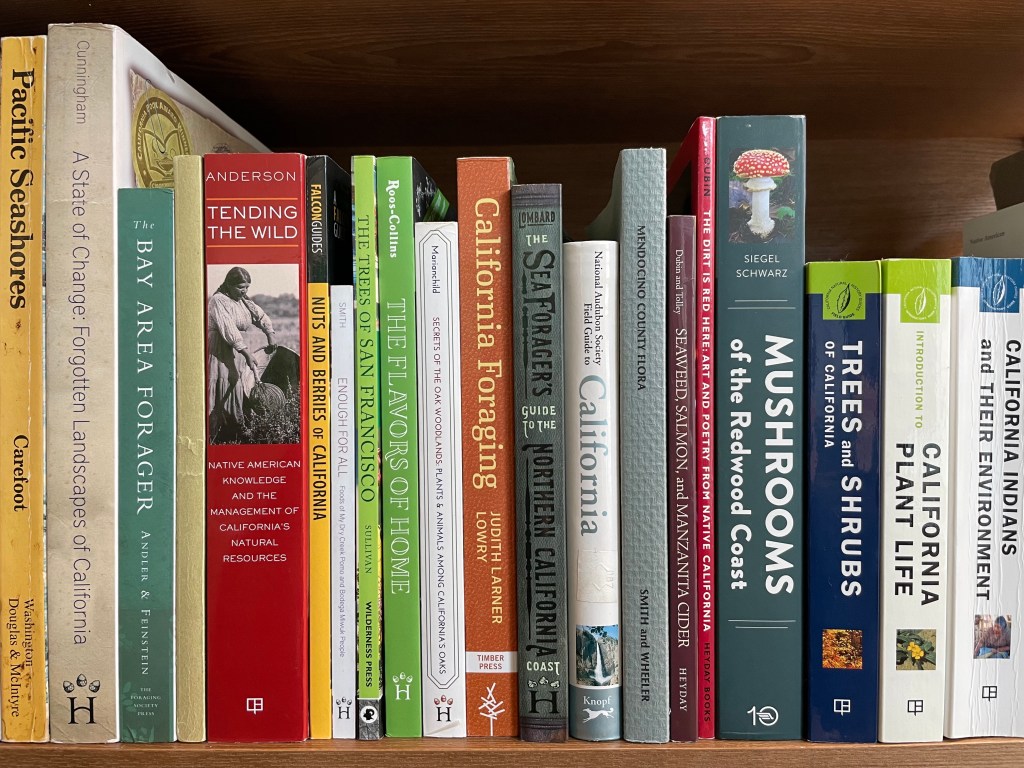
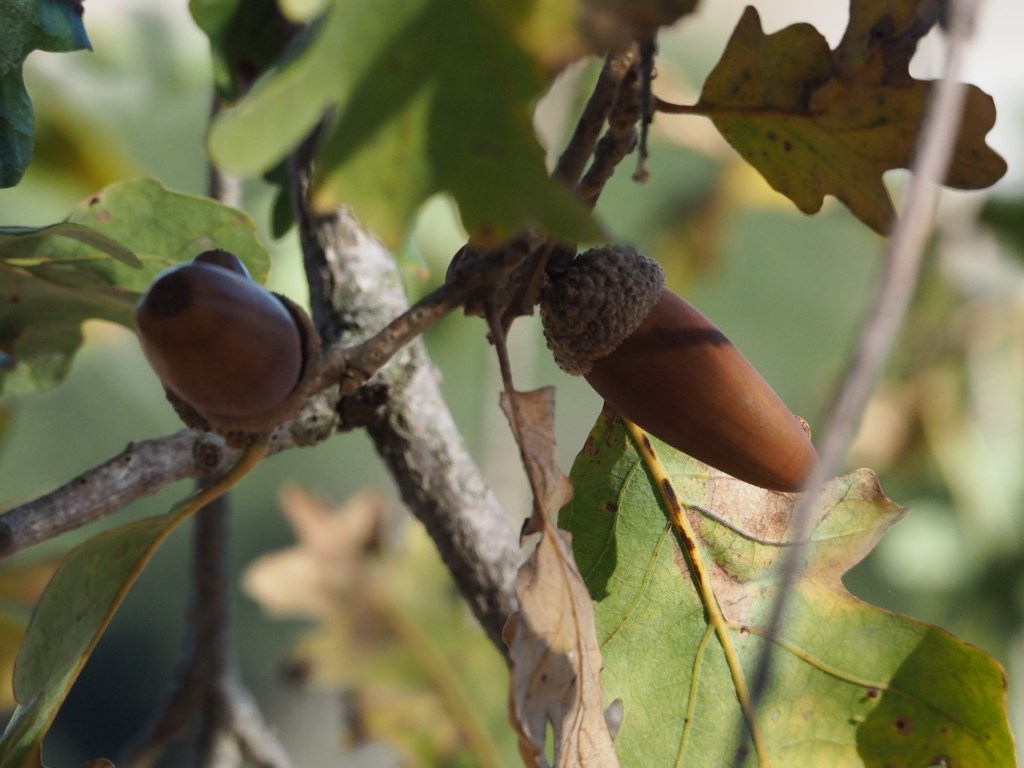


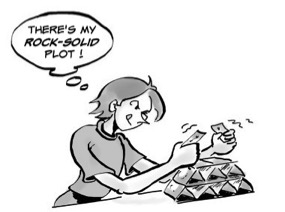
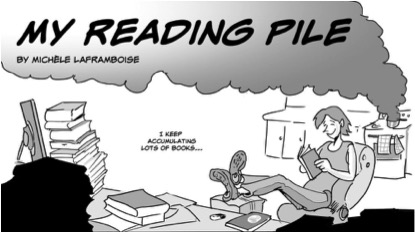
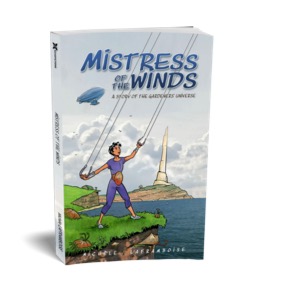
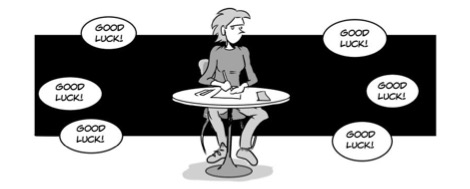
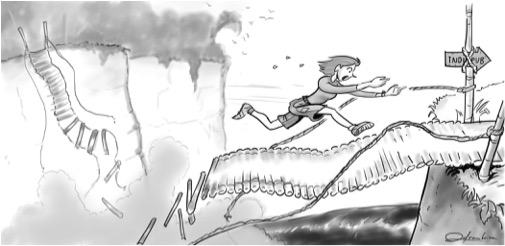

 From Earth to the Stars