Q&A With John Kessel

John Kessel was first published in Asimov’s around 40 years ago. Now he returns with “The Ghost,” his latest novella in our [September/October issue, on sale now!]. Read on to find out how a turn-of-the century New Year’s Eve party hosted by H.G. Wells helped inspire this latest work.

Asimov’s Editor: How did this story germinate? Was there a spark of inspiration, or did it come to you slowly?
John Kessel: I’ve always been a fan of the science fiction of H.G. Wells, and became interested in his biography a long time ago. One of my most well-known stories, “Buffalo,” set in the 1930s, has the older Wells as one of the two major characters (the other is my father).
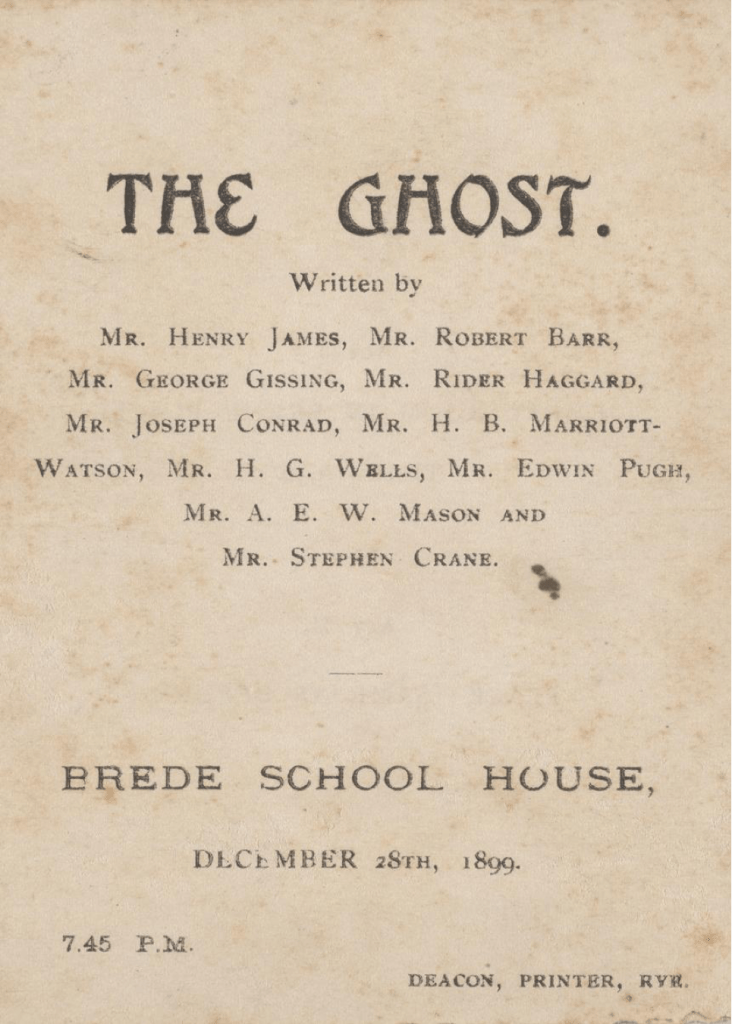
“The Ghost” started when I read that the American writer Stephen Crane, famous for The Red Badge of Courage, lived in England in the last years of his life, and that he and Wells were friends. They seemed like a real odd couple to me. Then I found out Crane threw a big multi-day New Year’s party at the end of 1899 to celebrate the start of the 20th century at a 500-year-old haunted manor house in the south of England. Crane persuaded a remarkable list of writers to contribute to a play, “The Ghost,” that the partygoers would perform for the people of a nearby town. Wells and his wife Jane were a part of all this; the more I learned about it the more I felt there was a story in it.
It took me a long time to find exactly the right story to tell, however. In what way was the house haunted, and who was at risk? It made me think about other stories set in an English manor house where a bunch of privileged people come together for a weekend and end up behaving badly.   

Here’s the first page of the playbill that was printed for the play.

AE: Is this story part of a larger universe, or is it stand-alone?
JK: It’s one of a series of stories set in the first decade of the 20th century that I am writing. One of them, “The Dark Ride,” was the title story of my collection of 2022. All of the stories have some connection to the life and works of H.G. Wells, in particular his 1901 novel First Men in the Moon. I’m interested in the politics of that time, which reflect in some ways the politics of our own: vast inequalities between the rich and the poor, new technologies that were going to transform the next century, the personal struggles of individuals in this context, the efforts of artists like Wells to understand and affect the world. One of the other stories is set during a world’s fair, the Paris exposition of 1900;  “The Dark Ride” describes a “Trip to the Moon” fair ride at the Pan-American Exhibition in Buffalo in 1901, based on Wells’s novel, where the anarchist Leon Czolgosz assassinated President William McKinley. Yet another concerns the French pioneer filmmaker Georges Melies’ 1902 movie “A Trip to the Moon,” which also draws from Wells’s novel.
Eventually I expect these stories to make a book.

AE: What is your history with Asimov’s?
JK: It goes back a ways. Early in my career, in 1984 and 85, I had stories in Asimov’s back when it was edited by Shawna McCarthy, and later by Gardner Dozois, and still later by Sheila Williams.

AE: Who or what are your greatest influences and inspirations?
JK: Among SF and fantasy writers I’ve been affected by a lot of older writers from H.G. Wells to Robert Heinlein to Alfred Bester to C.M. Kornbluth to Damon Knight to Carol Emshwiller to Thomas Disch to Gene Wolfe to Ursula K. Le Guin. A lot of writers who came into the field in the 1980s when I did have had great influence, among them James Patrick Kelly, Karen Joy Fowler, Bruce Sterling, Kim Stanley Robinson, and a dozen others I could name.
And then there are the many writers outside the genre whose work I’ve admired, from classics to contemporaries. I don’t necessarily try to write like them, but I have learned from them, and the work they did has been an inspiration. To name just a few: Jane Austen, Herman Melville, Karel Capek, Raymond Chandler, Nathanael West, Flannery O’Connor, Kurt Vonnegut, Tobias Wolff, Don DeLillo.
I should mention that I have been an avid movie fan since I was a kid, and there are great films and filmmakers that have stuck in my mind and heart. Orson Welles, Preston Sturges, Stanley Kubrick, Akira Kurosawa, Michael Haneke, the Coen Brothers; individual movies from The Day the Earth Stood Still and 2001: A Space Odyssey to The Third Man and Fargo.


I’ve always been a political person who cares a great deal about right and wrong even when those things are not easy to determine, and I think my beliefs have shown up in my work, either through satire or through the fundamental values the stories espouse.


AE: Are there any themes that you find yourself returning to throughout your writing? If yes, what and why?
JK: I’ve always been a political person who cares a great deal about right and wrong even when those things are not easy to determine, and I think my beliefs have shown up in my work, either through satire or through the fundamental values the stories espouse. I try not to write tracts, or to preach. I don’t think there are many characters in my stories who speak for me; in fact, if a character gives a political speech in some story of mine, you can pretty well count on it not to represent my own beliefs. I use a lot of not completely reliable viewpoint characters.
Another area, related to this, that comes up in my fiction a lot is male-female relationships. I try not to approach them from the point of view of a political agenda. I’m more interested in the ways that interpersonal dynamics reflect gender attitudes.
And connected to this are questions of masculinity, which comes up a lot in my stories. What is it that makes someone a man? To what degree are the behaviors that have typically been associated with men, and that society has encouraged—not to say forced—men to adopt, the result of inherent biological inclinations vs. culturally constructed expectations?  I don’t necessarily know the answers to these questions. I look at this from a lot of different angles, ages, and circumstances. I think it’s there in “The Ghost” in the portrayals of Stephen and Cora, H.G. and Jane, though I’m not sure that is precisely what the story is about.

AE: What other projects are you currently working on?
JK: Most of my writing right now is taken up with the story series of which “The Ghost” is a part. I dabbled a bit in recent years in screenplays and writing for TV, but nothing has come of that yet.

AE: What are you reading right now?
JK: I recently read Gregory Frost’s trilogy Rhymer, Rhymer: Hoode, and Rhymer: Hel, and his separate historical horror novel The Secret House (set in the 1840s about the rise of John Tyler to the presidency, in a haunted White House). I like the way these books all use well researched historical material from which Frost creates fantasy and horror. And his characterization is great.

AE: Do you have any advice for up-and-coming writers?
JK: Read a lot, not just in your chosen genre, but every sort of fiction and non-fiction. Try to be a person who has both broad and deep interests. Follow them where they lead you. Be persistent. Try to have fun doing it. Find a way to fit your writing into your life in a humane way.

AE: What is something we should know about you that we haven’t thought to ask?
JK: I am very tall. This has had a significant effect on my life, mostly for good—as a teacher I suspect that I frequently received unearned respect from students just by walking into the room. But it has a downside that most people probably don’t think about, from the unintentional comedy of my using airplane restrooms to the astonishing number of times I have hit my head on things that most people never have to pay attention to: street signs, light fixtures, doorways, car hatches, tree limbs, stairwell ceilings. Ouch. 

AE: What other careers have you had, and how have they affected your writing?
JK: For forty years I taught literature and fiction writing at North Carolina State University. It had a great effect. The works and writers that I taught offered me many examples of different ways to be excellent, in addition to exposing me to material that I have incorporated into my fiction. “The Ghost,” filled with real historical figures and based on real events, is one example of a story that I never would have written if I had not studied literature. And teaching creative writing forced me to think a lot about what makes a good story, the different kinds of good stories, how one constructs such a story, and the subjectivity of standards. Teaching a skill almost automatically hones that skill.

AE: How can our readers follow you and your writing?
JK: I have a (rather dormant) website at:  https://johnjosephkessel.wixsite.com/kessel-website

You’re more likely to learn what I’m up to and what I’ve published at my facebook page: https://www.facebook.com/john.kessel3/

I also have a substack at: John Kessel


John Kessel is an emeritus professor at NC State University, where he helped found the MFA program in creative writing. His fiction has received the Theodore Sturgeon, Locus, James Tiptree Jr./Otherwise, Ignotus, and Shirley Jackson awards, and twice received the Nebula award. The Dark Ride: The Best Short Fiction of John Kessel, was published in 2022, and his collection The Presidential Papers appeared in PM Press’s Outspoken Authors series in 2024. 

Q&A With Leah Cypess

Prolific middle-grade author and Nebula finalist Leah Cypess tells us how her love of historical fiction helped inspire “A Tide of Paper,” her latest novelette, which you can find in our [Sept/Oct issue, on sale now!]

Asimov’s Editor: What is the story behind this piece?
Leah Cypess: This story started as a tie-in story for a book that has (so far) not been published.
Even though I mostly write science fiction and fantasy, I also have another beloved genre, which is historical fiction. Back in 2018, I finished a young adult historical fiction novel about crypto-Jews in Renaissance Venice. That book got me my current agent, but did not, sadly, sell to a publisher.
While researching Renaissance Venice, I bumped into a lot of information about (1) the Jewish printing presses in Renaissance Venice, and (2) the ghost stories that people in Renaissance Venice believed. I wrote several versions of this story, all with Samuel—who is based on a real historical figure—as the main character. Those versions all revolved around his romance with the main character in that YA book. In my final rewriting, I took all of those links out and focused just on Samuel’s personal arc (which also made it a stronger story), and then I sent it to Asimov’s. 😊

AE: How did the title for this piece come to you?
LC: The title, “A Tide of Paper,” is a direct quote from some of the complaints people in the Renaissance made about printing presses. (Fun fact, I actually had two titles in mind for this story, both real quotes from people unhappy with the results of this new technology: A Tide of Paper and An Overabundance of Books. Readers can let me know if they think I chose the right one!)

AE: What other projects are you currently working on?
LC: I’m currently publishing an early chapter book series, Miriam’s Magical Creature Files, with Amulet Books/Abrams. This series is so much fun—I love writing humor, and it is an amazing experience to see a fantastic illustrator bring a book to life! I’m also working on the sequel to my children’s science fiction book, Future Me Saves the World (and Ruins My Life), which was published by Aladdin/Simon & Schuster in June.

AE: What are you reading right now?
LC: I am someone who reads lots of books at once, so this is going to be a long answer! In historical fiction, I’m in middle of The Master Jeweler by Weina Dai Randel, and I also sneaked in the first few chapters of The Boy with the Star Tattoo by Talia Carner. In SFF, I just started an advance copy of The Philosophy of Thieves by Fran Wilde. I also read middle grade—partly because I write middle grade, partly because I just like it!—and so I also just started The Secrets of Lovelace Academy by Marie Benedict and Courtney Sheinmel.

And in non-fiction . . . no, just kidding, I think that’s enough.

AE: How can our readers follow you and your writing? (IE: Social media handles, website URL . . .)
LC: My website, which I update frequently (and where you can sign up for a new releases only newsletter), is www.leahcypess.com. Currently I post about books, scenery, and sometimes food on Instagram and Facebook, in both places as Leah Cypess.


Leah Cypess is the author of the middle grade series Sisters Ever After, the early chapter book series Miriam’s Magical Creature Files, and the middle grade book Future Me Saves The World (And Ruins My Life). Leah has also written four young adult fantasy novels and numerous works of short fiction. She is a four-time Nebula Award finalist and a World Fantasy Award finalist. You can learn more about her and her writing at www.leahcypess.com.

Shared Space: Thoughts On “Aftermath”

by William Preston

William Preston discusses how the communal experience of reading and sharing ideas about art with others helped inspire “Aftermath,” his latest story in our [July/August issue, on sale now!]

One of my earliest memories is of running across the playground at my nursery school, shouting, like the Human Torch, “Flame on!” I was five years old. To write of this now is to advance a few worn frames of film through a machine that erodes as it projects; in showing you, I have further degraded the original image.

The only Fantastic Four comic I had read at the time was the replica of the first issue that came with the voice-acted LP; it was released that same year, also the year the foursome had their first animated show (from Hanna-Barbera Productions). I don’t remember the show, though I must have watched it. I still have the record and accompanying book.

I mention this not because my story “Aftermath” concerns our relationship with memory, though that is certainly a motif, but because so much of my creative life—in which I include childhood play—has been engendered and sustained by the creativity of others.

Creative works, of whatever medium, invite our participation, though such participation may include confusion and resistance. We imagine ourselves in that setting or as that character; sing a song from a musical as if to an audience; act in a play we’ve seen others perform; recite a poem in the silence of our house; step into a watercolor scene. In those moments, we share the creator’s breath. We see as they did and inhale the air they conjured.

For decades, I’ve enjoyed the author comments in the rearward material of the O. Henry Prize and Best American Short Stories collections; I may not read all of the stories, but I read all of those notes. Authors often tie a story’s origin to a personal event or relationship. Other times, the seed of an idea comes from another creative work. I have caught myself thinking that I am “unoriginal” or even “not especially creative” because of my reliance on the work of others in prompting me; reading how other writers are themselves moved to write provides a corrective.


We imagine ourselves in that setting or as that character; sing a song from a musical as if to an audience; act in a play we’ve seen others perform; recite a poem in the silence of our house; step into a watercolor scene. In those moments, we share the creator’s breath. We see as they did and inhale the air they conjured.

I have no idea how or when I landed on the term “springboard.” I may have first used it in teaching. Describing the commonalities between, say, Le Guin’s “The Ones Who Walk Away from Omelas” and the argument about the suffering child in Dostoevsky’s Brothers Karamazov, I might have said, “Le Guin isn’t telling the same story, but she springboards off Dostoevsky to address our moral response.” Such phrasing appeals to me—more than language such as “inspired,” with its hint of a hidden world—because it’s so concrete, and I like to think of writing as analogous to carpentry or architecture.

“Aftermath” springboards from Ray Bradbury’s “Night Meeting,” which first appeared in his Martian Chronicles in 1950. The story, written expressly for the book, presents a presumably Mexican-American colonist from Earth interacting on this dead Mars with a Martian riding a vehicle that looks like a bejeweled praying mantis; to each of them, the other is an impossibility.

My first reading of “Night Meeting” is another of my over-viewed, thin memories. It faintly exists as a scene on a summer’s day, a too-hot day in Pennsylvania when I sprawled reading in my childhood bed. “Night Meeting” is one of those Bradbury tales in which the writer maintains tight control over his sometimes-rampant figurative language; tellingly, it’s also a story in which realism and the fantastical (call it science fiction if you must) are in perfect balance. Nothing about the speculative elements is especially credible, but the conviction and concreteness of the prose along with the believability of the characters’ points of view make the thing work. My strong sense of it still—I remember this feeling—is that there is space around the words; the prose isn’t aiming to stuff you full of detail so you have nothing except what the author says. Rather, you’re invited into the temporary and liminal shared world. You inhabit this world with Bradbury and these two characters, all of you standing mystified under the stars.

My “Aftermath” is also an example of “playing in someone else’s sandbox,” though I brought my own toys to add to Bradbury’s few. What I’m evoking should be recognizable as Bradbury’s Mars, though if you’ve read The Martian Chronicles, you know that there’s no one Mars in its pages but rather a host of stories that work together despite inconsistencies, a collection of scriptures that live in tension but avoid coming to blows because they’ve been set between two covers and called canon.

Every creative work welcomes someone—maybe not everyone—into a common experience. I like talking with people who have read my work less because of any pride in the result than because I, too, experience it after its completion as any reader might; I hardly remember what I’ve done.

With this story of an impossible Mars (and another that I just finished writing), I’m inviting readers to enter my own thin recollection of reading and discovering The Martian Chronicles. I still have my ragged childhood copy; I just took it down from among my other Bradbury books, between bookends made of pieces from the late author’s attic. The pages smell old in that way we all know, the shed molecules of paper puffing upward to get in our eyes and nostrils. They smell, too, of summer at the open window and all the possibilities of life and worlds to come.


William Preston is a former teacher whose short fiction has appeared repeatedly in Asimov’s. His story “A Crisis for Mr. Lion” won the 2006 All-Story Short Fiction Contest. He is currently at work on both longer and shorter pieces of writing. He may be found online at @williampreston.bsky.social.

Q&A With Derek Künsken

Derek Künsken, winner of our 2013 Readers’ Award for best novelette, returns to Asimov’s for the 13th time with “Worm Song,” appearing in our [July/August issue, on sale now!] Find out how a Chinese publisher helped Derek’s latest story come to be in this illuminating Q&A

Asimov’s Editor: What is the story behind this piece?
Derek Künsken: I was approached by a Chinese publisher who had previously translated some of my stories. They were looking for a new story that included the elements of “new year” and “dragons.” I really like imagining weird places and inventing strange aliens with unconventional relationships with their environments. My vision of this story was pretty clear right away. From the beginning, “Worm Song” had most of the elements that ended up in the final draft: the gas giant, families apart and hoping to reconcile, insights into the alien, and the gas giant.

AE: Do you particularly relate to any of the characters in this story?
DK: I think we’ve all had our hearts broken. I think we’ve all been in relationships that are important to us where we feel that one person or the other is drifting away. I think I was going for that kind of tragic personal vibe in this story, to reflect the larger alien dragon tragedy going on in the depths of the gas giant.

AE: How did the title for this piece come to you?
DK: I don’t know that my process for titling is very conscious or systematic. Titles are very much a feel thing, a gut thing for me. Although I was supposed to be focusing on dragons, and we did get there in the story, the key to the dragons is of course the worm song, which felt like the right title for the piece.

AE: What is your history with Asimov’s?
DK: I think this is my 13th Asimov’s story. Sheila Williams bought my second short story sale back in 2008 and I’ve been very lucky with Asimov’s since then. Its readers have been very supportive—I won the Asimov’s Reader’s Poll in 2013. And the editors have been great to share creative space with.

AE: Who or what are your greatest influences and inspirations?
DK: I think there are early influences, which didn’t really help me understand science fiction or how to be a writer, but they were fun at the time: Edgar Rice Burroughs, Tolkien, Frank Herbert, and way too many Marvel comic books. Later, I think I was much more consciously inspired by Iain M. Banks, Alastair Reynolds, Stephen Baxter, Ken MacLeod, and other exemplars of British Space Opera, which is the sub-genre I feel I’m most often writing and reading.

AE: Are there any themes that you find yourself returning to throughout your writing? If yes, what and why?
DK: I seem to keep coming back to worries about the genetic engineering of humanity. This comes across most strongly in my Quantum Evolution novel series (starting with The Quantum Magician) where humanity has genetically engineered itself into several subspecies, and ultimately, evolutionary arms races that are no good for anyone. A distant second is probably just weird places in space: strange stars, strange moons, strange planets. Heck, even strange gas clouds . . .

AE: How did you break into writing?
DK: Slowly haha. Yeah, slowly. I was writing for real seriously for about 20 years before I was good enough to make my first sale around the time I was 35 years old. That’s one of the reasons I call myself a slow learner. Around that time, I also started listening to podcasted short stories. That really helped me sharpen my writing instincts and craft. About 3 years of intensive listening/reading and writing stories and sending them off got me to a place where most of what I was writing was selling. When I had enough of a track record with short fiction publications, I tried with a novel to get an agent. I had a number of novelfails but finally, in 2018, The Quantum Magician was published by Solaris Books to some great responses and I’m finishing drafting the 4th novel in the series right now.

AE: What are you reading right now?
DK: I have a toddler, so I don’t get all the sleep I would like, so my reading is a lot of rereading right now, or podcasts about comics or video games. I’m currently rereading The Algebraist by Iain M. Banks and some older science fiction. On new books, I recently enjoyed Someone You Can Build a Nest In by John Wiswell, Shigidi and the Brass Head of Obalufon, by Wole Talabi, and Empire of Sand by Tashi Suri.

AE: Do you have any advice for up-and-coming writers?
DK: I know it’s not for everyone, but try to break in through short fiction. My agent asked me for my novel on the basis of my pitch and my short fiction track record. That means reading (analytically) a lot of short fiction. I wish I’d followed that advice sooner.

AE: What other careers have you had, and how have they affected your writing?
DK: I’ve worked with street kids as a volunteer, and I’ve done cancer research for my masters degree, and I’ve been a diplomat with an occasional focus on humanitarian issues. All three of those things show up in my writing from time to time, sometimes at center stage.

AE: How can our readers follow you and your writing? (IE: Social media handles, website URL…)
DK: I’m actively at bluesky @derekkunsken, very passively at twitter @derekkunsken, and my website is www.derekkunsken.com. I occasionally end up on podcasts talking about comic books, like the Magazines and Monsters Podcast, the Graymalkin Lane podcast, and once each on the Quarter-Bin podcast or House of X Book Club podcast. It’s fun talking comics.


After leaving molecular biology, Derek worked with street kids in Central America before finding himself in the Canadian foreign service as a diplomat. He has two space opera novel series, beginning with The Quantum Magician and The House of Styx published by Solaris, and a collection called Flight From the Ages and Other Stories. Critic Rich Horton describes Derek “as one of the best pure ‘hard science’ writers of the current generation . . .” Derek makes his internet home at DerekKunsken.com, and blueskies from @derekkunsken.

Q&A With Rich Larson

Rich Larson returns to Asimov’s in our July/August issue with “Most Things,” his latest story since the publication of his first novella, which appeared in our May/June 2024 issue. Catch up with Rich in our latest author interview about the dream that inspired “Most Things,” the writing contest that kicked-off Rich’s writing career, the merits of spa-day reading, and other surprising topics.

Asimov’s Editor: What is the story behind this piece?
Rich Larson: This story had a long gestation and synthesized many inspirations. The initial sparks came from 1) a vivid dream of a non-existent movie that opened with two middle-aged substance abusers (one played by a grizzled Matt Damon) crashing their car outside a fancy restaurant, bringing their multi-day bender to an abrupt halt 2) a vivid mid-morning high in the Crown & Anchor parking lot, produced by a particularly potent cocktail of weed, shrooms, coffee, and booze.
To elaborate: a friend had come through town to say goodbye before heading off to join the Navy, and he was talking to me about meth-head drywallers and ants being the earliest machine intelligence and how he hopes we eat the rich, and I was too high for it. I kept getting ideas and texting myself so as not to forget; some went on to inspire “Deathmatch” in Lightspeed and “Even If Such Ways Are Bad” in Reactor. The one most relevant to “Most Things” is transcribed below:

Different highs need different words, and for this one I need a word that is a poisonous yellow-black swamp whirling through space, aggressive in vacuum. I can feel the intent in its creepers and flowering tendrils.

That, combined with the aforementioned dream, got me underway. At some point I decided to incorporate the quantic lore from my Clarkesworld story “Carouseling,” creating a rare (for me) shared universe. The ending imagery at the beach came from both my own life and from another dream, in which an immortal being slept tethered to the sandy shallows, and before rising to the surface would carve themselves into a roughly human shape, shedding all the alien mass that would terrify onlookers.

AE: Do you particularly relate to any of the characters in this story?
RL: I can certainly relate to Mack’s fear of death, Arvo’s taste in poetry, and the way the two interact with each other—it’s based heavily on how I interact with old friends from Grande Prairie.

AE: How did the title for this piece come to you?
RL: The working title was “Stagger,” because I was originally going to open with Mack and Arvo staggering out from the wreckage of a car crash. Once the story was actually finished, I retitled it “Life After Heat Death”—but Sarah Pinsker had a better idea during the Sycamore Hill workshop. That’s how I ended up with the poem-referential “Most Things.”

AE: What is your history with Asimov’s?
RL: Long! Asimov’s has published twelve of my stories prior to this one, from “Bidding War” back in 2015 to my first-ever novella Barbarians just last year. Hopefully there are more to come.  

AE: Are there any themes that you find yourself returning to throughout your writing?
RL: Fraught sibling relationships often appear in my work, and recently I’m prone to write stories involving memory, loss, and memory loss. Sometimes I get fixated on a certain motif that lasts for several projects—disembodied heads, for example, feature in my novel Ymir, my novella Barbarians, and, naturally, my Reactor story “Headhunting.” But I work hard to stretch myself and find new forms / themes / relationships, so I’m not too worried about repetition.

AE: How did you break into writing?
RL: Local library writing contest: once per year, two thousand words written to a specific theme, cash prizes. That created my early association between writing and getting paid / recognized, and then at eighteen I was a finalist for the long-defunct Amazon Breakthrough Novel Award, which cemented the idea I could write for a living. I sold some poems and a lot of short stories and eventually got my first novel contract when I was twenty-five. I’ve managed to survive as a full-time writer ever since.

AE: What other projects are you currently working on?
RL: I always have a bunch of irons in the fire. Right now I’m working on eight of my own stories, plus collaborating on a noir novella with another Canadian writer, plus doing some TV writing. I also have a new novel brewing in the back of my mind.

AE: What are you reading right now?
RL: Lately I’ve been doing a lot of spa reading—a book is a great distraction from the cold plunge, and a good companion in the sauna. I’m currently muddling through an Italian thriller, as a way to test my Italian comprehension, and before that I finished Karen Joy Fowler’s The Jane Austen Book Club.

AE: Do you have any advice for up-and-coming writers?
RL: Be kind to yourself. Write things that really interest you. Try flash fiction as a way to practice finishing things, which is its own skill.

AE: What is something we should know about you that we haven’t thought to ask?
RL: I’ve got some new books out! My self-illustrated flash collection, The Sky Didn’t Load Today and Other Glitches, and Changelog, the heftier follow-up to my debut collection Tomorrow Factory.

AE: How can our readers follow you and your writing?
RL: You can find free reads at richwlarson.tumblr.com, support my work at patreon.com/richlarson, and follow me on Instagram at @richlarsonwrites.


Rich Larson was born in Niger, has lived in Spain and Czech Republic, and is currently based in Canada. He is the author of the novels Ymir and Annex, as well as over 250 short stories, some of the best of which appear in his collections Changelog and Tomorrow Factory. His fiction has been translated into over a dozen languages, including Polish, French, Romanian and Japanese, and adapted into an Emmy-winning episode of LOVE DEATH + ROBOTS.

The Origins Of ‘In the Forest of Mechanical Trees’

by Steve Rasnic Tem

Steve Rasnic Tem discusses the looming specter of climate change, what efforts are being made to fight it, and how this inspired him to write “In the Forest of Mechanical Trees”, available to read in our [May/June issue, on sale now!]

At this point I’ve published a little more than 530 short stories. To create that much fiction a writer takes inspiration from a wide variety of sources: news stories, art, folklore, historical events, hopes, dreams, and nightmares. Sometimes it’s difficult to pinpoint an exact source. I might start with a phrase, a character, or a setting, and by some mysterious means a narrative grows from those bare, often unpromising materials.

But this tale, “In the Forest of Mechanical Trees,” has some quite specific origins. I have a dear friend of almost 50 years, a former housewife, ex-social worker, mother of two, who has been an active volunteer for many years. She started with the Hunger Project, unable to tolerate the fact that in a world of so much abundance a great many people were still going to bed hungry every night. During her work combating hunger, she discovered that one of the key elements affecting food production around the world, especially in poorer countries, was climate change. Her volunteering shifted to climate change work with such organizations as the Citizens Climate Lobby (CCL), 2030orBust, and more recently—understanding that reducing emissions isn’t enough given the amount of carbon already in the air—F4CR, the Foundation for Climate Restoration, an organization dedicated to restoring a historically safe and stable climate. By “historically safe,” they mean the climate in which humans have thrived for millennia – the pre-industrial climate.

At one time climate change was a thorny issue. In some circles it still is. People believed it didn’t exist. Over the past couple of decades that has changed considerably. Even the local weather forecasters sometimes refer to climate change and its effect on the weather people are seeing in their hometowns and local regions. Climate change as a real phenomenon has become widely accepted.

But if you ask What can we do about climate change? you’re likely to see a lot of shrugs. Climate change creates feelings of helplessness in a great many people. Climate change belongs to a class of things sometimes referred to as hyperobjects (a term coined by the philosopher Timothy Morton). Hyperobjects are phenomena so massively distributed in time and space they defy traditional notions of what a thing is. They tend to be larger than any one state or nation and they exist beyond the bounds of a single person’s lifetime. Human beings naturally have a hard time with hyperobjects. We feel powerless in their presence.

But people who volunteer for climate change activism believe there are things we can do to remedy this, and I agree. We had the power to create this problem in the first place with our uncontrolled carbon emissions and fossil fuel usage. Our boundless invention and ingenuity created climate change. Perhaps invention and ingenuity, along with self-control, if applied soon enough, will fix it. Climate change activists talk about two different goals: reducing our carbon emissions so that we’re no longer poisoning our air and removing the carbon already in the atmosphere in the hopes of restoring it to what it was before the industrial revolution.


Our boundless invention and ingenuity created climate change. Perhaps invention and ingenuity, along with self-control, if applied soon enough, will fix it.


Organizations like CCL work on the first goal, reducing greenhouse emissions through such strategies as carbon fee and dividend. Organizations like F4CR focus on the second goal, pulling carbon out of the air using the proposed techniques of synthetic limestone manufacture, seaweed permaculture, accelerated natural methane oxidation, and ocean iron fertilization. These methods are discussed in detail in physicist Peter Fiekowsky’s book Climate Restoration: The Only Future That Will Sustain the Human Race. It is important that these methods be studied thoroughly through well-funded pilot projects while there’s still time so that they might be safely implemented on a larger scale.

I’ve come to believe that no one solution is going to repair our world’s climate, but that many different solutions, working in concert, just might. There are a lot of proposals out there, large and small, including olivine beaches, planting more forests, and the solution I talk about in this particular story, mechanical trees. Whatever the method, they all require a fundamental shift in how we view our planet. We have always believed that the Earth and its systems were too big to break. Now we know better. What we do to the world we live in has effects far beyond what we once imagined.

In this story I focus on the grandparents. I’m a grandfather to seven, a great-grandfather to another two. Like many grandparents I worry about the world my generation is leaving behind for my grandchildren. If I live long enough to have to answer for what I did or didn’t do about climate change (which will affect them much more than it has me) what would I say? This aspect of the story was inspired in part by the F4CR-related project The Grandparents Fund for Climate Restoration, grandparents contributing something to help their grandchildren thrive by restoring a climate fit for humans.          

I’ve been thinking about these climate-related issues for some time. But I still wasn’t ready to write a short story about it. That final bit of inspiration came one afternoon when my old friend took me on a walk through a neighborhood in Sebastopol, California. She wanted to show me something she knew I would enjoy. A lot of things, actually. I’m a fan of both sculpture and collage, especially sculpture which re-uses “junk” and turns it into art. In Sebastopol there is an artist by the name of Patrick Amiot (https://patrickamiot.com/) who creates sculptures from objects destined for the scrap heap. These large, intricate, often satirical works of art can be seen throughout the community—in a field by Highway 12, in front of the hardware store, the fire station, fronting office buildings, and on one particular street filling almost every yard—fashioned from hubcaps, lids, watering cans, water heaters, buckets, car hoods, barrels and barrows and oilers—all created by Patrick Amiot and brightly painted by his wife Brigitte Laurent.

Almost immediately I could see my destination, an entire attraction devoted to such sculptures, surrounded by the mechanical trees this artwork financially supported, in the desert somewhere south of an almost uninhabitable Phoenix Arizona. A defiant, creative outpost in a world ravaged by climate change.


Steve Rasnic Tem has published over 525 short stories during his forty-five-plus year career. Recent collections of his work include Figures Unseen and Thanatrauma (Valancourt), and Rough Justice and Everyday Horrors (Macabre Ink). He has won the Bram Stoker, World Fantasy, and British Fantasy Awards, and in 2024 he received the Horror Writers Association Lifetime Achievement Award. You may follow him on the web at www.stevetem.com,  www.facebook.com/steve.tem and @stevetem.bsky.social.

Spinning Science Fiction

by Carrie Vaughn

Carrie Vaughn leads a guided tour through the wide world of yarn on her way to explain how she came up with the idea for her short story “Woolly”, appearing in our [May/June issue, on sale now!]

I can tell you exactly where my story “Woolly” started. It started with a spindle.

I learned to spin wool on a drop spindle maybe a dozen years ago. A thing I love about spindles is they’re one of the oldest technologies we have – probably around 15,000 to 20,000 years old. The spindle is older than agriculture. The first spindles were probably not much more complex than a stick that people would use to gather wool shed by wild sheep and goats, and wind it up for felting and early weaving. Spindles are portable. You can spin while waiting for the stew to cook, while watching the babies, or walking to the next camp. I love that I have this skill that’s been passed down for thousands of years and hasn’t changed much in all that time. It feels like a cosmic connection.  

I sometimes think our ancestors would be shocked that these days, most of us do this for fun.

Spinning is very satisfying. For those of us who have trouble sitting still, this gives us something to do with our hands. The original fidget spinner. I learned to knit mostly because I was spinning all this yarn.

Once you start spinning, once you get confident at it, you start looking at the world a little differently. You start asking a big question: Can I spin that? Is there a big pile of fluff nearby? Yes, you can probably spin that. Any fiber I can get my hands on, I’ve spun. Sheep, alpaca, and angora rabbit are the obvious candidates. But I’ve also tried spinning camel fiber. Bison fiber? Yes.  My miniature American Eskimo Dog Lily was maybe 80% fluff, and yes, I spun her fur into a very poofy yarn. I’ve seen Golden Retriever and Husky yarn. I’m currently spinning a 50% merino, 50% yak blend that is soft and divine.

How about… Mammoth?

Well. Wouldn’t it be lovely to find out?


The classic science fiction extrapolation, an exploration of the unintended consequences.


That’s the question I asked when the plans to clone woolly mammoths got underway. A number of preserved mammoth specimens show that they had thick, golden-brown coats with a relatively long staple. (This is the length of a fiber, which can tell you how well it will spin, and the quality of yarn it will produce. Longer staple tends to produce stronger, smoother yarns.)

I bet we could spin mammoth hair. I wonder if the folks working on the cloning would let me try.

I asked the group of spinners that meets at the local yarn shop about modern analogs that might give us some idea of what spinning mammoth would be like. What we came up with was yak, one of the survivors of ice age megafauna that features a coarse, shaggy outer coat and soft undercoat. Mammoths probably did as well. Wool can be harvested by plucking – gathering as it naturally sheds – rather than shearing.

Because I write science fiction, I can take this a couple of steps further. We clone mammoths – yes, wonderful! It turns out mammoth fiber makes excellent yarn– very good! Mammoths are very large and difficult to care for – unsurprising! So let’s miniaturize them! Uh… And sell them as pets! Wait a minute…

The minute someone starts breeding and selling animals, the next thing to come along will be animal rescue. Because someone, somewhere will screw it up. So while the story started with a spindle, it ended with miniature woolly mammoth rescue, because that’s the inevitable conclusion. The classic science fiction extrapolation, an exploration of the unintended consequences.

I still want to try to spin mammoth fiber.


Carrie Vaughn’s work includes the Philip K. Dick Award-winning novel Bannerless, the New York Times Bestselling Kitty Norville urban fantasy series, over twenty novels and upward of one hundred short stories, two of which have been finalists for the Hugo Award. Her latest novel, The Naturalist Society, is about nineteenth-century ornithologists, awkward love triangles, and the magic of binomial nomenclature. An air force brat, she survived her nomadic childhood and managed to put down roots in Boulder, Colorado. 

Truth, Story, And Connecting To Hope

by A. M. Dellamonica

A. M. Dellamonica returns to Asimov’s with their short story “The Humming of Tamed Dragons”, an exploration of trauma, airplanes, and how much of an author lives in any given character. Read it in our [May/June issue, on sale now!].

When I was about six years old, I was out in my backyard with a friend and a small airplane crashed through our backyard. 

The plane smashed the new roof of the garage next door to our house, ripped through my father’s potato garden, obliterated the fence at the end of our yard, and came to rest in the other next-door neighbor’s sandbox. It was a spot where a bunch of us kids routinely played, but that family was off camping or something… nobody had been home, on that fortunate day, to invite us over.

Nobody was seriously hurt in the incident, happily, and in the grand scheme it wasn’t a particularly big or even a surprising accident. We lived under the municipal airport… little cropdusters like this one were taking off over our house all the time. 

Because ours was a small town, the owner of the plane was the father of one of the kids in my second grade class, and the pilot was the father of another of those kids. The tale became a bit of a nine days’ wonder when we all got back to school.

Another thing about that summer crash was that all of my grandparents were visiting at the time… and so one of the legacies of the event was three generations of my family simultaneously coming into a little bit of PTSD… and at a time when the disorder was barely being discovered and documented.

Afterwards, the airport returned to business as usual, with planes roaring overhead all day. The psychic fingerprints of that trauma left barely visible marks all over my family, like sticky food residue deposited by tiny fingers on clean kitchen walls. 

I’ve had a lot of years to come past that day, and I fly all over the world now, almost calmly. Still, the noise of airplanes bothers me at times. I dream in plane crashes, and am primed, always, to notice things like articles about acoustic sustainability in aviation—the technological search to make aircraft quieter—and the development of electric planes. 

All of which is a long wind-up to saying that quite recently I had one of the experiences Huan has in my new Asimov’s story, where she’s outdoors near a major airport, coping with the noise of planes landing and taking off. I was just in a line-up for a music concert, but in the story, Huan is trying to do something quite important despite the plane noise. The sheer presence of that sound makes everything harder. 

And at that point real life and fiction diverge, because what Huan is doing at the airport is something entirely outside my experience. For her, the planes are background noise, and a different shadow from the past is front and center.

One of the ways we sometimes redeem the harder parts of growing up is by going into careers that let us try to do better for others than was done for our young selves. Huan, in addition to having issues with airplanes, is an adult survivor of childhood parental abduction. She has developed an algorithm that is supposed to identify parents who are gearing up to snatch their kids illegally. 

Huan is working on proof of concept, on ensuring her technology can be adopted… while also dealing with the noise of planes overhead.

Writers do this: we put things into stories that are true pieces of the past, and we mix them up with pieces of the world that we’ve only read about or studied or imagined, elements that aren’t autobiography. I’ve never been abducted by a non-custodial parent. I just got interested, months ago, when I realized there are uncountable adults moving through the world, every day, who have survived custodial interference and perhaps left their kidnappers—their family—behind. Somehow that sparked a story.


The world holds terrors and we put them in fiction. The world holds wonders and those go into it too.


That movement from the factual to the fictional, is something I love about fiction. Blurring the boundary, choosing things from both the real and unreal… it’s a delight, a spark, a source of joy.

And the real furniture in your stories isn’t always the bad stuff! I set the story at Vancouver International Airport, the launch point of many of my real life’s great adventures. I took Huan to have a meltdown beside the spectacular Bill Reid sculpture, Spirit of Haida Gwai, which sits in that airport. 

The world holds terrors and we put them in fiction. The world holds wonders and those go into it too.

Writing short stories takes a lot of craft. Every layer you add on a character adds complexity… and length! In “The Humming of Tamed Dragons,” Huan is driven by the memory of having been kidnapped and has this secondary trauma from having been involved in an airline incident.

Imbuing a story with a few clashing layers gives you a super-interesting character or situation to write about. Then you have to give everything enough attention and nuance to make the story interesting and believable. If you keep it simple… if you don’t layer in enough, the story might lack sparkle. For me, at least, this is always the balancing act: enough, but not too much. 

I like to have lots of facets. My novels tend to run long as a result. 

Facets: this story, which is quite short, has more than two kidnappings and airplanes and a piece of art I love. It has three other characters and takes place in kind of a fun, near future world. Huan’s partner has some cyborg parts, people don’t live with the threat of gun violence anymore, and Huan, in the end, meets an intriguing new person who more or less offers herself up as a distraction from the planes and the problem at hand.

I like to imagine living in a world where we can sometimes be a mess out in public and help comes from unexpected places. I like to imagine worlds where we can be be open to the idea of that help coming to us when needed… and being that help sometimes, for others in our turn. 

For some time now we’ve been subjected to a lot of people who want to send or amplify the message that people are bad and dangerous. And indeed, there are bad people, but there are also kind people, and quirky ones. There is still humour and altruism and sexual attraction, beauty and welcome distractions in unsupportable moments. There is comfort and fellow-feeling to be found in community, and even in strangers. 

All of this tumbles together at once, the planes falling and the beautiful sculptures at airports and moments of possible connection between us. 

Sometimes we find chances to reach out to someone, or accept them reaching out to us. Those connections, I like to believe, vibrate through the social ecosystem, carried on the nerves of our shared humanity. 

Even now, with roaring overhead and no silent jets within earshot, we have potential to make things better. I think, at core, a lot of my stories are probably about that.


A.M. Dellamonica’s first novel, Indigo Springs, won the Sunburst Award for Canadian Literature of the Fantastic. Their fourth, A Daughter of No Nation, won the 2016 Prix Aurora for Best Novel. They have published over forty short stories in Tor.com, Asimovs, The Magazine of Fantasy and SF, and elsewhere, along with poetry, pop culture essays, and even the 2021 play Dressed as People,which they co-wrote with Kelly Robson and Amal El-Mohtar. Their newest novels, Gamechanger and Dealbreaker, were released under the name L.X. Beckett and are solarpunk adventures that imagine humanity surviving climate change and creating a post-carbon economy.

Q&A With Michael Libling

Michael Libling answers questions about his novelette, “Trial by Harry”, in our [May/June issue, on sale now!]. Read on to learn about the tragic catalyst for this story and about his career as a writer in multiple fields.

Asimov’s Editor: How did this story germinate? Was there a spark of inspiration, or did it come to you slowly?
Michael Libling: The answer you’re looking for is slowly. Very slowly. By my estimate, TRIAL BY HARRY was over twenty years in the making.

In retrospect, I suppose, the idea began with my mother. She had been diagnosed with Alzheimer’s disease and though she was well into her eighties, it in no way softened the blow. She had always been confident, witty, outgoing, and as sharp as anyone when it came to business. To see her reduced to what gradually amounted to a shell of her former self was, to say the least, painful for all who had known her.

Often, while sitting with her or taking her for walks, I tried to imagine what might be going on inside her head. I wondered if it was possible that two worlds were at play, the one my mother was now trapped in versus the world she’d left behind, the one we continued to live in without her. The last two years of her life were especially tough, made all the more inexplicable by these rare moments in which it seemed as if she’d returned to us—offering a fleeting glimpse of the person she had been.  

Once, in the dining room, of the residence where she was living, she spit the seed of a lemon onto the floor during dinner, and a caregiver chided her. “You know you shouldn’t spit on the floor, Mollie.” To which my allegedly oblivious Mom quipped, “Where do you want me to spit, on the ceiling?”

For a good month or two leading up to her death, most of her time was spent in bed, unresponsive to anything or anyone around her. She didn’t recognize any of us. But then, less than a week before my mother would ultimately pass, the youngest of our three daughters came to visit after school. “Hi, Bubby,” she said, as she always did, “bubby” being a variation on the Yiddish for grandmother. My mother blinked awake for the first time in a long while, smiled at my daughter as if it was merely another day, and said, “Hi, Margie. How are you doing?”

Sadly, despite these instances and the flicker of hope that a miraculous turnaround might be underway, my mother’s awareness was gone as quickly as it had appeared. It was like she was dropping in on us every now and then, just to say hello, before returning to that unknown realm where she now spent the greater part of her time.

While there was little promise of a cure during my mother’s lifetime, recent research into senolytics, GLP-1 receptor agonists, and other therapies have offered hope, with some suggestion of even adding years to one’s life.

It was against this entire backdrop TRIAL BY HARRY took shape, with potential scenarios exploring various shades of light and dark, before the dark won out, yet again, and the cautionary tale before you emerged.

AE: Do you particularly relate to any of the characters in this story?
ML: Yes. Definitely. Harry’s children.

I see my sister, my wife, my daughters, my brother-in-law, and myself at my mother’s bedside, holding her hand, talking to her, consulting with doctors, chatting with the nurses and caregivers, protecting her interests in the same way she had always fought for ours. It was here, in the midst of all the sadness, I was struck by the extent to which small talk prevailed. My mother was dying, her kidneys were failing, and yet we continued to natter on about the weather, the news, movies, TV shows, restaurants…. I hated the fact it was all so business as usual, all so ordinary. Nothing could resist it, not even Death.

AE: Clearly, you have a strong personal connection to the story. Did this make it easier or more difficult to write?
ML: Neither, really. While the writing brought back many memories, good and bad, of those days with my mother, fiction is fiction, however personal its roots. My goal was, as always, to tell a good story—period. Had I written TRIAL BY HARRY years earlier, closer to the time of my mother’s passing, I suspect the story might not have been as dark in terms of character and plot. Back then, emotions were running in a far different direction.


While the writing brought back many memories, good and bad, of those days with my mother, fiction is fiction, however personal its roots. My goal was, as always, to tell a good story—period.


AE: How much or little do current events impact your writing?
ML: Current events—whether politics or conflict or science or culture or anything— inevitably slip into every story. Sometimes more, sometimes less. In the case of TRIAL BY HARRY, I took recent developments in Alzheimer’s research and extrapolated them to some future date. It’s an optimistic “if this goes on” approach, which, admittedly, is the only optimistic aspect of the story. Whether the current research ultimately amounts to anything, of course, will determine whether I was prophetic, misguided, or just plain twisted.

AE: How did you break into writing?
ML: I’d wanted to write since I was a kid, thanks to the encouragement of my older sister, Mara, a couple of great high school teachers, and, in university, the teacher/writers Clark Blaise and Mordecai Richler. I sold gaglines to cartoonists and concepts to greeting card companies. I wrote term papers at seven bucks a page. I had newspaper and magazine features published. I wrote and edited a Canadian stock market magazine. And I landed a job in advertising, rising from junior copywriter to creative director. (Yes, I accept full responsibility for writing “Ex-Lax. It can make your day overnight.”) Throughout these other writing pursuits, my fiction submissions gathered nothing but rejections. Hundreds! Often, the rejections would include personal, sometimes handwritten notes inviting me to submit more work, but in my mind a rejection was nothing but a rejection. In fact, I preferred form rejections over the personal ones that noted how “your story came closer than most.” Not every writer would agree, but I found editors’ simultaneous encouragement and rejection too damn frustrating. If my story came “closer than most,” why the heck didn’t you buy it!!?? What does coming close even mean? It was only after I landed an agent, the late Virginia Kidd, that my fiction began to sell. Fact is, within a month of her signing me, I made my first fiction sale. Amazingly, pretty much every story I’ve written since has found a pro market. I can also say that every sale is as much of a thrill as my first.

AE: How do you deal with writers’ block?
ML: I’ve talked about this several times in previous interviews and realize now my answer is never the same. Frankly, I struggle with writers’ block every single time I complete a project. Look, I know this will sound nuts, but I forget how I managed to pull off all previous stories. While I’ve read endless articles on how to overcome writers’ block, I’ve never found any method that works for me with any consistency. My only solution is to write, write, write ANYTHING—often with only the glimmer of a concept in mind. I put down sentences. I complete paragraphs. I fill pages. And I keep going until suddenly—and I have zero understanding as to why—the story takes over my life and I’m zipping along with an end in sight. Yeah, I just might be the most clueless working writer out there.

AE: You mention you worked in advertising. Did this or any other job you might have had affect your writing? If so, how?
ML: Advertising taught me focus, discipline, self-editing, and the importance of meeting deadlines. Advertising also taught me to roll with the punches, to never take rejection personally. Indeed, rejection was an everyday occurrence, where your best ideas—the most daring—usually ended up in the trash. Trust me, the most troublesome editor you’ve ever dealt with is a saint compared to your average client in the advertising world. I should also add that I, personally, have yet to encounter a troublesome editor. (Yeah, I’m covering my butt here, just in case.)

With a nod to your previous question, copywriters’ block never once reared its head, and I’m at loss to understand why. Kind of odd, really.

Now and then, I’ve incorporated my advertising days into stories, along with other jobs I’ve held. As a kid, I worked in a marina, which factored into my novel HOLLYWOOD NORTH. I also spent a lot of time in my parents’ small diner in Trenton, Ontario, where I scooped ice cream among other things, which played a big part in my most recent novel, THE SERIAL KILLER’S SON TAKES A WIFE. Yeah, ice cream and serial killing. Hmm…notice how subtly I managed to plug my novels?

AE: What are you reading right now?
ML: I’ve been reading a lot of nonfiction in recent months. Just finished Ben Macintyre’s ROGUE HEROES: THE HISTORY OF THE SAS, the book on which the terrific BBC series ROGUE HEROES is based. I was surprised by how faithful the teleplay is to the actual story. Week before that it was HITCHCOCK’S BLONDES by Laurence Leamer. As of today, I’ve started MOONWALKING WITH EINSTEIN, Johsua Foer’s foray into The Art & Science of Remembering Everything. I have long had the habit of gathering odd facts and bits of information. My library runs the gamut from literary and genre fiction to books on history, geography, science, pop culture, and the weirdly offbeat—including CLUCK!: THE TRUE STORY OF CHICKENS IN THE CINEMA by Jon Stephen Fink to name but one.

AE: Interesting. Has this habit paid off in your writing or in other ways?
ML: All the time! For instance, pop culture trivia is peppered throughout HOLLYWOOD NORTH. As well, I was once on a team that won the CBC TV Trivia championship for Quebec, eventually placing second in the national finals, losing only in the closing seconds after leading throughout. Grrr…that loss still rankles. I did, however, manage to parlay my knowledge into a twenty-year gig in radio, creating, writing, and co-hosting The Trivia Show on CJAD in Montreal. Although I left in December of 1999, the show is still running on Sunday mornings and remains a fun listen. It’s nice to know that something I created from scratch continues to thrive after forty-four years on the air.

AE: How can our readers follow you and your writing?
ML: My website and occasional blog can be found at http://www.michaellibling.com. I can also be contacted by email through the site. Elsewhere, you’ll find me on…

Twitter, Bluesky, or Mastodon: @michaellibling

Instagram: michaelliblingwriter

Facebook, well, just search for me: Michael Libling

Please follow or “friend” me. As I’ve said in other interviews, if you’ve managed to tolerate my babbling to this point, it should be clear that I can use all the friends I can get, real, imaginary, and otherworldly.


Michael Libling is a World Fantasy Award finalist whose short fiction has appeared in F&SFRealms of FantasyAmazing Stories, and several anthologies, including the Year’s Best variety. His fantasy noir, Hollywood North: A Novel in Six Reels (ChiZine/Open Road Media), was published in 2019 and his horror/thriller novel, The Serial Killer’s Son Takes a Wife (WordFire Press), in 2023. You can find him online at michaellibling.com and pretty much every social media outlet, Instagram, Facebook, Mastodon, and Blue Sky among them.

Q&A With Harry Turtledove

Legendary SF author Harry Turtledove returns to Asimov’s, where he was first published in 1981, with “The Fight Goes On,” his story in our [May/June issue, on sale now!]. Learn more about Harry’s influences and current projects in the our latest interview him

Asimov’s Editor: What is the story behind this piece?
Harry Turtledove: It’s a story that envisions a complication of time travel not many people have played with:  namely, that as a people travel back to important events from further and further uptime, eventually, whole swarms of them will be there, all gawking at and trying to change those events.  Robert Silverberg may have been the first to notice it, and used it in Up the Line in the late 1960s.  Not many others have since then.

AE: How did the title for this piece come to you?
HT: When the past is mutable, when it can get changed, recharged, unchanged, changed back, and changed again, nothing is permanent and the fight always goes on.

AE: What is your history with Asimov’s?
HT: My first story in Asimov’s, “Death in Vesunna” (cowritten with my ex), appeared in the January 19, 1981 issue, when George Scithers was the editor.  I’ve been lucky enough to have a good many in here since then.

AE: Who or what are your greatest influences and inspirations?
HT: If I hand’t discovered  L. Sprague de Camp’s Lest Darkness Fall at an impressionable age, my whole life would be different now.  It led me to study Byzantine history after I flunked out of Caltech, to have written most of what I’ve written (I would have written something anyway—I already hd the bug), to be married to my wife (whom I met while pinch-hitting for my prof at UCLA), have the kids I have….Other than that, it didn’t change my life a bit.  Alternate history on the micro historical level!


When the past is mutable, when it can get changed, recharged, unchanged, changed back, and changed again, nothing is permanent and the fight always goes on.


AE: How much or little do current events impact your writing?
HT: Usually, not very much, because alternate history written about near-contemporary events quickly turns into a political tract.  To steal from Ted Sturgeon, I don’t aim to sell my birthright for a pot of message.  But I have had one or two sharp things to say in print about the fascist idiot currently infesting the White House.

AE: What other projects are you currently working on?
HT: I recently had a noirish urban fantasy, Twice As Dead, come out from Caezik.  It’s set in a postwar L.A. with a hard-drinking detective, vampires, zombies, ghosts, the Central Avenue jazz scene, a bunch of corrupt cops, and a smartass talking cat.  I’ve sold a couple of others in the same milieu, and am working on one more still.  I’m also playing with an off-the-wall short piece.

AE: What are you reading right now?
HT: A bawdy diary by an Englishman who traveled in—i.e., drank, gambled, and whored his way through—the United States in 1884-85, made friends with Buffalo Bill, and was later instrumental in bringing Buffalo Bill’s Wild West show to England and Europe; and a Max Hastings book about the RAF’s 1943 effort to knock out German industry in the Ruhr using Barnes Wallis’ bouncing bombs against the dams on the rivers there.

AE: Do you have any advice for up-and-coming writers?
HT: Read a lot. Write.  Imitate what you admire.  Submit what you write.  Keep submitting when it comes back, because it often will.  Repeat endlessly.  (This is related to and descended from Heinlein’s writing tips, but is not identical to them.)

AE: How can our readers follow you and your writing? (IE: Social media handles, website URL…)
HT: I’m @hntdove.bsky.social, and have been annoying people there for a few months now.


The two most recent books by Harry Turtledove <@hntdove on Bluesky and @hntdove@wandering.shop on Mastodon> are Other People’s Playgrounds, a collection of stories set in other people’s universes; and Twice as Dead, a noirish urban fantasy that takes place in postwar Los Angeles. Coming later this year are City in Chains, a fantasy about collaboration and resistance; and Powerless, an alternate history about a Marxist-Leninist-Stalinist West Coast in a Marxist-Leninist-Stalinist world. He also has stories in anthologies edited by Henry Herz (Combat Monsters) and Darrell Schweitzer (Cold War Cthulhu). “The Fight Goes On” looks at one of the complications of trying to change the past that may not have been considered enough.