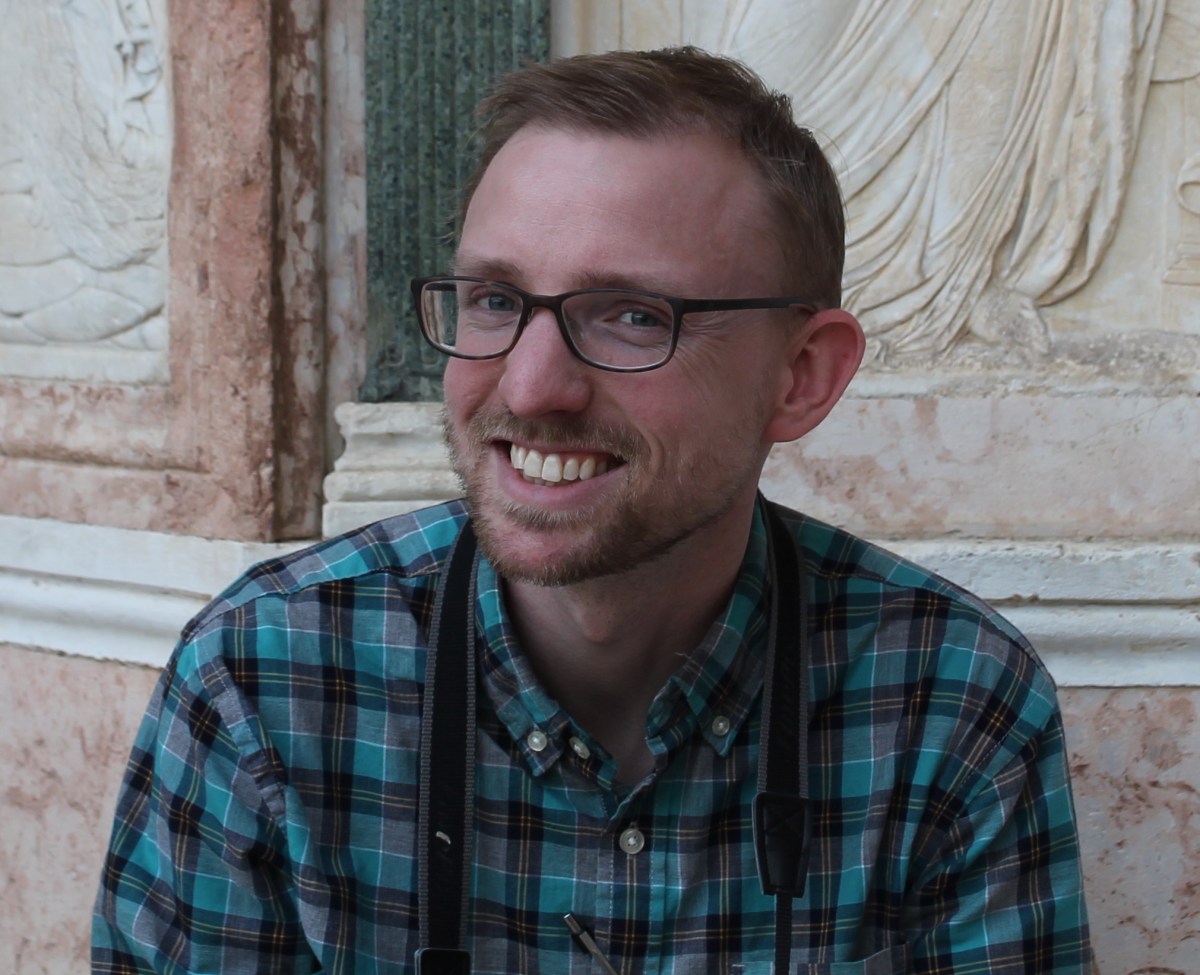
Q&A With David Erik Nelson

David Erik Nelson discusses his latest story while answering questions about his inspirations, his history with our magazine, and the science fictional predictions he’d like to see stop coming true. Read “The Dead Letter Office” in our [September/October issue, on sale now!]

Asimov’s Editor: What is the story behind this piece?
David Erik Nelson: I tend to think of new story ideas while on vacation with my wife and kids, often while driving. On one particular winter break I came up with two. One was about a woman who, upon meeting her fiancée’s family (avid deer hunters, like her own single father), abruptly realizes that the thing she thought was “venison” all her life most definitely was not.
The other story was this one, which was really no more than the working title: “Children’s Letters to Satan.”  I asked my wife and kids (a grade-schooler and high-schooler) which I should write first, and they chose “Children’s Letters to Satan.”

AE: Is this story part of a larger universe?
DEN: Sort of. It’s probably more accurate to say it’s anchored in a sort of “private mythology” based on Jewish theology, folktales, Kabbalah, topology, and n-dimensional physics. Other stories in this same mythos include “This Place is Best Shunned” (available from Tor.com) and my short novel There Was a Crooked Man, He Flipped a Crooked House.

AE: Do you particularly relate to any of the characters in this story?
DEN: Yeah. I particularly identify with both the protagonist (Patrice) and her friend (LeCharles). That might seem odd, as they are very different—in race, gender, attitude, where they are in their lives—but they’ve both survived similar trauma, and arrived at very different places. I think that’s sort of reflective of how I personally struggle with what the appropriate moral response is to people who do Very Bad Things™.

AE: What is your history with Asimov’s?
DEN: My first major sale was to Asimov’s, a short steampunk story titled “The Bold Explorer in the Place Beyond.” This was back in the days of paper submissions, and I recently found the acceptance letter from Sheila Williams, which I love.  It only runs about three sentences, and two of them read as follows:

“There is much that I absolutely love about this story, but I can’t get myself past Dickie drinking the alcohol off the mud and turds etc. I wouldn’t mind looking at slightly toned down version, but, whatever you decide to do, I am very much looking forward to seeing your next story.”

I kinda feel like that’s my writing career in a nutshell.

AE: What inspired you to start writing?
DEN: I don’t know about what inspired me to start, but I know two things that made me keep with it, even though it’s often hard:
One was that, when I was a kid, working on a story was extremely soothing. The activity of typing on my old off-brand IBM “clicky” keyboard was by itself hypnotic, and that helped. But more importantly, after I was done writing for the day, my head would feel clear and orderly. Writing was the first form of self-medication I ever discovered.  
Second was in high school, after I finally submitted a story to my high school’s literary magazine. They published it, and I discovered a fundamental truth: if I wrote stories and published them, then girls I didn’t even know would want to talk to me. I wasn’t a cool kid, and I was an increasingly anxious and troubled one by that time. Meanwhile, the kind of girls who wanted to talk to you because they read a story like this one, those were definitely the kind of people I wanted to be around.
And so here we are.


Writing was the first form of self-medication I ever discovered.  


AE: How much or little do current events impact your writing?
DEN: An awful lot, frankly. I think that’s sorta obvious in this particular story (which is pretty clearly set around 2020, and namechecks pandemic measures, civil unrest, and the whole rest of the American mess of that period). But even when they aren’t right on the surface, current events are usually exerting a powerful gravitational pull on my work. A lot of what is happening in the world is scary, and a lot of how I come to grips with scary things is through scary stories.

AE: What other projects are you currently working on?
DEN: I’m currently in the midst of revising a cosmic horror novel titled The Giftschrank. Although it’s not directly connected to this story, they do share thematic elements and that same “private mythology” (let’s call it “The Cantorian Judeo-Cthuloid Mythos”).

AE: What SFnal prediction would you like to see come true?
DEN: I have no clue. At this point, I’d sorta love it if William Gibson’s predictions stopped coming true. No offense, because I love Gibson as a human and adore his writing, but why did he have to be the guy who was spot on? Why couldn’t we get a fun future with Mr. Fusion-powered cars, ‘80s nostalgia restaurants, and everyone wearing double-neckties?

AE: What are you reading right now?
DEN: I just finished The Premonitions Bureau: A True Account of Death Foretold by Sam Knight, which is a fun nonfiction book about the intersection of psychology/psychiatry and ESP in the 1960s and the brief life of the British Premonitions Bureau.
On the fiction side, I’m in the middle of Victor LaValle’s latest horror novel, Lone Women (a historical set in the American West about a lone Black farmer and her Mysteriously Heavy Trunk leaving her predominantly Black farming community in California to homestead in Montana). I absolutely love LaValle (first got hooked by his Ballad of Black Tom), and this is shaping up to be his best book yet. 

AE: Do you have any advice for up-and-coming writers?
DEN: It’s trite, but seriously: write every day, read every day. Every successful writer I know writes every day, and every writer I’ve ever known or heard of who’s tried to buck this advice eventually comes around to doing it. (Incidentally, that includes me: I didn’t think I need to read everyday and write everyday, either—you know, because I’m so damn special and different and artistically unique. *sighs* 🤦‍♀️)
Buck up: it’s the 21st Century. Everyone you see every day has immediate access to all the best writing in human history. If they’re going to read your story, it has to be because they have reason to think doing so will be a better experience then re-reading whatever it is they already know and love. You’ve got to give them something that Atwood, Austin, Butler, Dickenson, Hughes, King, Shakespeare, Yeats—whoever—doesn’t.
Elite athletes train every day. Ballet dancers—even the “nobodies” in the chorus—practice every day. If you wanna be in the show, you’d better do likewise.

AE: How can our readers follow you and your writing? (IE: Social media handles, website URL . . .)
DEN: I can be found online at www.dave0.com (where you can read more of my work in the Free Fiction section: https://www.dave0.com/FreeFiction/ ). If you sign up for my newsletter ( http://eepurl.com/IZckf ), you’ll gets a heads up about new work, as well as some exclusive stories. I get my social media fix on Mastodon (https://a2mi.social/@dave0), and am always happy to kibbitz with new folks there.


David Erik Nelson is an award-winning Jewish author from the Rustbelt Midwest. Over the past 20 years his stories have appeared in Tor.com, Asimov’s, The Magazine of Fantasy & Science Fiction, The New Voices of Science Fiction, Best Horror Of The Year, and elsewhere. He’s written two DIY books, several hundred reference articles, almost a dozen textbooks, at least a million words of technical and commercial copy, and the short novels There Was a Crooked Man, He Flipped a Crooked House and There Was No Sound of Thunder (available in Autumn 2023). Find him online at dave0.com

Q&A With Kofi Nyameye

Kofi Nyameye is a writer and evangelist from Accra, Ghana, and his writing often explores different aspects of human nature. His latest work for Asimov’s presents a unique twist to an old Bible story. Read “The Pit of Babel” in our [September/October issue, on sale now!]

Asimov’s Editor: What is the story behind this piece?
Kofi Nyameye: “The Pit of Babel” started out as an idea I wrote down in one of my journals around seven or eight years ago. The working title at the time was “Dig,” and it was originally going to follow the last remnants of humanity digging a giant pit to the center of the earth for some reason or other. I thought it’d be cool to jump from character to character and chronicle the infighting and sabotage that would inevitably happen.
So I wrote the idea down and then completely forgot about it for several years, but then . . .

AE: How did this story germinate? Was there a spark of inspiration, or did it come to you slowly?
KN: . . . one day I was reading the Bible and I came across the story of the Tower of Babel, and I remembered the idea I’d had several years before. I asked myself what would happen if instead of building a tower to Heaven, mankind built a tunnel into Hell? What would happen if I completely turned that story on its head? And it just built itself from there.

AE: Do you particularly relate to any of the characters in this story?
KN: I don’t know if I’d say I relate to him, but I absolutely love the character of Lucifer. (And okay, maybe I relate to him just a little bit.)
I’m a Christian and an evangelist, so you wouldn’t think I’d say that about the devil, but this is one of the few times that a character has shown up in a story and just absolutely taken over the whole thing. I particularly loved exploring his pride. Look, the Bible’s been written, right? From a Christian point of view, you’d think the devil would know by now that he loses in the end. So why does he continue to do it? That was interesting to dive into.

AE: Are there any themes that you find yourself returning to throughout your writing? If yes, what and why?
KN: My answer to this question changes, depending on where I am in my life and my creativity. Right now if you pushed me for an answer, I’d say “human nature.” A lot of the stories I’m writing right now are in a way trying to answer the question “Why are we the way we are? Why do we do what we do in spite of overwhelming evidence that it is a bad idea?”

AE: How much or little do current events impact your writing?
KN: Almost never. I’ve tried. It comes out sounding false and forced. Most of those stories, I never finish.

AE: What is your process?
KN: I always start with a first draft that’s overlong and quite meandering. I sit down with an idea, and the first draft is me discovering for myself what kind of story fits the idea. Mind you, that doesn’t mean the draft I’ve written is that story. It’s just how I discover what the story should be.
In the second draft, I rewrite the whole thing and come out with a story that makes sense and has all its logic, character arcs, etc. in order.
Then I do like four to five drafts after that where I edit and tweak till the story flows as smoothly as I can get it to. Then at that point I just have to let it go.


I feel like as a species we would be wise to slow down a little, instead of speeding up even more.


AE: How do you deal with writers’ block?
KN: Ha! I’m still working on it. I’m trying to learn to keep showing up anyway.
Talking through the block with a couple (trusted) storyteller friends also helps.

AE: If you could choose one SFnal universe to live in, what universe would it be, and why?
KN: I only just read Children of Time by Adrian Tchaikovsky earlier this year, and I feel like Kern’s World would be fun to live on for a bit. Not sure about staying permanently, though.

AE: What SFnal prediction would you like to see come true?
KN: Almost none of them. Maybe space travel. Aside from that, almost none of them. I feel like as a species we would be wise to slow down a little, instead of speeding up even more.

AE: What are you reading right now?
KN
: Atomic Habits, by James Clear. I know, I know: took me long enough. But here’s the thing: I’ve been dealing with a deep depression for the past couple of years, and it really slowed down my writing to the point of pretty much stopping it entirely. This book’s helping me get back into the consistency of writing and just showing up for my life in general.
Honestly, it feels really good. And isn’t that just a great place to end this?


Kofi Nyameye is a writer, evangelist, and unrepentant digital hermit. His work has appeared in Asimov’s, The Manchester Review, Science Fiction World, and the Best of World SF: Volume 1 anthology, edited by Lavie Tidhar. He lives in Accra, Ghana.

Q&A With Lisa Goldstein

We spoke to Lisa Goldstein about her lengthy writing background and delved into a number of other topics along the way, including her love of Ursula K. Le Guin’s Earthsea universe, and why she enjoys writing about magic in the real world. Read her latest Asimov’s story,”In the Fox’s House,” in our [September/October issue, on sale now!]

Asimov’s Editor: How did this story germinate? Was there a spark of inspiration, or did it come to you slowly?
Lisa Goldstein: The story started when a friend of mine told me about videos online that showed foxes jumping on trampolines in people’s backyards.  Foxes can be tricky or untrustworthy in the old tales, so I wondered what those foxes were up to.

AE: What is your history with Asimov’s?
LG: I’ve sold stories to Asimov’s nearly from the beginning, to Shawna McCarthy, Gardner Dozois, and now to Sheila Williams. All of them knew a lot about editing and gave me great feedback. If any of them rejected a story I was pretty sure there was something wrong with it, and I’d continue working on it or, sometimes, put it away to look at later.

AE: Are there any themes that you find yourself returning to throughout your writing? If yes, what and why?
LG: I like to write stories about magic in the real world, where there’s a possibility of something astonishing or mysterious just around the corner, in a place you’ve passed a hundred times before. And I like showing what happens when the borders between the two worlds become blurred, and what that does to the main character, if it frightens them or changes them or makes them understand something important.

AE: How do you deal with writer’s block?
LG: Not easily. I once read a piece of advice to writers that helps every so often: Pretend you are writing a letter to an author you admire, explaining your problem and asking for solutions. Of course you will never send this letter; instead it’s a way of putting yourself into the mindset of someone who has solved the kind of difficulty you find yourself in. Once I was having trouble with the plot of a novel and I addressed a letter to Nancy Kress, someone who I think is brilliant at plotting. A long time later I told her what I’d done and she said, “Well, you owe me a letter now!” The letter was long gone, though, and it was so filled with despairing cries for help that I could never show it to anyone.

AE: How did you break into writing?
LG: I wrote a short story, and a friend of mine told me I should turn it into a novel.  So I wrote the novel, which became my first book, The Red Magician.  I sold it to the second editor I sent it to, Ellen Kushner, who was at Pocket Books at the time. 
Beginning writers usually hate this story because it seemed so easy for me.  I want to assure them that my career was just as rocky as most people’s.  For example, after writing a novel I couldn’t figure out how to write a short story for a long time.


I like to write stories about magic in the real world, where there’s a possibility of something astonishing or mysterious just around the corner, in a place you’ve passed a hundred times before.


AE: What inspired you to start writing?
LG: I can’t remember when I started wanting to be a writer.  Maybe it was when I read my first book.  Creating an entire world out of your head seemed the coolest thing anyone could possibly do.  It turned out to be a lot harder than I thought, though.  When I was in college I took a summer between classes to do nothing but write, and I went stir-crazy.  Did people really lock themselves in their rooms with only a piece of paper for company?  (This was before computers.)  But after a while I started to like it.

AE: If you could choose one SFnal universe to live in, what universe would it be, and why?
LG: Two choices, at opposite ends of the spectrum: I’d like to live on one of the islands in Ursula Le Guin’s Earthsea. Not only would there be the possibility of seeing dragons and wizards and magic, there’s also daily life, which in Tehanu seemed slow but fulfilling: herding goats and spinning their fleece, planting and growing crops, visiting your neighbors, telling stories by the fire, and every so often consulting with the local witch about the weather or an illness. My other choice is about as far away as you can get from that, Iain Banks’s Culture, a technological utopia where AIs fulfill most of your needs, there are amazing scientific breakthroughs, and you’re free to do whatever you want, including exploring other planets and societies.

AE: What are you reading right now?
LG: I’m amazed by the number of terrific women writers working today: Tamsyn Muir, Arkady Martine, Ann Leckie, Rebecca Roanhorse, R. F. Kuang, T. Kingfisher.  There’s a lot more of them than when I started reading sf, so I’m spoiled for choice.  I’ve also been reading Adrian Tchaikovsky.  It took me a while to pick up one of his books because of two words—“giant spiders”—but I like what I’ve read so far.

AE: Do you have any advice for up-and-coming writers?
LG: To start with, there are no shortcuts.  You have to sit down every weekday to write, even if you’re blocked.  Read pretty much everything and study how an author pulls off something particularly brilliant or, conversely, figure out why the story you just read is particularly terrible.  Imitate the good ones until you understand more about style, then stop imitating.  Write about things that excite you or anger you or scare you instead of just following a trend or writing for a market.  Write the stories you feel need to be told, the stories only you can tell.  Have fun—if you’re bored, the reader can tell.  Oh, and get an agent.

AE: What other careers have you had, and how have they affected your writing?
LG: I’ve worked in bookstores a lot.  It hasn’t helped my writing that much, except for allowing me to get books at a discount, which let me read widely in a lot of genres and research topics I was interested in.  Also, people who work in bookstores are usually quirky and idiosyncratic, and know an impressive amount about weird subjects.
I’ve also taught at Clarion and other places.  It sounds like a cliche, but I learned about as much from the students as I taught them.

AE: How can our readers follow you and your writing? (IE: Social media handles, website URL . . .)
LG: Website: brazenhussies.net/goldstein
Blog: lisa_goldstein.dreamwidth.org


Lisa Goldstein’s latest novel is Ivory Apples, from Tachyon Press. Her other novels include The Red Magician, which won the American Book Award for Best Paperback, and The Uncertain Places, which won the Mythopoeic Award. She has also won the Sidewise Award for her short story “Paradise Is a Walled Garden.” Her stories have appeared in Ms., Asimov’s Science Fiction, The Magazine of Fantasy and Science Fiction, and The Year’s Best Fantasy, among other places, and her novels and short stories have been finalists for the Hugo, Nebula, and World Fantasy awards.

Q&A With Robert Reed

Check our interview with Robert Reed, an author who is no stranger to our pages. Here we discuss his writing history, his relationship with Asimov’s, and how he came up with the title of his latest story, “What>We>Will>Never>Be,” which you can read in our [July/August issue, on sale now!]

Asimov’s Editor: How did the title for this piece come to you?
Robert Reed: “Excavations” was my working title. The story existed for years as an empty folder on my Google Docs cloud—one of those maybe-projects that the author wants to get to eventually, but not today. The general idea was that an alien gentleman lived alone inside an unusual apartment. I didn’t know why he was alone or what made his home valuable, but one of the Great Ship’s rulers wanted to acquire that property for themself. And that ruler happened to be an !eech, which is why this could be a compelling tale.
The Great Ship is the linchpin of my professional life. Marrow and The Well of Stars are two novels about the world-sized starship, written more than two decades ago and both still in print. The Well ends with the !eech taking control of the mangled Ship, and “Excavations” was to occur hundreds or thousands of years later. I didn’t yet know how much later, and for that matter, I had no idea what an !eech was or what they might want with a harum-scarum’s abode.
Infinite sagas are exactly that. Boundless. The Great Ship will never be fully explored, and the multitudes living onboard will largely remain unnamed and unappreciated. But I did eventually figure out the !eech, at least well enough to write about them. In early 2022, I began three Great Ship novellas, each attempting to cover events just before and a little while after the !eech takeover. “Excavations” was the title for the first two drafts, and while a lot of work remained—most of the plot and action sequences weren’t obvious to me—the two habitats had very respectable names. “What>We>Will>Never>Be” was a typographical nightmare to produce on command. But it so perfectly fits the mood that I was trying for, familiar words bracketed what might be greater-than signs. Though I suspect that a more thorough translation would be more elaborate and beautiful than what weak little English can manage.

Twenty thousand word stories are probably my strong suit. Which helps and hurts. It helps because I can solve my writing problems without having to pound together a string of 100,000 word books. But it hurts because there were never many novella markets when I was starting in this business, and the situation has only gotten more dire. I’ve sold two of the novellas that I wrote last year. One way or another, the third story will be published, if in a slightly smaller form. But I’m well aware that when I do make a sale, a younger author loses their place in the table of contents.

AE: What is your history with Asimov’s?
RR: I have a long, enjoyable relationship with the magazine. More than thirty years, which includes several Hugo nominations and one Hugo win—for a novella, of course. “A Billion Eves.”


AE: What other projects are you currently working on?
RR: I consider myself semi-retired. Yet most mornings are spent working on something. For instance, last week and next week, and maybe until the end June, 2023, I’m building a series of collections to put up on Kindle. The first volume will be called The Esteemed and Strange Love. “The Esteemed” is another Reed novella first published in Asimov’s. It’s wrapped around a Ted Talk that I’ll never give, the 15 minutes where I name and define the five grave threats to civilization on the Earth, and perhaps to intelligence across the universe. The Strange Love portion will contain R. Reed stories about nukes running amok and other civilization-ending wars. Winter Dies is global warming. Polishing the Seed are my gene-engineering tales. Uncannies refers to the “uncanny valley” phrase that I keep seeing on the Web. You know, about AIs. And finally, two volumes about ETs that are with us and removed from us. About Us and On the Brink of That Bright New World.
By my count, I’ll republish around 700,000 words in five epub editions.
Which is probably not even one-fifth of my lifetime output.


“What>We>Will>Never>Be” was a typographical nightmare to produce on command. But it so perfectly fits the mood that I was trying for, familiar words bracketed what might be greater-than signs. Though I suspect that a more thorough translation would be more elaborate and beautiful than what weak little English can manage.


AE: Do you have any advice for up-and-coming authors?”
RR: First: “Up-and-coming” is a cliche, and it’s also a warning. All these years, and I feel like an “up-and-coming” writer. I’m always trying to prove myself, if only to myself. When I can’t do this anymore, I will retire, and the world will likely be a better place for my refusal to string words together.
Second, on the topic of stringing words together. Let’s mention large language models. Which aren’t AIs, but that doesn’t keep them from being profound and unsettling. Their sudden appearance in the public mind is one more proof that we live inside a science fiction universe. But this is a shared universe populated with many up-and-coming authors, each genius wanting to raise the stakes with every new work. Nukes. Climate change. Pandemics and UABs. Who knows what comes next? I sure don’t. But I have strong doubts that writing will survive long in its current form. I halfway expect Amazon to eventually fire all of its human authors, including me, employing large language models that have read and mastered the millions of works already available on the Kindle platform. This won’t happen tomorrow. Probably not. But eventually, there will be meetings with coffee and doughnuts, and teams will be assembled to plan this kind of apocalypse.
And my third attempt at advice: I was a youngster in my twenties, and I hadn’t sold shit. Writing meant a typewriter and ribbons, and in the earliest days, carbon paper to make your only copy. My brother came to visit, and I showed him what I was doing with my evenings. On a board covered with hexagons, I was the Wehrmacht invading the Soviet Union, and I was the Siberian reinforcements defending Moscow from the Nazis. Both at once, and it was great fun.
My brother, who was never shy about offering advice, suggested that I stop playing games and spend more time writing. But that’s a deeply mistaken attitude common to nonwriters. I was in the throes of something huge, imagining two great forces clashing on an epic landscape. In that case, it was the Germans and the Russians. How do they move, how do they survive? And my main goal? I wanted to find the best possible outcome, which was both sides being exhausted and useless, allowing room for something a little better to come into the world.


Robert Reed is a prolific, Hugo Award-winning science fiction author whose work appears regularly in Asimov’s and F&SF. He is from Nebraska and holds a Bachelor of Science degree in biology.

Q&A With Stephen Case

Get to know author and historian Stephen Case in this insightful interview that touches on space opera, good writing habits, and taking advice from Stephen King and Ursula K. LeGuin. Don’t miss Case’s latest Asimov’s story, “Sisters of the Lattice,” in our [July/August issue, on sale now!]

Asimov’s Editor: What is the story behind this piece?
Stephen Case: I’ve always loved space opera. I wanted to play with a galaxy-spanning narrative and wondered if I could capture an epic feel in a short story. I’m also fascinated by religious orders and how their members’ vows shape their lives. I wanted to explore that in a science fiction setting, somewhat along the lines of Marie Doria Russel’s The Sparrow.

AE: How did this story germinate? Was there a spark of inspiration, or did it come to you slowly?
SC: “Sisters of the Lattice” had a germination period significantly longer than most of my stories. I wrote an early draft pre-pandemic, which grew into a novel draft, which ultimately didn’t go anywhere. I ended up almost completely re-writing the original for this final version. It got taken apart and put back together several times, but I kept coming back to images of the sisters, the Lattice, and their planet of ice.

AE: Is this story part of a larger universe, or is it stand-alone?
SC: There’s more to tell. I’ve finished a story set on the Decalogue during the years of the Long Retreat, and hopefully readers will get a chance to see it soon.

AE: How much or little do current events impact your writing?
SC: At least consciously, I would say they don’t impact it much. It was a bit surreal, however, to be working on this piece as the COVID pandemic got underway. I was in the early phases of revision as everything was shutting down, which definitely lent poignancy to working through a story of the galaxy gradually going dark and planets being isolated from each other.

AE: What is your process?
SC: I tend to do most of my drafting longhand. My job has me at a screen most of the day, so I prefer to write first drafts of stories in notebooks. Usually I write in the mornings and evenings, with most revision happening in the mornings before I go to work. Writing longhand means the additional step of transcribing, but that becomes the first iteration of editing. I usually go through a piece four or five times before sending to markets.

AE: What other projects are you currently working on?
SC: My fiction usually comes in bursts; I just finished a few short stories, one of which is forthcoming in Clarkesworld. My larger projects at the moment are non-fiction: I’m revising a manuscript for a book about the nineteenth-century British polymath John Herschel that I wrote for University of Pittsburgh Press, and for the past year I’ve been working as co-editor for Cambridge University Press on the Cambridge Companion to John Herschel. An article I wrote on Herschel and why he’s so important is due out in the June issue of Physics Today.

AE: What are you reading right now?
SC: I just finished Shaun Bythell’s The Diary of a Bookseller and the two volumes that followed and couldn’t put them down. If you’re cranky and love books, I highly recommend.

AE: Do you have any advice for up-and-coming writers?
SC: Read and write a lot. Read some books on writing as well. Stephen King and Ursula LeGuin are particularly helpful.

AE: What other careers have you had, and how have they affected your writing?
SC: A writing mentor told me early on to find a career that could support the writing habit. I would add to that advice to make that a career that involves writing, if possible. I was writing my dissertation at the same time that I wrote my first novel, and almost every day I’m working on a book chapter, review, or article for my “real” job. As best as I can tell, this doesn’t exhaust the writing faculties but rather strengthens them. And teaching (I teach physics and astronomy) forces me think about how to explain things more simply or using analogies and to consider my audience, which I hope shapes how I write.

AE: How can our readers follow you and your writing?
SC: I’m fairly inactive on social media, though I tweet occasionally @StephenRCase and about my research projects @Herschels_Astro. The best place to find info on my writing is at www.stephenrcase.com. You can also join my mailing list there, where I send very occasional updates about new publications.


Stephen Case is a writer and a historian of astronomy living and working in Illinois. He has published over forty short stories in places like Beneath Ceaseless Skies, Shimmer, and Orson Scott Card’s Intergalactic Medicine Show, and his non-fiction has appeared in Physics Today, Aeon, and American Scientist. His novel First Fleet (Axiomatic Press) is Lovecraftian horror meets military sci-fi.

Crossing Bridges

by Sean Monaghan

Will advanced AI allow humanity to flourish in unexpected ways, or will it cast its creators aside? Sean Monaghan considers this question in the blog post below, as well as in his latest short story, “Bridges,” available in our [July/August issue, on sale now!]


When I first drafted “Bridges” the concept of AI—Artificial Intelligence—had been around for a long time, and there were inklings of it beginning to slip into the mainstream. I’d been fascinated by the “This Person Does Not Exist” image-generating page, with competitive AI systems creating an image that looked photographically like a person, but was really an amalgam of elements of faces from a huge database.

In the time since I completed the story, AI has become far more mainstream. ChatGPT apparently gained 100 million users faster than Instagram or TikTok. People are using it daily. Businesses are using it, and other similar systems, to analyze data, respond to customers and develop plans.

There are plenty of commentators more qualified than I am about the subject. I imagine that some of them are even AI themselves.

One of my favorite comparisons was discussing whether the advent of AI would be like the printing press or the atomic bomb. Is this a boon or the end of civilization as we know it? Star Trek or Terminator?

With my story, I started looking a long way out. More than decades, probably more than centuries. AI is still around, and imperfect, but we humans are but a sideshow.

Perhaps you, or someone you know, puts out seeds or sugar water for the birds? On my morning constitutional I sometimes see a woman going around with a can of cat food, gifting spoonfuls for strays.

These animals would do fine without us, but we feel good helping them. That’s my take, at least for this story, on AIs in the future. Humans would do fine, but AIs toss us the equivalents of seeds and spoonfuls of canned food.

And the AIs are not quite right. They’re not particularly benevolent, nor malevolent, nor are they human. They’re something else.

They look at the world a certain way, that’s not quite the way that we would look at it. 

Much of the discussion I’ve seen seems to fall into two camps. Those who see job losses and, even, human redundancy. And those who see opportunity. Ways to free up the mundane drudgery of much of human existence.


And the AIs are not quite right. They’re not particularly benevolent, nor malevolent, nor are they human. They’re something else.


Creative people who see opportunity in the way that AI can create visual art, music, even writing. Perhaps not finished works, but works that stimulate new avenues of creativity.

That’s exciting.

There are many who note that what we have at the moment ought not to be considered genuine “artificial intelligence,” but more networks with a simple nature: very large language models. They’re smart enough to analyze vast bodies of data and recreate unique and clever outputs that seem reasonable and useful, but they’re not yet reasoning nor empathetic nor lateral enough to be anything more that very clever computers.

Of course, it’s early days.

Looking ahead through the mists of time, I wonder. Could Gutenberg have imagined what impact the printing press might have? Could those first clever souls who thought of connecting a couple of computers across campus have imagined the very power that the internet wields over our lives now? Could the person who put an axle through the center of a circular slab of wood have had any vague inkling of the pivotal impact that would have?

I suppose the metaphor of the title of my story—”Bridges”—is in looking for a link between our very human kind of intelligence and the very non-human kind of intelligence that may well be arising around us as we, perhaps, play with fire.

The world has always been changing, from letting wheels free us from dragging stuff through the dirt, to the idea of farming, or the invention of boats. I smile at the thought that cameras went from expensive, huge, delicate things in the hands of a few, to virtually all of us having them in our pockets, filled with more images than we can ever effectively deal with.

Science fiction posits possible futures. Sometimes they might be right. Sometimes way off.

I hope that we can cross our way through this next big change safely, but within that, I hope that I’ve written an entertaining and engaging story.


Sean Monaghan studied physical geography and geology, but often only notices once he’s completed a story just how much landscape has ended up playing a role. Previous stories in Asimov’s have featured volcanic calderas, tepuis, and ventifacts. His latest SF book is Dead Ringers from his Captain Arlon Stoddard universe, with the next, Tramp Steamers, due later in the year. He’s currently wrapping up his Karnish River Navigations series (more landscapes!), with the final two books due in 2024.

Karawynn Long on Autistic Representation

Author Karawynn Long shares her experience as an Autistic person and discusses the ways Autistic people are beginning to make their voices heard in blogs, essays, videos, and literature. Read Long’s latest story for Asimov’s, “Hope Is the Thing With Feathers,” in our [July/August issue, on sale now!]

“Hope Is the Thing With Feathers” exists because in late 2019, mere months before my fiftieth birthday, I accidentally discovered that I’m autistic.

I managed to reach age forty-nine without the slightest clue to this important fact about myself because for decades the academic study of autism has been dominated by non-autistic researchers who began with erroneous assumptions about the condition and conducted their research unscientifically and through a biased lens. The result has been widespread circulation among psychologists of non-representative stereotypes and flatly inaccurate information; those in turn have been magnified and perpetuated—again by non-autistics—in popular media.

I was able to celebrate my fiftieth birthday as a self-aware Autistic person only because, in the last decade or so, authentic Autistic voices have gotten significantly louder. The number of first-person blogs, essays, books, podcasts, and social media posts has exploded, both driven by and driving a veritable tsunami of adult epiphanies. A whole cohort of self-aware Autistic research psychologists have entered the field, particularly in the UK, and their publications have begun shifting the academic conversation in a more accurate direction.

My first clue came from an unexpected quarter—a podcast episode which told the story of a woman very much like myself who went looking for help for her anxiety and—surprise!—ended up discovering she was autistic. I responded to this information in (what I now realize is) the most autistic way ever: by hoovering up absolutely every piece of information about autism that I could find. I quickly became aware of the vast divide between most of the academic literature and the lived experience of Autistic people, so my research leaned ever more heavily on memoirs and other first-person accounts.

In the beginning, I gravitated toward experiences and presentations that were similar to my own, but eventually my curiosity grew to encompass the experiences of autistics whose situations are very different. My particular version of autism came packaged with hyperlexia; I learned to both speak and read at a precocious age. But there are others who have almost the exact opposite experience.

So I sought out stories from autistic people who experienced various sorts of profound communication challenges. Some autistic kids are simply delayed: they don’t speak at all for many years, but eventually develop spoken language indistinguishable from non-autistic children. Others have “unreliable speech,” where they have imperfect mental control over the words and sounds they utter. And still others have verbal apraxia, a brain-body disconnect that impedes their ability to shape their mouths in the intricate ways required for speech. These challenges are often accompanied by full-body dyspraxia or apraxia, an experience that at its most severe might be likened to being “locked-in,” except that one’s body is not inert but acts in unexpected ways and contrary to one’s wishes.


I was able to celebrate my fiftieth birthday as a self-aware Autistic person only because, in the last decade or so, authentic Autistic voices have gotten significantly louder.


In these first-person accounts—blog posts and videos and published memoirs —a pervasive and tragic pattern emerged. Autistic teens and young adults described living without any way to communicate, often for a decade or more, while the adults around them mistook their lack of coherent speech for lack of intelligence. Kids who felt frustration and shame every time someone spoke about them as stupid, who were in terrible pain but had no way to explain the problem, who could read fluently but were forced to repeat the same basic alphabet drills for years. So much creativity left fallow, so much curiosity left to wither—it was horrifying to imagine. And these were the voices of the few who’d been offered a way out of the endless silence. How many more never get that chance?

In the wake of this awareness, I reached out to a former coworker—someone I liked and respected—who had just posted to social media about his challenges with his nonspeaking autistic daughter. I wrote and expressed sympathy for his difficulties and offered to share my insights and suggestions for a way to proceed that didn’t involve institutionalizing her. We corresponded in detail for about three months.

By the time I started talking to my friend about his adopted daughter, his family had already been living with the situation for almost a decade. He had very entrenched ideas about who his daughter was, and what her capabilities were, and my perspective challenged that narrative. He seemed open and grateful when we began our dialog, but ultimately he told me that what I had to say produced too much “cognitive dissonance” for him, and he rejected my viewpoint and my advice.

My heart broke: for him and the rest of his family, but most of all for this girl I’d never met. From his stories and descriptions it was obvious to me (though not to him) that she was in frequent and severe physical and emotional pain, and it was equally clear that without intervention, her circumstances would only deteriorate. It gutted me that I couldn’t do more to help her.

After a few months of sheer empathic agony, I attached myself to a new goal: to share something of the experience of nonspeaking Autistics with people who would not ordinarily encounter it, thereby doing some small part to push back against the misinformation and misunderstanding. A character voice coalesced in my mind, synthesized out of the memoirs I’d read and my own autistic experience.

The study of intelligence among non-human animals has been another long-term fascination for me, and I drew on that knowledge to create the Bird Lab and its psittacid and corvid denizens. (Being an autistic fiction writer is extremely satisfying when you can take two unrelated ‘special interests’ and combine them into something that feels greater than the sum of its parts.)

Because portraying a realistic character was my paramount aim, I hired two nonspeaking Autistic young adults to read and give me feedback on “Hope Is the Thing With Feathers” before I submitted it. One of them, Emily Grodin, is a poet and co-author of her own memoir, I Have Been Buried Under Years of Dust; I recommend it to anyone who is interested in a nonfictional account from a nonspeaking, dyspraxic Autistic. Other good books that I drew on include The Reason I Jump and Fall Down 7 Times Get Up 8 (by Naoki Higashida, translated by David Mitchell of Cloud Atlas fame), and Ido in Autismland (by Ido Kedar).

I had chosen to end the story with a quote from Ursula K Le Guin. My other nonspeaking reader, a young man named Otto Lana, told me (in email) that his feelings about “Hope” were summed up by a different Le Guin quote: “You cannot buy the revolution. You cannot make the revolution. You can only be the revolution. It is in your spirit, or it is nowhere.”

Which—because I admire Le Guin so profoundly, and because it is both what my character was doing in the story and what I was seeking to do with the story —might be the loveliest response I could ever hope for, from anything that I write.

Thank you to Sheila Williams for giving “Hope” an audience.

Karawynn Long lives in central Mexico with her partner and three cats, where she’s writing an epic science fantasy novel. She also writes personal essays at https://karawynn.substack.com/ and can be found on Mastodon https://wandering.shop/@karawynn

Q&A With Sam W. Pisciotta

Sam W. Pisciotta’s work has appeared in many other fiction magazines, but “Morning Glory” is his first piece for Asimov’s, and you can read it in our [July/August issue, on sale now!] To mark Sam’s Asimov’s debut, we spoke with him about his favorite novels, his love of Virginia Woolf and Ray Bradbury, and his decision to give “Morning Glory” story an uplifting ending.

Asimov’s Editor: How did this story germinate? Was there a spark of inspiration, or did it come to you slowly?
Sam W. Pisciotta: I read an article about children not spending enough time playing outside. The idea is that as children spend an overwhelming amount of their time indoors on phones and video games and televisions, they’re spending less time in their backyards and in their neighborhood parks. A result is an increasing number of kids who are afraid of (or at least uncomfortable with) bugs and birds and other forms of nature. Honestly, I don’t know if the argument holds water, but it got me thinking.
Daisy is afraid of everything, and I’ve put her in a situation where she’s forced to confront her fears. She instinctively reaches for the technology that brings her comfort. Ironically, technology is the big, bad wolf knocking at her door.

AE: This is a dark story that takes a positive turn. Can you talk a little bit about why you made that decision?
SWP: Sure. “Morning Glory” could easily have developed into a dystopian story, and readers might even expect a dark ending as they plunge into Daisy’s world. But I wanted this to be a story of hope. I love both nature and technology, and I spend a lot of time with both. I believe that humanity can find equilibrium on this issue, and the idea that technology can bring us closer to nature appeals to me.

AE: How did the title of this piece come to you?
SWP: “Morning Glory” plays off the nature of those blossoming flowers: They open with light; they attract pollinators; they’re both fragile and resilient. Morning glories are an apt symbol for a character who comes to see the world differently and a world transformed by technology in a positive way.

AE: What is your history with Asimov’s?
SWP: This is my first story in Asimov’s, but I’ve been a fan of the magazine for much of my life. I’m so proud to have “Morning Glory” take a place in Asimov’s long history of beautiful and thought-provoking stories.

AE: Who or what are your greatest influences and inspirations?
SWP: Three names come to mind—Ray Bradbury, Virginia Woolf, and Ken Nordine. I loved what each of them had to say, and especially how they expressed their thoughts. Although they spoke with unique voices, I find a common thread in their works: language is beautiful and powerful and, above all, fun. I inherited that from them, I believe.
Also, I’m a fan of horror and dystopian literature, but I very much love a happy ending. Mostly that’s what I choose to write. For that, you can blame my lifelong addiction to Star Trek. I believe the direction of evolution is upward.


“Morning Glory” could easily have developed into a dystopian story, and readers might even expect a dark ending as they plunge into Daisy’s world. But I wanted this to be a story of hope.


AE: So, if you could choose a science fiction universe to live within, you would choose the Star Trek universe?
SWP: Absolutely. A life of exploration in a society that values tolerance and respect for others. There’s so much hope for humanity in those stories. The Federation establishes a society that allows for the expression of the individual. It’s the best of both worlds.
And of course, transporters. As a person who habitually runs late, I really appreciate the idea of a transporter. Oh, and who wouldn’t want to take a turn on the holodeck?

AE: What are some of your favorite books?
SWP: To the Lighthouse by Woolf and Dandelion Wine by Bradbury for their beautiful language. I’ve really enjoyed Okorafor’s Binti series, Wells’ Murderbot Diaries, and P. Djèlí Clark’s books in the Dead Djinn Universe. One of my all-time favorite works is The Street of Crocodiles by Bruno Schultz. It blurs fantasy and reality brilliantly, and I’ve always considered it a masterpiece. More recently, I finished Anthony Doerr’s Cloud Cuckoo Land. What a read! It’s enthralling and utterly poignant. I admire the way the novel spans centuries but still ends with a splinter-sharp narrative focus.

AE: Do you have any advice for up-and-coming writers?
SWP: Read a lot of books, both fiction and non-fiction. Read poetry. Go to museums and art galleries. Talk to strangers. Walk through forests and sit on beaches. Every now and then, lie down and look up at the stars. Your creative soup requires ingredients.
Writing has always been an important part of my life. I remember writing stories for my mom when I was a kid. But I was older when I started writing seriously and with purpose. I sometimes wish I would have started writing speculative fiction sooner, but I was living life and gaining experiences that would eventually work into my fiction. The years have taught me the value of balancing hard work with daydreaming.

AE: How can our readers follow you and your writing?
SWP: You can follow me on Twitter and Instagram at /silo34. I’m also a visual artist, so you’ll find my artwork online, as well, particularly on Instagram and at my website: http://www.silo34.com.


Sam W. Pisciotta lives in Colorado. After years of difficult training in daydreaming and doodling, he now calls himself a writer and visual artist. Thousands of cups of coffee and hours of contemplation have prepared him to pull worlds from the ether. Sam is a member of SFWA, HWA, and Codex Writers. He holds a Master of Arts in Literary Studies from the University of Colorado. His fiction has appeared or is forthcoming in Analog, F&SF, Factor Four Magazine, and other fine publications. Sam’s award-winning artwork has been shown throughout Colorado.

Q&A With Garth Nix

We’re kicking off our latest series of blog posts with an interview featuring acclaimed author Garth Nix! Read on to find out how he started writing, whom he writes for, and what he believes is the best kind of writing practice. Nix’s latest story for Asimov’s, “Showdown on Planetoid Pencrux,” appears in our [July/August issue, on sale now!]

Asimov’s Editor: How did this story germinate? Was there a spark of inspiration, or did it come to you slowly?
Garth Nix: I had the two main characters in mind early on, and as is usual for me, they lurked there for quite some time before I started writing. I didn’t know a lot beyond that they were survivors of a lost war, and differently human, and it wasn’t until I started actually putting words down I realized I wanted to write it as an SF Western. Also part way through, when I needed some small genetically engineered animals, I was reminded of the character Eet from Andre Norton’s novels The Zero Stone and Uncharted Stars, so I named my eets after Eet, in an homage to one of my favourite authors from my childhood and teenage years.

AE: Is this story part of a larger universe, or is it stand-alone?
GN: This is a standalone story, or at least it is now. But I have a tendency to set up everything I write as if it could be part of something bigger, while still being satisfying on its own. It is quite possible I might revisit the characters and the setting in future stories.

AE: How did the title for this piece come to you?
GN: I usually come up with titles very early, sometimes before I write anything else. In this case, I wrote the first few paragraphs and knew it would be an “SF planetary adventure/Western” and so I wanted a kind of classic Western-style story title, and “Showdown” is such a good word, I had to use it.

AE: How did you break into writing? My first paid writing pieces were role
GN: playing game articles and scenarios (for D&D and Traveller) written in my teens, and then short stories. I had a great early start where I sold the first story I sent out when I was nineteen years old, but it was rather illusory, as I wrote maybe twenty stories over the next few years but couldn’t sell them, and in fact sold my first novel when I was 25 before I ever had another story published. But it is all good practice, writing a story is never wasted time, no matter what happens (or doesn’t) with that individual story.

AE: What inspired you to start writing?
GN: Reading. I started writing simply because I wanted to emulate the writers whose work I loved, I wanted to write stories like they did. This has largely driven my entire writing career, I want to write the kind of stories I want to read.


“…Writing a story is never wasted time, no matter what happens (or doesn’t) with that individual story.”


AE: What other projects are you currently working on?
GN: I usually have multiple projects underway. I am finishing a children’s dark fantasy/horror novel right now, which is scheduled for publication in 2024; and noodling away on an adult SF novel due out in 2025; and making notes for a fantasy novel in one of my existing series which if all goes well will be out in 2026. But I also have several stories partly written, and no doubt will finish them and start some new ones, and I have some screenwriting work as well.

AE: What are you reading right now?
GN: I read very widely across all kinds of fiction and non-fiction, but in terms of SF/F, I just read and enjoyed: Some Desperate Glory by Emily Tesh, and Unconquerable Sun by Kate Elliott. I also caught up with the third novel (which I’d never read) in Alexei Panshin’s highly entertaining Antony Villiers series from the 1960s, now collected with the first two in New Celebrations.

AE: Do you have any advice for up-and-coming writers?
GN: There is no writing advice that works for everyone. Try out different things, don’t take one approach as gospel. That said, if you have something out on submission, or have self-published, don’t sit around waiting for something to happen with acceptance or sales, get to work on something new. It will take your mind away from worrying about that past work, and whatever happens for good or ill, a new work will give you new opportunities. Every new story, book, play, poem, screenplay, gets you another spin of the wheel. You can’t make things happen, but every finished work creates possibility.

AE: How can our readers follow you and your writing? (IE: Social media handles, website URL…)
GN: @garthnix on Twitter
facebook.com/garthnix
http://www.garthnix.com


Garth Nix has been a full-time writer since 2001, but has also worked as a literary agent, marketing consultant, book editor, book publicist, book sales representative, bookseller, and as a part-time soldier in the Australian Army Reserve.

Garth’s books include the Old Kingdom fantasy series: Sabriel, Lirael, Abhorsen, Clariel, Goldenhand, and Terciel and Elinor; SF novels Shade’s Children and A Confusion of Princes; fantasy novels Angel Mage; The Left-Handed Booksellers of London and sequel The Sinister Booksellers of Bath; and a Regency romance with magic, Newt’s Emerald. His novels for children include The Ragwitch; the six books of The Seventh Tower sequence; The Keys to the Kingdom series and Frogkisser!

More than six million copies of Garth’s books have been sold around the world, they have appeared on the bestseller lists of The New York Times, Publishers Weekly, The Bookseller and others; and his work has been translated into 42 languages. He has won multiple Aurealis Awards, the ABIA Award, Ditmar Award, the Mythopoeic Award, CBCA Honour Book, and has been shortlisted for the Locus Awards, the Shirley Jackson Award and others.

Q&A With Ursula Whitcher

In this week’s blog post, we chat with Ursula Whitcher, whose latest Asimov’s story, “The Fifteenth Saint,” appears in our [May/June issue, on sale now!]. Read on to learn about what inspired “The Fifteenth Saint,” and discover how Whitcher balances her fiction career with her work as a mathematician.

Asimov’s Editor: What is the setting of “The Fifteenth Saint”? Is this story part of a larger universe, or is it stand-alone?
Ursula Whitcher: “The Fifteenth Saint” takes place on the far-distant planet of Nakharat. That’s the same setting as several of my other published stories, including “The Last Tutor,” which came out in Asimov’s in 2022. But “Fifteenth Saint” is set quite a few years earlier than “Last Tutor”: the characters and situations stand alone!

AE: What was the inspiration for this piece?
UW: The spark for this story is extremely erudite—maybe that’s fitting for a piece involving a judge obsessed with poetry! In his dissertation on the early modern Ottoman empire, Jonathan Parkes Allen describes a sprawling book written by a sixteenth-century Sufi mystic and equipped with a marvelous technology: an index. By consulting the index, a reader could find whichever piece of the holy man’s advice was most relevant to their specific problem. The book simulated the mind of the saint.
I loved the way Allen’s analysis highlighted the disruptive potential of the lowly index, a technology we take for granted. I also knew that my far-future Nakhorians were intensely suspicious of certain technologies—specifically artificial intelligence, which they viewed as destructive and amoral. I wondered how they would respond to a simulation of a saint.

AE: The protagonist of “The Fifteenth Saint” is named Sannali Emenev, but some characters call him Sani or Nalek. What’s with all the different nicknames?
UW: If Tolstoy’s characters can have a stack of different names, so can mine! But more specifically, the man Emenev is in love with calls him Sani, while Emenev’s family calls him Nalek. Nalek is the normal Nakhorian nickname for a boy named Sannali; Emenev’s family has used it ever since he was a little kid. Sani is a gender-neutral nickname, and by using it, Emenev’s friend acknowledges that Emenev’s approach to gender and sexuality is more complex than one might guess from his very conventional public presentation.

AE: It sounds like you do a lot of research for your writing. What’s the most surprising piece of research that went into “The Fifteenth Saint”?
UW: I learned that nobody manufactures snow tires for buses! I replayed the same thirty seconds of a news story on Montreal bus maintenance on a loop, watching city workers adapt tire surfaces for winter weather and imagining how the process would look different with lots more robots.

AE: The artificially intelligent book in “Fifteenth Saint” often quotes poetry. What’s your favorite poetic form?
UW: I’ve never met a poetic form I didn’t enjoy, from Latin hexameters to iamb patterns inspired by Yoon Ha Lee’s dystopian hexarchate. But one of the forms that has most fascinated me in recent years is the duplex, an English form involving cascading couplets that Jericho Brown invented after experimenting with ghazals. I first encountered the duplex in a poem that ends:

What’s yours at home is a wolf in my city.
You can’t accuse me of sleeping with a man.


AE: A fraught, queer relationship and hints of the supernatural—I can see why this poem resonated with you! What other poetry have you been enjoying recently?
UW: I really enjoyed Alycia Pirmohamed’s collection Another Way to Split Water, especially the poem “Meditation While Plaiting My Hair.”


There are ways in which fiction can feel more personal than math—but I never have to worry that a fictional lemma will be false!


AE: In an earlier interview, you mentioned Le Guin as an influence. What other science fiction writers are major influences on your work?
UW: When I was twelve or so, I read and re-read R.A. MacAvoy without knowing how to explain why: her books weren’t conventionally escapist in a way I recognized, and there were definitely pieces I was too young to understand. I think some of MacAvoy’s meditative approach from books like Tea with the Black Dragon seeps into “The Fifteenth Saint.”
On a more recent re-read of C.J. Cherryh’s Downbelow Station, I was startled by her invocation of “the Deep”! In Cherryh’s work, the Deep is the parts of the galaxy that aren’t well-traveled, while in the universe of Nakharat it’s a different kind of space that enables faster-than-light travel. But I unconsciously picked up on Cherryh’s use of the Deep for symbolic effect!

AE: Writing and submitting creative work can entail setbacks and heartbreak. Why do you keep doing this?
UW: I think I have a different take on this process than many newer writers because, in my day job, I’m a mathematician. The cycle of submission, rejection, and resubmission is broadly similar across disciplines. But when doing research mathematics, not only do you inevitably worry about whether your project will be popular, you have to confront the possibility that you might be utterly, incontrovertibly wrong. I spent three months last summer trying to count solutions to the same equation in three different ways and getting three different answers, and this is a story with a happy ending: I eventually figured out which of those numbers was correct!
As a PhD student, I spent a lot of time being scared, first that I would never prove an original result, and then that the first time was a fluke. But as I matured as a mathematician, I realized that every project had its share of confusion and uncertainty, as well as flashes of joy. I began to treat managing the swirl of emotion around research not as separate from the work, but as part of the work.
I took some of that acceptance of the swirl with me as I started to submit fiction for publication. There are ways in which fiction can feel more personal than math—but I never have to worry that a fictional lemma will be false!

AE: Can you tell us about some mathematics you’ve been enjoying lately?
UW: I loved playing with the tools on Gabriel Dorfsman-Hopkins’s website that offer ways to visualize arithmetic in the p-adic numbers. Individual p-adic numbers are familiar fractions, but the notion of distance for p-adics is very different from our usual ideas of what makes two numbers close together. These tools suggest different kinds of intuition—and they’re full of rainbows!

AE: Are there more Nakharat stories in the pipeline?
UW: Yes! I am absolutely thrilled to tell you that North Continent Ribbon, a collection of Nakharat stories including an all-new novelette, is coming out from Neon Hemlock Press in 2024. When you put all the Nakharat stories together, the society itself becomes a character, with its own sort of arc plot. I’m so excited to share that transformation with the world.

AE: How can our readers follow you and your writing?
UW: I’m on Twitter as superyarn and I’m yarntheory@wandering.shop on Mastodon. My website is yarntheory.net, and if you want updates about what I’m writing and publishing, you can subscribe to my newsletter at buttondown.email/yarntheory. I try to make sure every newsletter issue has at least one really good cat picture.


Ursula Whitcher is a mathematician, editor, and poet whose writing can be found everywhere from the magazine Cossmass Infinities or the anthology Climbing Lightly Through Forests to the American Mathematical Society’s Feature Column