

Lois Metzger makes her Asimov’s debut in our September/October issue with “The Great Game,” a fantastic science fiction story about “the damaging nature of false friendships, the healing nature of true friendships.” Get to know Lois in this informative Q&A, where we discuss her Queens upbringing, her connection to Samuel Delany, her advice for upcoming writers, and the board game that inspired “The Great Game”!
Asimov’s Editor: How did this story germinate? Was there a spark of inspiration, or did it come to you slowly?
Lois Metzger: Both a spark and very slowly! I’ve always been fascinated by friendships—the ones that last forever, the ones that feel doomed from the start. Only recently it came to me that a story about toxic friendships, the kind that entice you and you keep coming back for more even while you know you should stay away, might work best as science fiction. But I’ve been thinking about this story for years—the damaging nature of false friendships, the healing nature of true friendships.
AE: Do you particularly relate to any of the characters in this story?
LM: Yes, which surprised me. My main character is Cindy, a name I never use in fiction because my middle name is Cynthia (too close). Cindy was a kind of placeholder in early drafts, until one of the other characters called her “Cin,” which rhymes with “sin”—that felt right and so the name stuck. (Full disclosure: like Cindy, I own Birko-Flor Birkenstocks.) Also, one of the other characters blurts things out without thinking and then realizes she’s said too much. That happens to me more often than I’d like.
AE: How did the title for this piece come to you?
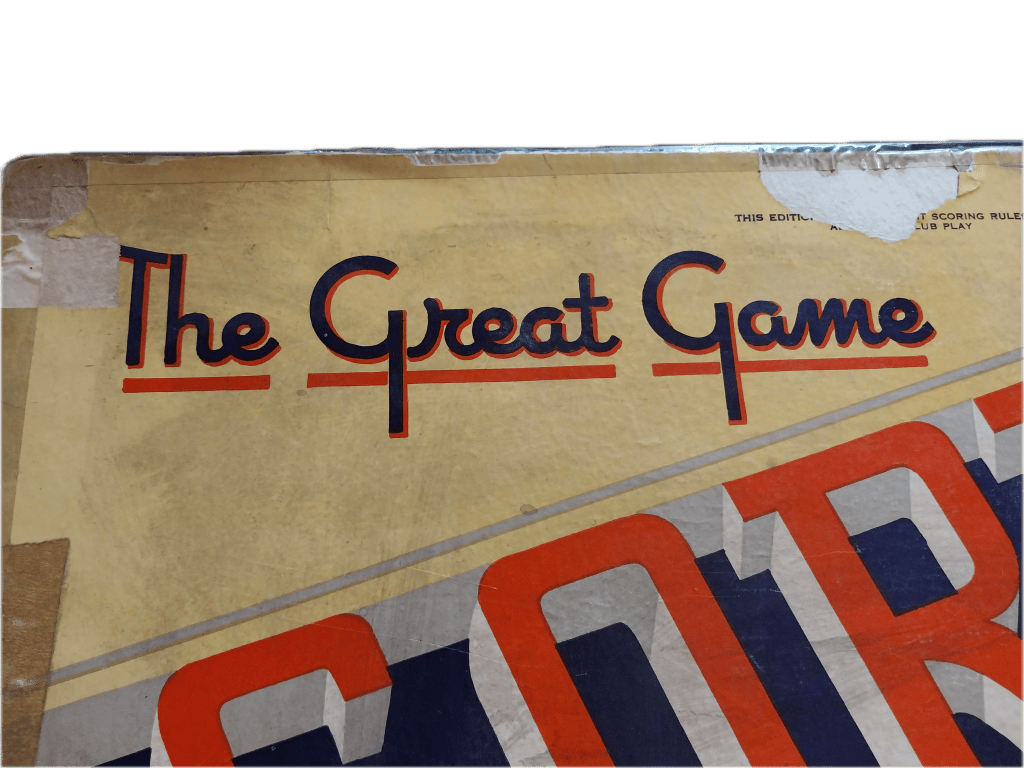
LM: Titles are tricky for me. Usually, I go through several before making a final decision, but in this case “The Great Game” was the first and only one. In the story, the characters play the board game Sorry! and I had a 1950s version of the game in a big rectangular box next to me the whole time I was working on it. There it sat, day after day, Sorry! Parker Brothers’ Trade-Mark Name for Its Slide Pursuit Game. Above the Sorry!, in unique, elegant, roundish sans-serif lettering, was the simple and confident declaration: The Great Game. Only later I found out the Parker Brothers considered this their masterpiece, even more so than Monopoly. Also, the title fits in terms of how the characters play mind games with one another.
AE: What is your history with Asimov’s?
LM: This is my first story in Asimov’s. Very proud! And grateful to the awesome Sheila Williams for accepting it.
AE: Are there any themes that you find yourself returning to throughout your writing? If yes, what and why?
LM: Mind manipulation—how do you get someone to do something they don’t want to do? In my fiction, I always have my main characters fall under the influence of forces internal or external (or both) and then act very much out of character. Nice people become not so nice. Easy-going people become ultra-controlling. I like seeing this dynamic up close, how people lose themselves—sometimes it takes weeks or months, other times in what feels like an instant. Then they have to find their way back—to themselves or to something better.
AE: How did you break into writing?
LM: Many years ago, as an undergraduate at the University at Buffalo, I had Samuel R. Delany for a writing teacher. He told me about the Clarion Writer’s Workshop in East Lansing, Michigan, and that summer I met Kate Wilhelm and Damon Knight. (Besides Chip, Kate, and Damon, the other Clarion teachers were Gene Wolfe, Joe Haldeman, and Roger Zelazny. How great a line-up is that?) Kate was editing an anthology of stories by Clarion students—my first science-fiction sale. Since then, I’ve written a bunch of young-adult novels and a couple of nonfiction books for middle-school readers—but for short stories I always seem to come back to science fiction.
Nice people become not so nice. Easy-going people become ultra-controlling. I like seeing this dynamic up close, how people lose themselves—sometimes it takes weeks or months, other times in what feels like an instant. Then they have to find their way back—to themselves or to something better.
AE: What inspired you to start writing?
LM: J.D. Salinger’s Nine Stories. I wanted to write that tenth story.
AE: What other projects are you currently working on?
LM: My most recent novel, The Danger Ebbs and Flows, is about a “mini-cult,” a small group of people, maybe a half dozen or a dozen, that behaves exactly like a “regular” cult, the ones we hear about, with hundreds or many hundreds of thousands of members. Kaye, the 15-year-old narrator, lives with her mother in a Queens, New York City apartment; money’s tight, and they rent out a spare room to a man who turns out to be a cult leader. Kaye is smart and savvy, thinks she’s not the “type” to join a cult, and learns the hard way she is no match for this guy. (And along the way she discovers there is no “type”: anyone can fall victim to a cult, if they are at a particularly vulnerable moment in their lives and cross paths with a master manipulator.)
AE: Do you have any advice for up-and-coming writers?
LM: Something told to me decades ago I repeat to myself almost every day: “There’s always a way.” No matter how hopeless it may seem to express what you want to say, it can be done.
AE: What is something we should know about your writing that we haven’t thought to ask?
LM: I grew up in Queens, in different neighborhoods in Flushing, Kew Gardens, Kew Gardens Hills, and Forest Hills. I found all those places unbearably boring and nothing to write home about, so to speak. Now Queens is a very different borough, a lot of fun, diverse, vibrant. But when I write for young adults, I return to that older version of Queens, to a fictional neighborhood I call Belle Heights (“Belle” from Bell Boulevard and “Heights” from Jackson Heights). Belle Heights, uninspiring and nondescript, provides the perfect contrast to what the characters have to go through.
AE: How can our readers follow you and your writing?
LM: Please check out my website: www.loismetzger.com also https://x.com/MetzgerLois and https://www.facebook.com/profile.php?id=100063451545925 (Facebook page).
Lois Metzger is the author of five novels for young adults, including A Trick of the Light, named an ALA Best Fiction for Young Adults and a Bank Street College Best Children’s Book of the Year. She has also written two nonfiction books about the Holocaust for middle-school readers and edited five books of original stories, and her short stories have appeared in anthologies all over the world. You can find her online at loismetzger.com and on Facebook and @MetzgerLois on X. In her first story for Asimov’s, she writes about how exciting life is when you make new friends, especially when they seem so glamorous and fun-loving and—well, friendly.

