

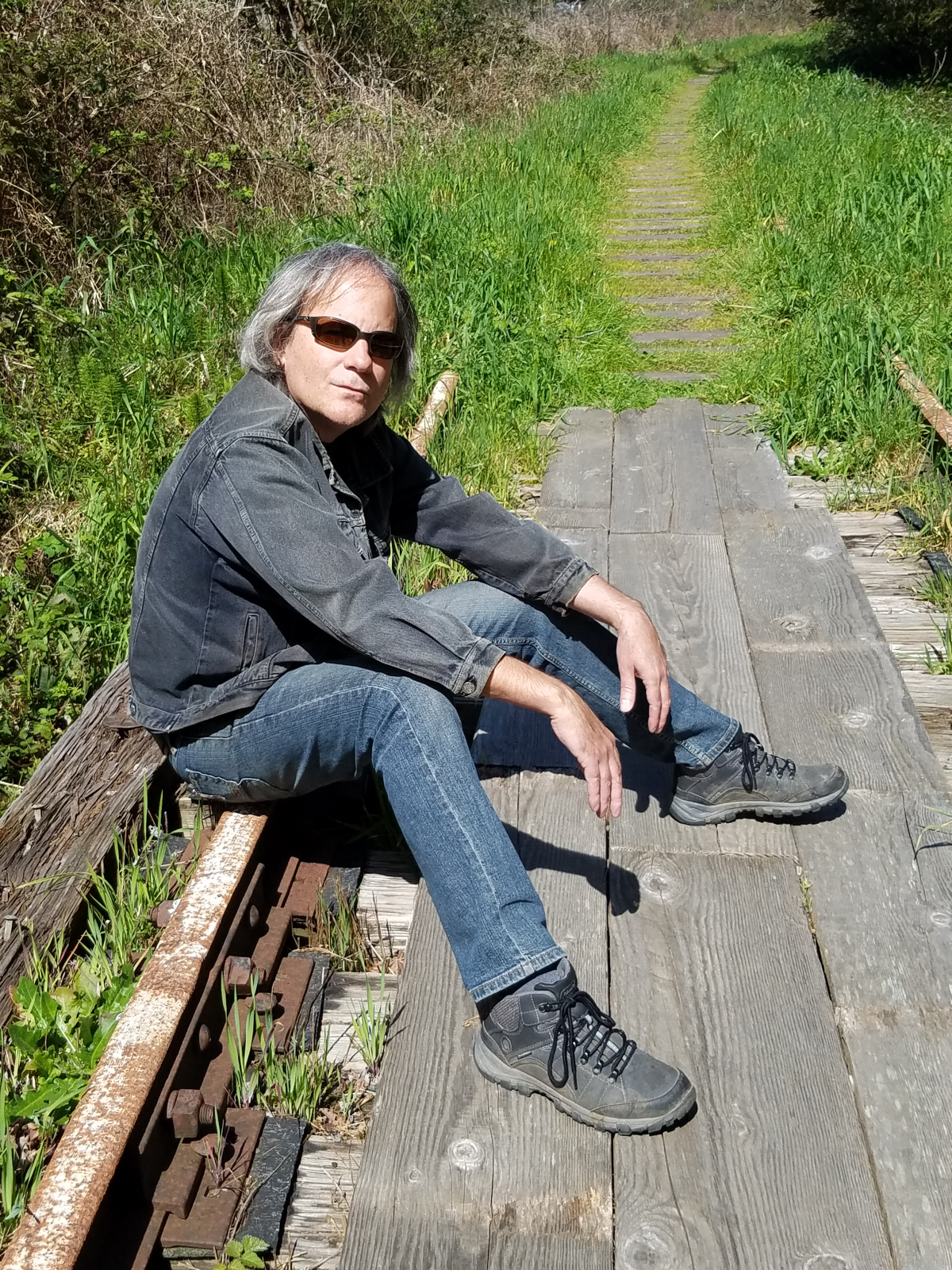
[PHOTO CREDIT: Shaniya Johnson]
Andy Duncan suggests new authors get their start by modeling their greatest influences and working until they write stories that only they could write. In that vein, “Charlie Tells Another” in the current issue [on sale now] is a uniquely Andy Duncan story. He offers us more tricks of the trade and the inspiration behind this and other stories below.
Asimov’s Editor: Is this story part of a larger universe, or is it stand-alone?
AD: My Charlieverse, as you might call it, sprang from a conversation with Eileen Gunn in summer 1994. I was a student at Clarion West in Seattle, and Eileen was not only one of the local volunteers, but also one of my instant mentors. She picked me up at the airport and promptly lent me her magic typewriter, on which she had written her first published story and on which, that summer, I would write my first published story. During a classroom break, Eileen asked me, “Have you ever heard of Charlie Poole?” Oh, yes, I said; he was one of the first pioneer recording artists I heard about when I moved to his old neighborhood in North Carolina in 1986. “I’ve been thinking for some time,” Eileen continued, “that someone ought to write a story about Charlie Poole, and now I think it should be you.” I said something on the order of, thank you, I’ll get right on it—thus beginning decades of happy amateur musicology and associated research, and thousands of words of fiction revolving around what The Encyclopedia of Fantasy might call the Matter of Charlie Poole, which to me is also the Matter of the Carolinas and a lot of other Matters. While two short stories from this ever-evolving mass were published in small-press volumes years ago, “Charlie Tells Another One” is by far the biggest and most significant chunk to be published, and I’m very proud that it’s in Asimov’s. A huge thanks, again, to Eileen for initially pushing what looks like a perpetual-motion machine!
AE: How did the title for this piece come to you?
AD: Normally, titles come to me very early. Indeed, sometimes I settle on a title before I’ve settled on a story to go with it! That wasn’t the case with this story, though. When I brought the draft manuscript in June 2018 to the Sycamore Hill Writers Conference (held, coincidentally, in the North Carolina mountains, near where the story is set), it had only a placeholder title: “Banjo Lessons.” Everyone agreed, yep, it was a placeholder title, all right—one that might mislead the reader into expecting actual, you know, banjo lessons! But the ensuing discussion helped me realize the title should reflect the central theme of nested yarnspinning, and ultimately my wife and best reader, Sydney, helped me select the right one. Who knows? “Andy Tells Another One” might be the title of a Duncan collection one day.
AE: What made you think of Asimov’s for this story?
AD: Well, for one thing, Asimov’s is an excellent magazine that regularly publishes many of my favorite writers and favorite stories. But it also exerts a strong emotional pull on me. My first fiction sale was to Asimov’s, in January 1995—though the story didn’t appear for more than two years, in the issue dated March 1997. That was “Beluthahatchie,” which I had written during the first week of the 1994 Clarion West workshop in Seattle, on Eileen Gunn’s magic typewriter, and which became a Hugo Award finalist in 1998. I will forever be grateful to Asimov’s for taking a chance on me and on so many other unknown writers through the years. I also owe quite a lot, personally, to the late Gardner Dozois, who pulled me from the slush pile and became a great friend, writing coach, and mentor, and to Sheila Williams, who treated me to a nice French dinner—with wine!—at the 2001 World Fantasy Convention in Montreal, just like I was Somebody, and has been extraordinarily generous with her time and encouragement ever since.
So I write about history, especially in the gaps, and on the margins. I write about race, and class and gender. I write about words and language. I write about the American South, about very specific times and places, and about place-ness—the crucial importance of being in this spot, rather than all those other spots.
AE: Who or what are your greatest influences and inspirations?
AD: A top-of-my-head sampling, in alphabetical order, from a very long list: Continue reading “Q&A with Andy Duncan”







 From Earth to the Stars