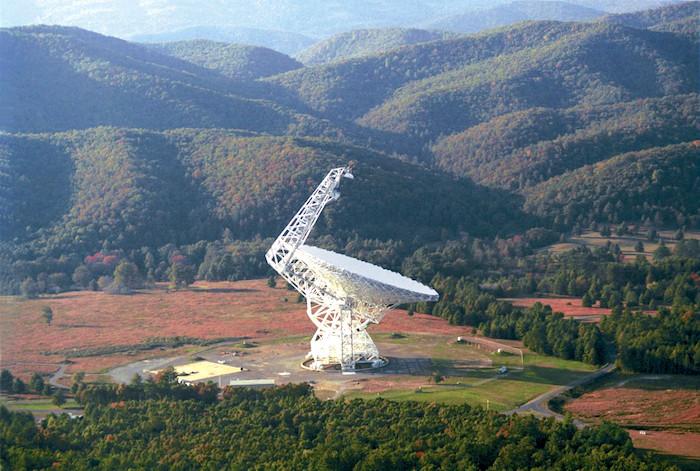
Image courtesy of NRAO/AUI
By Jay Cole
As I wrote my article about my experience teaching a course about Isaac Asimov (“A Semester with Isaac Asimov in the May/June issue on sale now), I found myself thinking about what he did not write. By this, I mean the Good Doctor was a prolific author of science fiction novels and stories that help to explain and popularize a variety of scientific topics and issues.
From robotics to mathematical sociology, Asimov’s science fiction has had a significant impact on public opinion and the popular imagination. This was, after all, one of my primary reasons for creating and teaching the course. Recognizing that he could not write about everything (although, thankfully, he gave it his best effort), what scientific topic or issue do I wish he had addressed in a novel or story? My answer: radio astronomy.
I say this because two radio astronomy facilities, the Arecibo Observatory and the Green Bank Observatory in West Virginia, face uncertain futures. Due to budget cuts, the National Science Foundation (NSF) has made some tough choices recently about how to allocate scarce dollars across a large portfolio of expensive scientific installations and programs. Thus, the NSF is dramatically reducing its investment in both Arecibo and Green Bank over the next few years. These observatories are seeking other sources of funding to continue their essential research, education, and outreach. Arecibo just announced a partnership with the University of Central Florida.
The impact of these facilities has been very significant. Arecibo (http://outreach.naic.edu/ao/landing) has been instrumental in a range of discoveries from neutron stars to ice at the poles of Mercury. Green Bank (http://greenbankobservatory.org/), located in my home state of West Virginia, discovered the first signal of an organic molecule in space and is at the forefront of detecting gravitational waves from pulsars. And in 1960, Frank Drake launched the modern search for extraterrestrial intelligence by using a Green Bank radio telescope.
With such a legacy, it is not surprising that radio astronomy has been a topic for science fiction literature and film. James Gunn’s 1972 novel, The Listeners, tells a very compelling story, set at the Arecibo Observatory in Puerto Rico, about the social and political struggles that might result from detecting an intelligent signal from beyond Earth. Gunn paved the way for Carl Sagan’s best-selling novel, Contact, in 1985 and the 1997 film based on the book. The film, in particular, has promoted awareness of the Jansky Very Large Array, a collection of radio telescopes in New Mexico. (In a nice example of crossover between science and science fiction, Jodie Foster, the star of Contact, narrates a video that plays at the VLA’s Welcome Center.)
The novels by Gunn and Sagan are two great examples of how science fiction literature can help to shape public interest in and understanding of science, in this case the search for extraterrestrial intelligence. I just wish Asimov had written a book about radio astronomy as well!
There is every chance that Asimov’s treatment would differ sharply from Gunn and Sagan. Perhaps he would have focused less on searching for extraterrestrial life and more on radio telescopes as a research tool for understanding the nature of time and the shape of space. (It is important to note that Asimov did write about radio astronomy in his nonfiction. His summary of the history of radio astronomy and his explanation of how radio telescopes work occupy two chapters in his book, Eyes on the Universe: A History of the Telescope.)
However Asimov would have approached it, we can be confident it would have been thought-provoking. As authors such as Asimov, Gunn, Sagan, and many others have demonstrated over the years, there is a special power in science fiction to capture the imagination, generate enthusiasm, and influence opinion. And of course, it is not too late for the next generation of science fiction authors to weave radio astronomy into their stories and novels, and explore the scientific and social issues that swirl around the field.
A radio astronomy-themed science fiction anthology, anyone?