by William Ledbetter
Like most writers, the ideas for my stories come from various sources. Many times, they are kernels that grow slowly in my mind. Sometimes I’ll see something out a window or on a walk that triggers an immediate story idea. On many occasions a piece of music sets up a cascade of thoughts that grow into a story. Since my muse is so scattered and inconsistent, it can often be difficult to answer the question “where did you get the idea for this story.” That’s not the case for “What I Am” [on sale in our current issue now and available as a podcast]. I can point to a very specific prompt and the process that gave birth to this particular tale.
Early in 2017 I applied to be in a collaborative art show which is run by my friend and fellow writer Bonnie Jo Stufflebeam and was thrilled to be accepted. Her Art & Words show has been running since 2012 and it pairs up eleven artists and eleven writers from around the world. Writers send in a story or poem, and then if chosen to participate we are given the image of a piece of art as a prompt to write a second story. The artists send in a piece of visual art and if chosen are given a story or poem as inspiration for a second piece of art. The result is twenty-two pieces of art and twenty-two stories or poems.
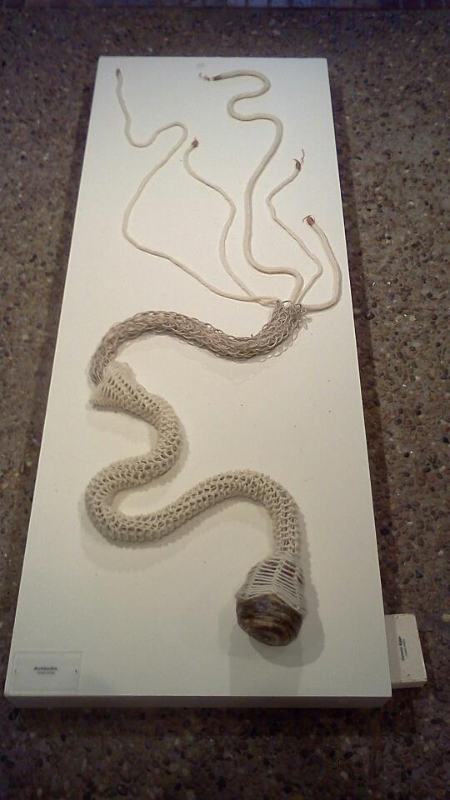
My prompt was a sculpture called Architeuthis, created by Texas artist Stacy Tompkins. This piece was both inspiring and quite challenging. Every time I looked at it I saw different things. Sometimes it resembled a macramé squid, which is where the sculpture gets its name, and other times it reminded me of a severed arm from a woven beast or possibly an alien exotic worm. Of course it was just for inspiration. My story didn’t have to be actually about this object, but I thought it was cool and wanted to include it in some way. I also knew from the very first glance that it needed to be alive and aquatic.
Being mostly a science fiction writer I didn’t want to bring this beast to life using magic, so that left only electronics. It would have to be a robot. That said, coming up with an even slightly plausible reason for a robot to be built in that form—at least by humans—left me scratching my head, until I embraced the idea of a future where everything was endowed with some level of intelligent automation. Then the idea kind of took off. The boy’s sweater wanted to make him feel better—as any intelligent sweater would—so it offered to help him find the ring.
I also enjoyed creating a story arc where the protagonist didn’t change. The boy in the story was a vague stand-in for so many of us who are feeling lost, bitter, and sad in today’s chaotic world. The robot was a steadfast companion, who despite being hacked, rearranged and forced into a role it didn’t want, stayed true to its original purpose and was there for the boy when needed. Couldn’t we all use a friend like that?

William Ledbetter is a Nebula Award winning author with more than sixty speculative fiction stories and non-fiction articles published in markets such as Asimov’s, Fantasy & Science Fiction, Analog, Escape Pod, Baen.com, Daily SF, the SFWA blog, and Ad Astra. His new novel “Level Five” is available from Audible Originals.
He’s been a space and technology geek since childhood and spent most of his non-writing career in the aerospace and defense industry. He administers the Jim Baen Memorial Short Story Award contest for Baen Books and the National Space Society, is a member of SFWA, the National Space Society of North Texas, a Launch Pad Astronomy workshop graduate, and is the Science Track coordinator for the Fencon convention. He lives near Dallas with his wife, a needy dog and two spoiled cats.








 Stephanie Feldman is the author of the novel The Angel of Losses (Ecco), a Barnes & Noble Discover Great New Writers selection, winner of the Crawford Fantasy Award, and finalist for the Mythopoeic Award, and is the co-editor of the multi-genre anthology Who Will Speak for America? (Temple University Press). Her stories and essays have appeared in Asimov’s, Electric Literature, The Magazine of Fantasy & Science Fiction, The Maine Review, The Rumpus, and Vol. 1 Brooklyn.
