
Where the Past and Future Meet: Juxtaposing Historical and Science Fiction

by Nikki Braziel

Nikki Braziel lays out some of the surprising similarities between science fiction and historical fiction. To see how she puts these ideas into practice, check out Braziel’s latest story, “Through the Pinhole, or, the Origin of a Holostory,” in our [January/February issue, on sale now!]

Simplifying the definitions of two expansive genres, science fiction tells the story of the future, while historical fiction narrates the past. Science fiction discusses how society could be built. Will advances in technology reorganize what we know about community and culture? Historical fiction explores how society was built. Why did things turn out as they did, and what was it like to live through those times?

These would seem to be opposite genres.

But as science fiction readers know, space-time is a continuum. We don’t write our futures from an Archimedean point divorced from history. Our science fictions are informed by (written in response to, inspired by, celebrating, and disavowing) our personally and societally lived histories. There is a unique place for fiction that juxtaposes an invented future against a real Earth past.

The future makes the past strange.

A visitor sees what a resident takes for granted. Imagine walking through a foreign market. Every scent is an intriguing experience. How are the stalls laid out? How is the fruit hung? How is the market different from your grocery at home, and what does that say about your own culture? What inferences can you make about local agriculture or industrial food production? What are the implications on the broader economic system?

The details of daily life reveal what a society values, and the values of a society influences what it builds. Consider the difference between a Federation science vessel and a Romulan warbird.

When a visitor from the future comes to our present, or our past, we can see through their (detached, more critical) eyes what our society reveals about us. We can ask,

  • What does each civilization value?
  • What is the religious, technological, and scientific framework for understanding the world?
  • How does comparison allow an assessment of evolution? Or regression?

In “Through the Pinhole, or, the Origin of a Holostory,” which appears in the January/February 2025 issue of Asimov’s, I explore sixteenth century Malta through the eyes of a washed-up thirty-third century holonovelist. When our unnamed protagonist encounters Lady Imperia de Bonello, a shopkeeper in Mdina, she understands his time travel though her highly religious and comparatively simple scientific context. This informs her assumptions about how and why he has visited.

Compared to the sixteenth century, the thirty-third is less chauvinistic. When the protagonist is placed alongside a Knight Hospitaller from Imperia’s own time, his approach to gender becomes revolutionary; Imperia can laud and respect him in a way that his ex-wife, informed by the expectations of his own time, does not.

Science fiction and historical fiction collide across galaxies written and filmed.

Consider the popularity of the historical/sci-fi mashup in Star Trek: The Next Generation. The crew goes back in time physically or visits another era through the holodeck in nearly a dozen episodes. In “Elementary, Dear Data,” Geordi La Forge asks the computer to generate a holodeck opponent capable of defeating Data as Sherlock Holmes. Professor Moriarty, the resulting antagonist, becomes sentient, introducing a variety of futuristic ethical questions through the lens of the past.

In “The Big Goodbye,” Captain Picard engages in a holodeck simulation where he plays Dixon Hill, a hardboiled detective in a 1940s setting reminiscent of the work of Dashiell Hammett. The program reflects noir tropes. By comparing the utopian Star Trek universe to the crime and sexism prevalent in the mid-twentieth century underworld, the holodeck offers an aspirational argument for humanity’s improvement.

Doctor Who likewise visits the past, with half-a-dozen time travel episodes in the classic series and more than a dozen in the revived series. A distinction is made between fixed points—events which are unchangeable and have to happen—and fluid time, which can be altered with relatively minor consequence. A common favorite is “Vincent and the Doctor,” which explores the emotional weight of history.

The Man in the High Castle investigates how technology (in this case, video) influences how we imagine possible futures. Set in a timeline where the Nazis won World War II, its characters gain access to evidence of an alternate reality (our reality). Seeing what the world could be like inspires their resistance. The story makes a thematic argument for the recursive relationship between technology and society. A portal (like a pinhole) allows transit between worlds, establishing a relationship between the two.

The past makes the future more complex.

Science fiction and historical fiction are both worldbuilding genres. By examining our past, we can assess what mistakes were made and what assumptions were incorrect. What future were we hoping to arrive at? Remember, the automobile was once seen as an environmentally friendly solution, one that would remove the health and sanitation risks that came from manure dropped into the streets by horse-drawn carriages.

There are three primary methods of combining the past and the future.

  • Simulation, using technology like a holodeck in Star Trek. Characters may be affected by what they learn of the past, but that can’t influence what happened. The relationship is one-directional.
  • Physical time travel, using a device like Doctor Who’s TARDIS. Characters may alter the past, which might change the future. This, of course, depends on your story’s position on the butterfly effect and the integrity of the space-time continuum.
  • Alternate history, a separate but related structure in which the reader becomes the time traveler. Moving forward from a pivot point, the author juxtaposes our understanding of history against a new version.

Will you move forward (into the past) in your own writing?

Is there a historical period or event by which you’ve been fascinated? What is the consensus understanding of that moment? Or is there a diversity of narratives about its significance or impact? How would a visitor from the future see it differently? What type of time traveler would be at odds with our history? Who would have something to learn from it? How can our future selves help us assess our past? What can our past teach our future? By closing the distance between centuries, we give clarity to comparison and causality.


Nikki Braziel <Instagram: @nikkibraziel and Bluesky: @nikki braziel.bsky.social>, whose work has also appeared in Sunday Morning Transport, is making her Asimov’s debut with the tale of a washed-up holonovelist who crosses forty light-years and seventeen centuries to find himself trapped in the Great Siege of Malta. Will his near-death—and the romance he found alongside it—be enough to save his flailing career?

On Making Perspective a Priority

by Jendayi Brooks-Flemister

Jendayi Brooks-Flemister returns to the pages of Asimov’s with their story “Completely Normal” in our [January/February issue, on sale now!]. In this essay, Brooks-Flemister discusses how the the unique perspectives of science fiction characters can foster empathy in readers.

If you’d asked me what my favorite part of my writing process was when I was in middle school, I would’ve told you it was worldbuilding. I thrived creating worlds unknown, from giant rivers filled with horrifying monsters to oppressive regimes born out of rebellions. In truth, I was writing what felt the most like an escape. My childhood sucked. It was abusive and lonely. So, instead of existing in it, I wanted to embody characters in worlds that felt more welcoming, that addressed the hardships I faced with a certain nuance that I couldn’t articulate to my Geometry teacher.

If you’d asked me what my favorite part of my writing process was last year, I would’ve told you that it was the ability to write the characters–the stories, the backgrounds, the identities–that I most resonated with. I would’ve said that I’d evolved from running away from the problems of my youth; rather than create a new world, I was writing about the people of the current and future world. Science fiction to a tee, in a way. If I wrote about a little girl jumping to the Moon, or the sex worker in Tokyo trying her best to make ends meet, maybe people would learn to be kinder to each other, and thus, to the planet we all call home. I saw my writing as a way to embrace the uncertainties of the world . . . to try and create a certainty of my own: we gotta do something.


If I wrote about a little girl jumping to the Moon, or the sex worker in Tokyo trying her best to make ends meet, maybe people would learn to be kinder to each other, and thus, to the planet we all call home.


But now, if you ask me what my favorite part of my writing process is, I can say so confidently that it is both the same as middle school me and last year me, yet different in its refinery. What I didn’t understand before–and what I’m pretending to understand now–is that what I love most is the ability to play with perspectives. What excites me about writing, whether it’s my short stories or my in-progress novel (shhh), is the ability to show you a new version of the world you’d never imagined. You think you know what it means to struggle? You think you know what it means to succeed? You think you know what it means to hope? I won’t question that you think you do–but I will question the lens you look through to conceptualize them.

To me, perspectives are a goldmine of realities. It isn’t just about the worldbuilding or the characters you create, but the ways in which you ultimately decide to tell your story. First person? We know that already. Third close? Been there. Unreliable narrator? We love her. But what if we had all three at once? What if we switched perspectives with each beat, and with each switch we gain new truths that change exactly how we perceived the story we thought we knew. Isn’t that wonderful to consider? It is to me. And maybe I’m just weird. But to me, there is no one truth. And to claim that there is somehow one truth is truly a disservice to the many people and interactions that characters will have throughout their journeys. No one is shaped by themselves.

“Completely Normal” is just that–a completely normal conversation between two completely normal people. However, as the story unfolds, you learn so much about the way perspective shapes what normal looks like. You, the reader and the person receiving the story, are told that the narrator’s perspective–that everything they share with you–is their normal. And what does it mean to receive that? To have no choice but to accept that reality because, in a fleeting moment, the interaction ends. When you’re left wondering if it were true, you’re met with the point I’m trying to make: this person’s perspective is their reality. And if you don’t accept their reality, then aren’t you just denying their existence as a whole?

I hope this story makes you think, but not about the story itself. I hope it makes you consider the perspectives of others around you. There’s so much hate in the world, and I’m so tired of having my identities on every electoral ticket. If we could all appreciate each others’ perspectives a bit more–if maybe we could just accept that there are some things we can’t understand, but that we can at least respect–then wouldn’t it be a nicer world overall?

Maybe I’m silly for being this optimistic. I’m not usually like this. But I think we have a duty as writers (especially as science fiction writers) to unlock more parts of the world to our readers. You probably don’t know someone with a tomato soup obsession. But if you did, how would you engage? If your instincts tell you to question their reality, then maybe shift your own perspective instead. Try seeing it their way. Try seeing it from the chef who made the soup in the first place. Then try imagining the pride a tomato must feel to be so delicious that someone can get addicted to that tangy, acidic, sweet, juicy goodness. Oh to be a plump, ripe tomato, excited to become so much more because others can see your potential.


Jendayi Brooks-Flemister (they/them) has been writing since they were eight. They focus on Black queer experiences within Afrofuturism/speculative and science fiction, and fantasy literature. Jendayi has been published in Asimov’s, Lightspeed, FIYAH, and many other venues. When not working on short stories or their debut novel, they are hard at work as a People Operations professional, playing video games, or fixing up their new home.

Q&A With Matthew Kressel

Get to know author and coder Matthew Kressel in this enlightening Q&A that delves into the themes and inspirations behind “Five Hundred KPH Toward Heaven,” Kressel’s story from our [January/February issue, on sale now!]

Asimov’s Editor: What is the story behind this piece?
Matthew Kressel: In “Five Hundred KPH Toward Heaven” a space elevator operator is forced into early retirement. At a corporate “last hurrah” party held in an ascending space elevator car, she laments the loss of something beautiful and profound with her co-workers while Earth slowly drops away beneath them.

AE: How did this story germinate? Was there a spark of inspiration, or did it come to you slowly?
MK: I had this image in my head of co-workers getting drunk at a corporate party, talking dirt about their jobs and bosses, while the reader slowly comes to realize they’re inside a giant space elevator carriage, ascending to space.
I love cool SFnal settings, and I’ve always loved space elevators. I was particularly inspired by two things: One is the idea of things that we think of as futuristic already being old hat to someone. And two, the death of so-called “third spaces.” After Covid, and now with so many things moving increasingly online, there are fewer and fewer places for people to congregate. In the story, my protagonist Terese recognizes that the slow ascent into space, which takes days, is a time for people to disconnect from their busy lives and interact with their fellow human beings without screens to mediate their conversations. I wanted to explore the so-called “Overview Effect” of seeing Earth from space while surrounded by many others. What kind of effect would that have on people?

AE: Is this story part of a larger universe, or is it stand-alone?
MK: This story is part of my “Numenverse” series of stories that all take place in the same universe. Stories in this world include “Truth is Like the Sun”, “Saving Diego”, “Now We Paint Worlds”, “Still You Linger Like Soot in the Air”, and several others, as well as my forthcoming novel Space Trucker Jess(Fairwood Press, Jun ’25), and my forthcoming novella The Rainseekers (Tordotcom, Feb ’26). 

AE: Who or what are your greatest influences and inspirations?
MK: My inspirations change, depending on who I’m reading. For this story, though it may not seem obvious, I was reading the Wyoming stories of Annie Proulx. I was blown away at how deftly she is able to paint characters in very few words.
I’m also loving Alan Moore’s prose fiction. I’ve read his graphic novels and loved them, but his short story collection Illuminations blew me away. I’m reading The Great When now and it’s a lot of fun.
Other inspirations include the short stories of Jeffrey Ford, Kelly Link, the novels of Kim Stanley Robinson, and the amazing far-future artwork of Paul Chadeisson.

AE: How much or little do current events impact your writing?
MK: They seep in. For example, my forthcoming novella The Rainseekers was a direct response to the first Covid lockdowns. I deliberately wanted to write something optimistic as a challenge to my dour mood. I found it really hard, because the tendency of both my brain (and current entertainment media) is to go dark. It’s a challenge to write optimistically right now. Gloom and doom sell, because people are gloomy and doomy.  
Usually I write about what I just can’t get out of my head, as a kind of exorcism. It could be current events or it might be personal. I have a story coming out in October at Reactor (formerly Tor.com) called “Model Collapse” about my fear of A.I. and automation.

AE: Are there any themes that you find yourself returning to throughout your writing? If yes, what and why?
MK: I don’t usually write themes consciously. They emerge from whatever I’m working on. Mercurio D. Rivera recently wrote the introduction to my forthcoming short story collection Histories Within Us, and he said many of my stories have a similar theme: someone forced to leave their ancestral home who must make a new home somewhere else. I suppose that theme churns round in my subconscious a lot. I do come from a wandering people, so maybe it’s written in my DNA.


I deliberately wanted to write something optimistic as a challenge to my dour mood. I found it really hard, because the tendency of both my brain (and current entertainment media) is to go dark. It’s a challenge to write optimistically right now. Gloom and doom sell, because people are gloomy and doomy.  


AE: What other projects are you currently working on?
MK: Right now I’m doing final edits on my novel Space Trucker Jess, which is coming out in June from Fairwood Press. It’s about a grifter girl who goes on an odyssey across the galaxy searching for her missing father. There are alien gods, missing planets, and cosmic stakes. I like to describe the book as if Natasha Lyonne were narrating 2001: A Space Odyssey.
Once that’s done, I’ll get back to working on my sequel to The Rainseekers. I don’t want to say too much about it, since the first book isn’t published yet. But the sequel takes up pretty much where the first book leaves off. Whereas the first book is more of a “road” novel, the second is more of a science-fiction mystery-thriller.

AE: If you could choose one SFnal universe to live in, what universe would it be, and why?
MK: Probably Ian M. Bank’s Culture universe. It seems as if humans in that universe live near trouble-free lives with total freedom to travel the galaxy and do, practice, learn whatever they wish. Sickness and death are extremely rare, and each individual makes their own meaning. It’s also incredibly expansive. If humanity ever does reach a level like that, I don’t think that would be so bad.

AE: What are you reading right now?
MK: As I mentioned, The Great When, by Alan Moore. Also The Varieties of Religious Experience by William James and The Writer’s Journey by Christopher Vogler. I jump between books, depending on where I am sitting at the moment.

AE: Do you have any advice for up-and-coming writers?
MK: When I started writing in 2002, social media wasn’t a thing and you still had to send most submissions by snail mail. So my trajectory and a beginning writer are likely to be vastly different. However, one trend I often see among successful authors is a strong work ethic. Don’t write just when you feel like it, or only when you’re inspired. Make it part of your daily schedule. That and get feedback from others, especially other writers who have similar goals. That way you can help each other improve and be each other’s cheerleader.

AE: How can our readers follow you and your writing?
MK: The best place to start is my website linktree. Here you can find links to all my creative projects, writing and otherwise: https://www.matthewkressel.net/contact/.
I’m also on BlueSky at @matthewkressel.net. And I have a newsletter at https://matthewkressel.substack.com/.


Matthew Kressel is a multiple Nebula and World Fantasy Award nominated author and coder. His many works of short fiction have appeared in Analog, Asimov’s, Lightspeed, Clarkesworld, Tor.com/Reactor, Beneath Ceaseless Skies, and many other publications and anthologies, including multiple Year’s Bests. Eighteen of his stories will be included in his debut collection, Histories Within Us, coming from Senses Five Press in February. His far-future novel Space Trucker Jess is coming in 2025 from Fairwood Press. And his Mars-based novella The Rainseekers is forthcoming from Tordotcom in early 2026. Alongside Ellen Datlow, he runs the Fantastic Fiction at KGB reading series in Manhattan. And he is the creator of the Moksha submissions system, used by many of the largest fiction publishers today.

The Rules

by Peter Wood

Peter Wood reveals and explains his personal list of rules for good writing. Check out his latest story, “Murder on the Orion Express”, in our [November/December issue, on sale now!]


On Writing by Stephen King should be required reading. There’s not a bad suggestion in the book, and you’ll also get some really cool backstories to some of King’s iconic fiction.

I don’t have a writing advice book in me, and I’m no Stephen King, but here are some rules I try to follow.

Goldilocks

I edit a monthly flash fiction contest for Stupefying Stories with word limits of around one hundred words. You can find the stories here: https://stupefyingstories.blogspot.com/p/the-pete-wood-challenge.html. If done well, that format can pack quite a wallop. If done poorly, the story ends unresolved or just summarizes a much longer story.

The opposite end of the spectrum is never-ending cliffhangers. I enjoyed most of The Three Body Problem, the alien invasion novel by Cixin Liu.  Alas, it ended like part one of a bad two-part episode of a 70s TV show. I gave up on the second book when it just kept meandering with a nonsensical opening scene that went nowhere. I might have put up with the drop off in quality if I knew the book might reach some sort of resolution.

A writer should neither summarize, nor pad. A story or novel or flash piece should not wear out its welcome or leave the reader hanging.

We’re Not in Kansas Anymore

Misguided experts tell writers stories should begin with the most exciting scene to grab the attention of the poor overworked slush reader, because they won’t have the patience for a more nuanced opening. I’m not sure this is true, but good luck finding any article on getting published that has different advice.

In a perfect world, a story could start out with an innocuous situation and then gradually become speculative. There’s a reason The Wizard of Oz doesn’t start in Munchkinland. Of course, writers shouldn’t dally too long in the mundane, but any speculative event that springs organically in the story can be rewarding. I read Station Eleven by Emily St. John Mandel without even reading the back cover. I had no idea it would soon evolve into apocalyptic fiction. What a ride.

Many of Stephen King’s novels start with the everyday and then gradually become fantasy or horror. The Dead Zone, for its first few pages, concerns an Average Joe teacher. Hints of the supernatural don’t pop up for quite a while and, because we got to know the characters first, we empathize with their journeys.

It’s hard to think of how one might read something speculative and not realize it. Some magazines that publish all manner of fiction might slip a horror or science fiction story past you. I read Rappaccini’s Daughter by Nathaniel Hawthorne in a collection of classic short stories and was pleasantly surprised by the genre shift halfway through.

But those instances are rare.

So, we also have stories that begin with a bang and then settle down and get really complicated. The television show, Lost, opens with a plane crash on an uncharted island, but that’s just the tip of the iceberg. The Stand by Stephen King begins with the accidental release of the most lethal virus imaginable from a top secret government lab, but you ain’t seen nothing yet.

Who’d You Rather Spend Time With?

Characters in bad fiction are like relatives you have to spend an awkward afternoon with every Thanksgiving.  In good fiction, the characters are your friends who flock together after the obligatory holiday meal.

Going back to The Stand for a moment here. It’s not a book about the apocalypse; it’s about Stu Redman, an easy-going Texan who becomes an epic hero, or Randall Flagg, the greatest bad guy in literature, or Frannie Goldsmith, a small town teenager who watches most of the world die. The book also has a couple of dozen other folks you’ll be glad you met.

Yeah, I know, it’s also a great speculative work, but an end of the world plague is not a new idea. Jack London explored the trope in The Scarlet Plague in 1912.  So did George Stewart in 1949’s Earth Abides. Plots get recycled.  There’s a reason most have never heard of those books.  The characters are completely forgettable.

A story or novel that doesn’t begin and end with its characters is not something I want to read. I don’t care how great your gimmick is; if I don’t find your characters compelling I don’t want to read your story.

Characters, setting, and plot, are the holy trinity of good fiction in that order. Good characters will trump setting and plot every time. If your characters have no stories of their own before the big event, I don’t care what happens to them. I want to see fleshed-out characters respond realistically, not chess pieces moved around while stuff—no matter how amazing—happens around them.

Books with boring characters are, well, kinda boring themselves. There is not a single memorable character in Level Seven by Mordecai Rush. It might be about life in a fallout shelter after the bombs fall, but even blowing up the planet won’t compensate for milquetoast characters.


Characters, setting, and plot, are the holy trinity of good fiction in that order. Good characters will trump setting and plot every time.


Don’t Go Back In the Haunted House

Your story is your universe. You create the rules. Just follow those rules.

A work training session I had recently  broke into a spirited conversation between me and the instructor about the Scream movies. We both loved the franchise, which honors and deconstructs the rules of slasher movies. We hated it when the killer murdered the most intelligent and charismatic character in the second movie in a pretty underwhelming fashion. The victim, a film aficionado, had explained the rules of slasher movies to the other characters in the first film. The Scream movies are a bloodbath and no one is safe, but knocking off the only character who understood “the rules” and could see a killing coming a mile away made no sense. The writer broke the rules.

The Calculating Stars by Mary Robinette Kowal has a hell of a premise. A meteorite hits Earth, spiraling the planet into a mini ice age in 1952, and the space program must figure out how to colonize the stars before the planet becomes completely unlivable in a century or two.  I gave up for two reasons. One, the flat characters didn’t act like real people. Nobody had any sense of urgency or anxiety or depression about the apocalyptic events. Two, the author forgot about the ice age. Characters in the middle of a crisis sat around chilling in a cafeteria eating fresh fruit and vegetables. Where did that food come from? How did we still grow crops in the snow? Canned food or military MREs I could buy, but not that.

If your characters have to go back in the haunted house, you need a better reason than you have fifty pages to kill. I watched an interview with the two writers of Star Trek: Generations and one had never seen an episode of the original series. Sadly, Kirk became a Red Shirt in his own franchise.

There’s one Stephen King story I can’t stand. The reversed-engineered The Jaunt manipulates its characters to reach the rather shocking ending. King might break all of my rules in this story, but the travesty is that, even given the futuristic world King has created, the characters’ responses to teleportation technology strain credibility. From the workers at the teleportation station to the family teleporting for the first time, nothing makes sense. Granted, after the terrifying twist, the characters behave realistically, but it’s too little too late.

I Don’t Need No Stinkin’ Rules

I imagine you can come up with some classic story that violates my rules in some way. Fair enough.

The goal is to write a good story. And, however you do that, works for me.


Peter Wood is an attorney in Raleigh, North Carolina, where he lives with his very patient and forgiving wife. This is his fifteenth story for Asimov’s. Pete grew up in Ottawa, Canada, and Brandon, Florida, where he read science fiction and murder mysteries and watched great detective shows on TV like The Rockford Files and Columbo. He figured it was time to write his own whodunnit.

Dream Logic And “The Ledgers”

by Jack Skillingstead

Jack Skillingstead illustrates the importance of persevering through the ever-treacherous path that is writing. Read his latest story, “The Ledgers”, in our [November/December issue, on sale now!]

What happens when a writer has exhausted, or—more charitably—thoroughly exploited his thematic obsession? Three options stand out.  

One: The writer presses on, no longer hacking new paths, discovering mysteries and secret connections, but simply changing costumes and performing the same dance over and over until boredom, the marketplace, old age, or a combination of all three turn off the words.

Two: The writer experiments, hoping to discover new ways of exploring themes that have grown stale, ways that don’t feel like retreads, even if it means upending his whole process, stepping into the unknown, and basically being willing to feel lost in unfamiliar territory. This only works if writing itself is an obsession.

Three: The writer quits and finds a hobby to occupy his hours. For instance, single malt Scotch whiskey.

But if it’s me (and it is) then I’m going for number two. For now I’ll confine the discussion to short fiction. I wrote for two decades before breaking into professional print. A big part of what finally got me through the door was my willingness to listen to what my sentences were trying to tell me—this as opposed to what I was trying to force the sentences to tell readers. Conscious control vs letting go. I’ll circle back to this.

I’ve talked before about one of my “Ah-ha!” moments when suddenly (after untold hours staring at sheets of paper and computer screens) I could see which sentences were essential and which not only could be cut but had to be cut. From there it was a matter of working with the remaining sentences, judiciously adding and subtracting, until the idea I’d started with began to emerge on the page in a coherent narrative line. It was still a while before I sold anything. But it was a turning point. (By the way, sales don’t automatically indicate mastery, or even progress, except in terms of craft.) Starting around the year 2000 I used this method to make a lot of stories happen, and from 2002 onwards I sold most of what I wrote.

I hadn’t discovered a story formula or mastered an arbitrary set of rules. Instead I had learned to recognize and abandon narrative ideas that resisted disentanglement. In other words I no longer forced a broken story to “work.” Now, some twenty years later, with a few novels and more than forty stories in print I’ve found myself walking away from half-completed stories, starting new ones then quickly running out of gas. This kind of thing hadn’t happened to me since my earliest attempts at writing fiction. What was going on?

There is an old adage that says writing gets harder, not easier, the more you do it. This didn’t make sense to me when I was younger but it does now. First, this is how it seems to get easier: through daily writing and reading you slowly learn to say what you mean. You gain facility with words. You learn to recognize and cut cliches, and you learn when—and if—to fill the gaps left by their elimination. You learn when to trust your voice and when to doubt it. If you have a decent ear for dialog you learn to not overdo it. If you have a tin ear you learn how to work around your limitations, compensating with narrative acceleration, among other things. And eventually the pages accumulate.

But now, late in the game, I’d been handed the Three Option Problem. During the desert years when it felt like I’d never make that first sale, let alone have a career (however modest), I occasionally flirted with option three. The lesson I’d learned then still obtained: I was constitutionally and psychologically incapable of Not Writing. If your brain is programed to insist you write, then there is no way out of it—at least not in my experience. I’m like a guy ceaselessly treading water. As soon as I quit treading I sink like a stone.

So. Option Two.


There is an old adage that says writing gets harder, not easier, the more you do it. This didn’t make sense to me when I was younger but it does now.


Back in the spring of 2023 I was struggling with a new story. The “idea” was essentially a milieu, a vaguely eastern European city enduring a bleak winter of perpetual war. I loved the opening. An ordinary citizen of this unnamed city-out-of-time is crossing the plaza on his way to the government building where he works when he is waylaid by a spooky guy I thought of vaguely as the Devil, or maybe a minor demon devoted to exploiting violent impulses in people. After that I wrote a scene where my guy discovers a body that has been savaged by a feral dog. These two scenes were connected by an information-heavy (i.e. boring) scene in the man’s office.

I had no clear idea what this story was about. I pushed on for weeks, trying one thing and another, all of them dead ends. I gave up on it a few times because I could not convincingly make the images tell a story. They were fascinating, those images, and disturbing. This story-that-wasn’t-a-story had the surrealistic juice of nightmares. I couldn’t let it go, though in the not too distant past I certainly would have.

Earlier I mentioned learning to abandon narrative paths that “resisted disentanglement.” The many incomplete drafts of “The Ledgers” were chock full of tangled narrative paths that begged abandoning. Every time I tried to push a logical sequence to the next logical sequence, the story resisted. It felt a little like it had decades ago when I regularly forced stories to be stories. Failed stories, but stories. “The Ledgers” worried me. I didn’t want to go backwards as a writer. But neither could I drop the story as a failed experiment. There was something there begging for expression.

It’s good to finish things. As a writer it’s essential that you finish things even if the finished thing ends up irreparably broken. That’s how you grow. Over many years I’d learned to tell the  difference between necessary and unnecessary sentences. But “The Ledgers” was teaching me something new, presenting me with a trove of moody horror-infused images straight from the unconscious, images that resisted all my conscious day-world attempts to organize them along what I think of as traditional narrative lines. I decided to follow the dream logic of the images wherever it led, even if I didn’t understand it.

Damon Knight used to tell student writers to “trust Fred.” Fred was what he called his unconscious mind. Okay, I was determined to trust my own Fred. Damon wrote a whole book of story-writing theories that only started with the unconscious. But for my experiment in dream logic I wasn’t going to pay any attention to his or even my own daylight thoughts about telling stories. In other words, I wasn’t going to make the images tell something to readers; I was going to allow the images to discover their own secret connections and show them to me. If you’ve ever awakened with a vivid and apparently nonsensical dream still glowing in your brain and then over coffee or scrolling news on your phone suddenly realized what the dream meant (oh, yeah! The three legged German Shepherd is my dad!) , then you know what I’m getting at.

And it worked.

“The Ledgers” revealed itself with very little conscious effort on my part. After that, it was up to my daylight skills to provide the necessary craft decisions. Writing this story was a revelation. To any new writers out there I say: Trust your dreams…and your nightmares.


Jack Skillingstead <Facebook jack.skillingstead, X JSkillingstead, and bluesky @jackskill.bsky.social> is the author of three novels and more than forty short stories. Jack has been a finalist for both the Sturgeon Award for short fiction and the Philip K. Dick award for SF novel. His short fiction has been collected in two volumes. The title story of the newest collection, “The Whole Mess” (Fairwood Press, November 2023), first appeared in Asimov’s September 2016 issue.

Reading the Last Page First

by Molly Gloss

Molly Gloss shares why her fondness for immediately reading the last pages of novels shouldn’t be so contentious to open-minded people. Check out Molly’s latest story, “Wápato,” in our [November/December issue, on sale now!]

Here is something about my reading habits that I suspect will horrify many of you:  I’ll read the first dozen or so pages of a novel, and then always (almost always) feel a sudden impulse to turn to the last page and read the last few paragraphs. Horrified as you are, you might be surprised to know that I seldom (almost never) actually learn anything concrete from that last page—not even, necessarily, who is still alive or who might have died, because I’ve learned that endings can trick me. 

I don’t really remember when this habit started or why, but I have come to realize that as I keep in mind that last page with its as-yet-mysterious and out-of-context information—as I view the book through that dim lens—I begin to notice things I might not otherwise have paid attention to. A new character showing up very late in the story but since I recall her name from that last page, I start paying attention to her, thinking she might become important.  Or a place—the turnoff at Iskuulpa Creek, say, which I would have read past without noticing, but on the last page I remember Annie is driving her truck past that Iskuulpa turnoff when she sees the coyote, so maybe that turnoff is a place—or a metaphor—I should keep an eye on. That sort of thing.

And I have some science to back up my habit of looking ahead at the ending of a novel.

Maybe a few of you saw or read a piece in the the NYT a while back, arguing that “spoiling” a television show or movie or novel, by premature plot revelations, does not actually ruin our enjoyment.  In a study published in Applied Cognitive Psychology, study participants who were told the ending of a tense Hitchcock scene before watching it, reported the same levels of engagement and enjoyment as those who didn’t know the ending. 


A novel is in some ways like a symphony, and toward the close of a novel, just as in the coda of a symphony, the writer will often (usually?) bring back directly, or in the form of recollection, some of the images, characters, events, encountered earlier, and in so doing call to mind the tone or mood or metaphor that has been driving the work all along.


It turns out we aren’t simply waiting in suspense to learn or guess the resolution to the question driving the plot. There are more significant factors that determine our enjoyment of narratives, and we are just as likely to get caught up in a story even when we know what is coming. Humans are hard-wired not just to absorb facts but also to lose ourselves in stories, to be completely pulled away from the present and transported into the alternate world of a fictional story. If watching a Hitchcock story makes us feel that we are living in that story, then knowing the ending doesn’t affect us, because the characters in the story don’t know the ending and, for that moment, we have hitched our mental state to theirs.

Here is something else I have come to realize from my habit of reading the last page early on:  A novel is in some ways like a symphony, and toward the close of a novel, just as in the coda of a symphony, the writer will often (usually?) bring back directly, or in the form of recollection, some of the images, characters, events, encountered earlier, and in so doing call to mind the tone or mood or metaphor that has been driving the work all along. So as I’ve been reading, holding in my mind that enigmatic fragment from the last page, I have slowly begun to glimpse—as in a symphony one begins to hear—that repeating motif, those recurrent images, the rise of the metaphor.

This understanding was driven home to me most forcefully in John Crowley’s novel Little, Big. It’s a book that is on my list of the best books I’ve ever read and never forgotten. My battered paperback copy has thumbed-down corners and pages marked up with scribbled notes, underlines, and exclamations. What I gradually understood, reading and rereading it, is that Little, Big itself, the novel, could best be described through the metaphor of Edgewood, the house that is its principal setting, the house in which many generations of the Drinkwater family live. A house designed by the patriarch to be many houses in one, like an intricate origami, just as Little, Big, the novel itself, is an extraordinary, intricately organized origami of a novel. A symphony of a novel.  Crowley returned to description of the house again and again in all its byzantine detail precisely because this was the recurrent motif that he intended to pull us through his long, byzantine novel . . . which I will now, ahem, spoil for you by sharing the last paragraph, a description of Edgewood empty and abandoned :  

“One by one the bulbs burned out, like long lives come to their expected ends. Then there was a dark house made once of time, made now of weather, and harder to find; impossible to find and not even as easy to dream of as when it was alight. Stories last longer: but only by becoming only stories. It was anyway all a long time ago; the world, we know now, is as it is and not different; if there was ever a time when there were passages, doors, the borders open and many crossing, that time is not now.  The world is older than it was. Even the weather isn’t as we remember it clearly once being; never lately does there come a summer day such as we remember, never clouds as white as that, never grass as odorous or shade as deep and full of promise as we remember they can be, as once upon a time they were.”

You shouldn’t imagine that every novel strives to end like Crowley’s with a symphonic moment that reverberates back through every scene. Little, Big is rightly celebrated because it is singular. I venture to say, even Crowley hasn’t been able to do that again. But it’s the example that proves to me, I am right to peek ahead at endings. To hold in my mind those symphonic last notes through every scene, right from the first page.


Molly Gloss is the author of six novels as well as the short story collection Unforeseen. Her fiction has collected many honors and awards, including a PEN West Fiction Prize, a James Tiptree Jr/Otherwise Award, and a Theodore Sturgeon Award. ”Lambing Season” (Asimov’s, July 2002) appeared in The Best of the Best: Twenty Years of the Year’s Best Science Fiction. You can find Molly on Facebook and Instagram using her actual name.
 

Q&A With Sean Monaghan

Sean Monaghan returns to the pages of Asimov’s with his latest space adventure, “Wildest Skies,” available now in our [November/December issue, on sale now!] In this enlightening Q&A, learn more about the movies and books that inspired Sean to write science fiction.

Asimov’s Editor: Is this story part of a larger universe, or is it stand-alone?
Sean Monaghan: To answer the question in a round-about way, I’m old enough to remember when the movie Alien came out, though young enough that its age restriction in New Zealand meant that I had to wait a few years before I got to see it. When I heard there was a sequel on the way, even as a teenager, I wondered how they might go about that. The film had had such an impact on me, that I couldn’t picture a movie where they Did The Same All Over Again would beat all interesting. I was impressed then, when Aliens came out, that it took the story in a whole new direction.
When I first embarked on “Wildest Skies,” I just wanted to write a fun adventure story with a character in a sticky situation. And it was a big story, covering a lot of ground and using a lot of words.
Ed Linklater’s story seemed to have been told.
But then my subconscious imagination held onto things and I found myself writing more stories with Ed. Taking him in, I think, different directions. And as the publication date in Asimov’s approached, I realized that all of the stories so far are prequel stories. There’s one about him and the crew training right before they leave on the mission (“Spindle Shatters”), and one about him looking for a job on Mars (“Martian Job Offer”) and even one with him as teen, about the age I was when I first missed out on seeing Alien, going with his family to see his first live rocket launch (“Launch Treat”).
Some of the stories are available now on my website and elsewhere, and some are out under consideration with publishers.
So yes, the novella “Wildest Skies” has turned out to be part of a larger universe, one that’s varied and distinct, but still, I hope, fun and full of adventure.
And all that said, I do wonder to myself if now that “Wildest Skies” is out in the world, will my imagination send me off writing sequel stories? What happens to Ed after the events on Dashell IV? I don’t know, but I kind of hope to find out.

AE: How did you break into writing?
SM: Back when I was first at university, oh so long ago, the English department published a vaguely annual anthology of local writing. I duly wrote a story and sent it in and was stunned when the print edition of the anthology arrived in my letterbox, with my story among the contents. Since then I’ve learned that editors generally make contact and send contracts before publication, but still, that was so uplifting and validating and gave me a vague kind of confidence to keep going. It took a while before further publications came my way, but now I seem to have reasonably steady stream of them happening, which is heartening.


I do wonder to myself if now that “Wildest Skies” is out in the world, will my imagination send me off writing sequel stories? What happens to Ed after the events on Dashell IV? I don’t know, but I kind of hope to find out.


AE: Do you have any advice for up and coming writers?
SM: Write.
I think that the venerable Mr. Heinlein said this many years ago. “You must write.” I think that any success I’ve had has come out of spending time in my writing chair and just writing. Practice, I guess.
The more you do it, well, chances are, the better you’ll get. I’ve met numerous writers who think about writing, or would like to write, or just get too busy, which is fine, but actually writing something is the key.
There’s also loads of advice out there about how to write, and I think another key is to find what works for you and go with that.

AE: Who or what are your greatest influences and inspirations?
SM: I write space adventure, plain and simple. I’m inspired by my reading from when I was a teen and our local secondhand bookstores were filled from floor to ceiling with battered and bruised paperbacks from the forties and fifties and sixties and seventies. I would shell out every last cent of my pocket money on a Friday night, buying up too many slim paperbacks.
Silverberg and E.E. Doc Smith and Asimov and Sheckley and Kern and Heinlein and Herbert and other less well-known names. Old copies of magazines like If and Galaxy and Amazing Stories. Some of those books were pretty explicit for a poor naive thirteen year old. Some of them failed to avoid mysogyny and racism and other things that would rightly and rapidly lead to cancellation in the here and now.
Many of them, though, from the more sophisticated writers, met those issues head on. After all, science fiction envisions a better future, and equality and tolerance were themes that I would like to think helped to shape the world as the modern era unfolded.
But it was the adventure I thrived on. Being able to visit distant worlds and contend with challenges of hostile environments and broken spaceships and dictatorial governments.
I would devour those books and return the following week for more.

AE: How can our readers follow you and your writing?
SM: My main website is www.seanmonaghan.com, but for this story there’s a special site with some of the other stories at www.wildestskies.com. On rare occasions I show up on facebook.com/seanmonaghanauthor, and sometimes at www.seanmonaghan.blog.
Thanks for the chance to participate in the blog.


Sean Monaghan writes from a nook in the corner of his 100 year old home in provincial New Zealand. His stories have appeared before in Asimov’s and also in Analog, as well as numerous other publications.

Q&A with R.P. Sand

R. P. Sand makes her Asimov’s debut with her new piece “Eternity is Moments”, available to read in our [September/October issue, on sale now!]

Asimov’s Editor: How did this story germinate? Was there a spark of inspiration, or did it come to you slowly?
R. P. Sand: Writing this story was one of the very rare occasions for me where the story basically flowed from the initial spark. A few hours after my maternal grandfather died, I heard a line in my head: “I met my grandfather today.”
I couldn’t shake it, even though it felt like nonsense — of course I hadn’t met my grandfather that day! He died in a completely different city, far from me. I was bereft.
But the thought persisted, so I decided to write it down. And then I just kept writing. The words flowed and I had a first draft in my hands far quicker than I ever had before.
Working on this story over the span of the next week or so helped me process my own grief and the tangle of emotions that come along with the death of someone you loved very much but with whom you had a complicated relationship. As strange as this may sound, I feel he was with me in a way.

AE: Is this story part of a larger universe, or is it stand-alone?
RPS: This story is a piece of a larger future history I am mapping for Earth, and I have several stories in this universe both published and in the works.
My three far future novelettes in Clarkesworld are part of this universe. The stories “Ask the Fireflies” and “An Ode to Stardust” depict humans living in a consortium of planets called the Archipelago. The third story, “The Last Civilian,” is also a part of this far future, but tells the tale of a starship that was lost before the humans reached the Archipelago.
Those humans are the descendants of the humans who leave our dwindling Earth. “Eternity is Moments” is about those who are left behind.

AE: How did the title for this piece come to you?
RPS: Death was very much on my mind when titling this piece. It struck me how an entire life with a myriad complicated connections, experiences, and emotions can effectively disappear in the moments of death. In mere instants, a person shifts from actively engaging with this world and influencing things around them to becoming inert. All that’s left are passive memories in other people’s thoughts.
I’ve heard the phrase “eternity in moments” to describe a portrayal of vastness in a short span of time. I use a depiction like this in the story by essentially compressing an entire woman’s life into a few select scenes. However, as a title it still didn’t feel right.
Because, no, our own eternity is moments, really. What we perceive to be Big Eternal Things in our lives are just moments in the grand scheme of things.

AE: Are there any themes that you find yourself returning to throughout your writing? If yes, what and why?
RPS: I tend to use writing speculative fiction as a means to process and understand the world around me. So I veer more towards exploring connections and interactions through character-driven storytelling, at least that is my aim. Connections can be with the self or with others, including non-humans. Writing about non-human connections works equally well in helping me understand connections in our real world.
Thus, my through-lines include identity, mental health, and many different forms of love, not only romantic.
And a silly little challenge I gave myself at the start of my writing career was to insert a cat in every story, either literally or figuratively. Because I adore cats and am owned by three. In this story, the daughters of the protagonist wear pastel cat-eared gas masks. A tiny detail, but it tickled me nonetheless.


Because of this ebb and flow, creativity feels like an active, living, breathing entity to me. I view it as a lover of sorts, as cheesy as that may sound. It deserves to be nurtured just like any other relationship you want permanently in your life.


AE: If you could choose one science-fictional universe to live in, what universe would it be, and why?
RPS: The Star Trek universe, hands down. I yearn for a future like that, where humans have finally evolved beyond prejudice, hatred, and capitalism. No more wars, no more climate emergencies, amazing strides in medicine. Just an era of kindness, curiosity, and exploration.

AE: Do you have any advice for up-and-coming writers?
RPS: I would say take each piece of advice you hear with a pinch of salt. Adapt it to make it your own and see what works for you, without the pressure of comparing how it has helped other writers. Experiment as much as you can, and don’t hesitate to let go of systems that no longer serve you as your own process evolves.
Having said that, I will share something that helped me at the beginning of the publishing phase of my writing journey for anyone who may resonate: write short fiction! Even if your goal is longer fiction, you can experiment so beautifully within the realm of short fiction. You can play with styles and voices and other elements that may be otherwise tedious or difficult to commit to in longer forms. This type of play will help hone your craft, even if you don’t want to stick to short fiction.
I wrote with novels in mind for most of my life, but when I discovered the delights of short fiction I decided to stay in this realm for a while. I may still write a novel one day, but I’m in no hurry.

AE: How do you deal with writers’ block?
RPS: Well, my immediate, instinctive reaction is to curl up into a ball and question my existence. But! I eventually remember that being hard on myself will only make it worse. I then actively remind myself that I deserve the same grace I’d extend to any other artist struggling with their art. A writer friend of mine likes to say that creatives sometimes need to breathe in and sometimes they need to breathe out and that is perfectly okay.
Because of this ebb and flow, creativity feels like an active, living, breathing entity to me. I view it as a lover of sorts, as cheesy as that may sound. It deserves to be nurtured just like any other relationship you want permanently in your life.
So, I actively court creativity. Depending on what’s going on in my life, this may look different. But I essentially do creative things with my hands like crafts and builds without the pressure of the result needing to be good or for profit, or even shared with another human. And I immerse myself in stories, not only by consuming fiction in all its forms (prose, cinema, games, etc.) but by seeking out interesting people and experiences, learning about psychology and history and mythology, and more. And then inspiration strikes at an unexpected moment and I’m breathing out again.

AE: How can our readers follow you and your writing? (IE: Social media handles, website URL…)
RPS: You can find me at rpsand.com. I also occasionally appear on Twitter/X (https://x.com/RadhaPyari) and Bluesky (https://bsky.app/profile/radhapyari.bsky.social).


R.P. Sand <rpsand.com> is a theoretical physicist turned science communicator and educator, and writer of speculative fiction whose words in Clarkesworld have made the Locus Recommended Reading List. Cats, coffee, cosplay, and colorful socks are a few of her favorite things. Her first story for Asimov’s takes a deep dive into science and the truth about some complex family relationships.    

Q&A With Nick Wolven

Nick Wolven’s latest contribution to Asimov’s explores colonialism, false repentance, and the line between suspicion and paranoia; available to read in our [September/October issue, on sale now!]

Asimov’s Editor: What is the story behind this piece?
Nick Wolven: I got the idea for this one back in 2020 or so when white privilege was a hot topic. So I was thinking about the horrors of European colonialism and the ways in which people respond to that history. The philosopher Liam Kofi Bright has this idea that white people tend to either be repenters or deniers with respect to the crimes of our ancestors, and when I read his work I thought to myself, “Those are just different ways of avoiding punishment.” The truth is, I’ve always been a bit suspicious of people who repent on behalf of a group that did bad things, as if they’re sneakily trying to wriggle out of being judged along with everyone else. So the story presents a scenario in which that suspicion is underlined. If someone comes to you full of passionate denunciations of the crimes of “their people,” are they for real? Or are they just trying to put one over on you? How can you tell?

AE: Is this story part of a larger universe, or is it stand-alone?
NW: Oh, it’s definitely stand-alone. I’m not a worldbuilder. I used to love reading old science fiction stories where the whole world had clearly been slapped together in a weekend just to illustrate one idea or concept or whatever, and the author would patch over the cracks by cramming in offhand references to the “Pixel Guild” or the “Azimuth Wars,” or what-have-you. “Potemkin stories,” I call them, after the fake villages the Soviets used to throw together to impress visitors. I’m a sucker for that kind of thing–for any craft where a few little details are used to suggest the presence of a larger world, whether we’re talking about Lego sets or theme parks or dioramas. Part of me wonders if this is a lost art, at least when it comes to narrative forms like films and TV shows. The trend now seems to be to fill in every little detail, down to the last little scrap of scenery, the last tidbit of backstory.

AE: Do you particularly relate to any of the characters in this story?
NW: The only character in this one who feels real to me is the heroine, Maya. All the other characters pop up like little demons and angels to apply pressure to her and try and get her to act in certain ways, but she’s the one who actually has to balance out those competing views and make a tough decision.

AE: How did the title for this piece come to you?
NW: This was one of those cases where I had no idea for a title at all, so I just pulled out a word from the story and stuck that where the title needed to be.

AE: What made you think of Asimov’s for this story?
NW: I always think of Asimov’s first for every story. 

AE: Who or what are your greatest influences and inspirations?
NW: I grew up on the SF of my parents, which was mostly adventure stuff from the 50s (Heinlein, Tolkien, Andre Norton, C.S. Lewis) and New Wave literature from the 60s and 70s (Delany, Le Guin, Tiptree). I also read a ton of 80s fantasy. So that’s the wellspring when it comes to inspiration. But I’d say I’m more influenced by reading works by younger writers and checking out all the new things people are trying.


So the story presents a scenario in which that suspicion is underlined. If comes to you full of passionate denunciations of the crimes of “their people,” are they for real? Or are they just trying to put one over on you? How can you tell?


AE: How much or little do current events impact your writing?
NW: I think I’m less affected by events themselves than by the conversations people have about those events. I don’t find Donald Trump very compelling, for instance, but I follow all the conversations around Trump and the debates about why people support him. Those debates often end up stressing me out more than the presence of Trump himself. I’m not sure why I’m put together that way.

AE: What is your process?
NW: My process has had to flex and adapt to accommodate various vision troubles I’ve developed in recent years. I used to just sit down at the computer and tinker around. When my eyes went to pot, I went back to writing longhand, and I was able to draft a lot of stuff that way, but it was too much work to type everything up. So for this story, I wrote everything by hand on a Remarkable tablet, then used various tools to turn the draft into a submittable document. But that was a very cumbersome process. At the moment, I’m back to writing on a laptop, and I mostly write with my eyes closed and use accessibility tools to read things back to me, which has led to a situation where I finish drafts but never get around to revising them. Oh well.

AE: How do you deal with writers’ block?
NW: These days, I just totally and completely surrender to writers’ block whenever it looms. I give in to it joyfully. I don’t make any real income by writing, and I feel no obligation to share my visions with the world. So writers’ block is like a gift from the universe saying it’s time to stop beating myself up about my productivity goals and go read something instead. 

AE: What SFnal prediction would you like to see come true?
NW: The weird thing about science fiction is that I kind of wouldn’t want to see any of it come true? Like, the whole point of SF is to tell interesting stories about new technologies, which means the technologies have to be tied to some conflict or dilemma or disaster that makes for an exciting plot. If the mRNA vaccines were the centerpiece of an SF book, the story would probably be about how they were part of a secret government plot to install mind control devices, or how they unexpectedly turned people into murderous mutants, or how they had terrible side effects and the government covered it up. Or the vaccines would be presented as a miracle cure that an evil corporation had been hoarding for the benefit of the rich. But in the real world the vaccines are just a nifty technology that lowers your chances of having a bad case of COVID. I sometimes wonder if one effect of reading lots of SF is that it teaches you to be more sensitive to this distinction—to the way the human instinct for story works, and consequently to the unstorylike qualities of reality. If I hear someone talking about a new technology, and what they describe sounds like a good science fiction story, I’ll often think to myself, “Well, THAT’s never going to happen—because THAT sounds like a good story, and reality doesn’t work that way.”

AE: What are you reading right now?
NW: I got to see an advance copy of Rich Larson’s new collection, and that was a blast. Right now I’m halfway through Beggars in Spain, by Nancy Kress.

AE: What other careers have you had, and how have they affected your writing?
NW: All my careers have been writing-related in some way. I trained as an English teacher, started as a technical writer, worked for a textbook publisher, and now I’m a librarian. What I’ve learned is that most writing in the world isn’t written to be read, but to provide tangible evidence of cognitive labor. That is, there are various institutions that recruit people to sit around and do intellectual work, and those institutions want to see that work has actually been done, so they ask people to produce X amount of pages by such and such a date. I think realizing this had the effect of making me extremely anxious about the value of writing, since anyone who sits around writing stuff all the time presumably wants to do more than just fulfill a bureaucratic requirement. A lot of people seem to be feeling a similar sense of anxiety now, because it’s this proof-of-thought function of writing that AI is poised to disrupt.


Nick Wolven’s science fiction has appeared in Wired, Clarkesworld, Analog, and many other magazines and anthologies. He is a frequent contributor to Asimov’s.
Although his writing usually focuses on near-future scenarios, he looks back with fondness to the genre’s early emphasis on sweeping tales of space exploration and sometimes even tries his hand at such far-future fantasies, as readers will see in his latest story.

Why “In the Dark” Didn’t Go As Planned

by James Patrick Kelly

James Patrick Kelly discusses the dramatic beginnings of his latest Asimov’s novelette “In the Dark,” now available in our [September/October issue, on sale now!]

Credit: Bill Clemente

There’s an annual conference that I like to attend called the International Conference on the Fantastic (ICFA). It takes place in March in Orlando, Florida. While it started as an academic conference, over time the organizers began to welcome working science fiction and fantasy writers.  Some of these worthies are the subjects of the learned papers presented there and some (like me) just enjoy spending a weekend with smart people who love our genre.  Especially if it means I can escape frosty New Hampshire in March.

The acronym ICFA may ring a bell for Asimov’s readers.  This is the conference where the annual Dell Magazines Awards for Undergraduate Excellence in Science Fiction and Fantasy Writing are given.  They go to the best short-stories written in the fantastic genres by students in college.  It was founded in 1992 by our own Editor Supreme Sheila Williams and frequent ‘Mov’s contributor and creative writing professor Rick Wilber (aka “the nicest man in science fiction”).  You’ve probably read one of Sheila’s columns congratulating the winners.   I have had many dinners at ICFA with the Dell Awards writers.

Wait, what does this have to do with the planning of “In The Dark?”

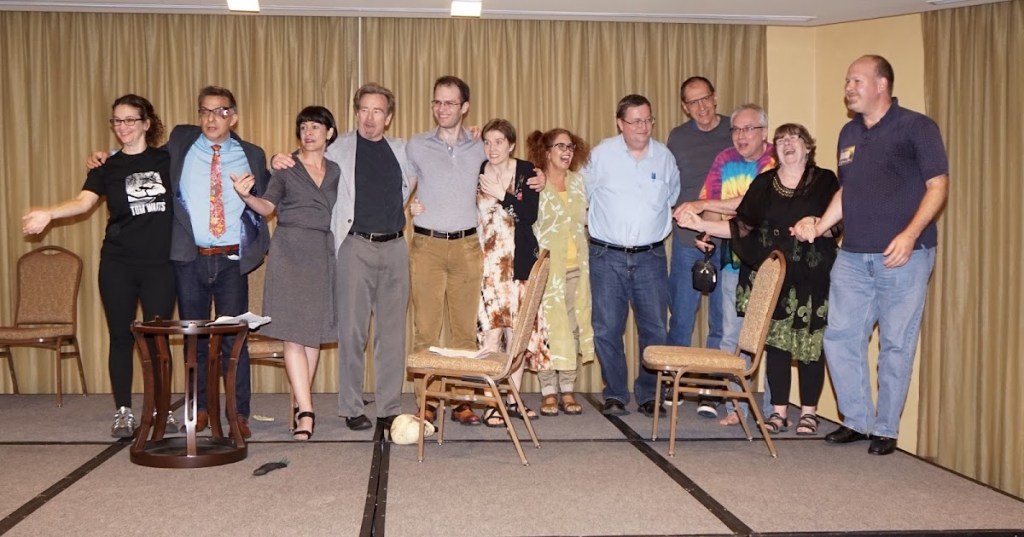
In addition to awards and academic papers, ICFA also features panels about the craft of writing and the culture of the fantastic.  Also, readings by the writers.  Lots of readings.  You can often preview the next year’s ToC here by sitting in on ICFA readings.  These readings used to be my favorite part of ICFA until Carrie J. Cole, a dramaturge (look it up), producing director and professor of Theater and Performance Studies founded the fiendish ICFA’s Flash Play Festival.  Every year, a couple of weeks before the conference begins, she sends out a call for plays.  She challenges us to write a ten-minute play (roughly ten pages of dialogue) with parts for no more than three actors which must include two specific elements: one of three props (which change every year) and a line of dialogue (which also changes every year).

And it must be written at the very last minute. 

Then she picks the five or six best plays and casts them from her Flash Players, a motley group of writers and academics of varying thespian skills (as for instance myself, a shameless graduate of the Bill Shatner School of Scenery Chewing).  On the first night of the conference, Carrie and the other professional directors rehearse the plays with their casts.  Two nights later, scripts in hand, ready or not. the players attempt not to embarrass themselves or the playwrights by performing the plays. I have participated both as a playwright and an actor many times.   Over the years, despite some silliness, or perhaps because of it, Carrie and I have become good friends.  In fact, some of the plays I’ve written, thanks to her astute dramaturgy, have been performed by real actors on real stages of real theater companies. 


A flash play is like flash fiction, right?  I already had the dialogue, all I needed was some setting.  Two or three thousand words tops!   Done before Labor Day!


In 2017, Carrie’s challenge included these three props, a bat, a mechanical arm and a cursed map and the following line:  “I think we can agree this did NOT go as planned.”  Because my daughter Maura Kelly (more on her later) was a fan of escape rooms, I imagined a kind of horror VR escape room.  My main character, a working class firefighter, would be going to this show carrying a baseball bat as a prop to fight vampires.  He would have invited his ex-girlfriend to meet there in an attempt to get back together, but she would stand him up.  So, “not as planned.”  Instead he would fall in with a very special and strange someone who would be the embodiment of a wicked cool science fiction trope I had never tried to write about before. What trope?  Well, if you’ve already read “In The Dark,” you know.  And if you haven’t, I’m not going to spoil it for you.  Go find the September/October issue of Asimov’s!  Read!

So I wrote my ten-minute play and sent it off to Carrie.  Right before the conference, she wrote to say that she was in the awkward position of turning it down.  “I hope you understand why we have to pass on this one this year. I hope you’re still willing to tread the boards with us. And I really do hope you play with this script a bit more for future possibilities.”  Did this sting?  Of course!  Every rejection stings.  But I did act in that year’s festival.  And I have written plays for the festival since.  When Carrie and I talked about the play later, I could see her point.  My little play didn’t really have an ending, just an opening and that wicked cool idea.  And I hadn’t really had time to explore the idea in just ten pages of dialogue.  I grumbled, put it in a drawer and chalked it up to experience.

Six years passed. 

As I said, I’ve written a bunch of these little plays and some are pretty good.  They’ve had other performances and a couple have actually been published.  Last summer I got to feeling guilty about not sending Sheila a story and I wondered if maybe I could adapt one of them.  A flash play is like flash fiction, right?  I already had the dialogue, all I needed was some setting.  Two or three thousand words tops!   Done before Labor Day!

Only what play did I choose to adapt?  The one with no ending, of course.  The one with the wicked cool idea.  But the more I thought about the idea, the more complicated it got.  Then I got interested in the sociological background of it and so I consulted my daughter Maura, who happens to be a professor of sociology at Portland State University in Oregon. She was partly responsible for the VR escape room so why not ask her to help me think about the wicked cool idea?  Which meant I needed a sociologist character to say some of the lines Maura fed me. Then I fell into a rabbit hole of research about the lives of firefighters.  Alas, the ten page play did not turn into a three thousand word short story in mere weeks. It took several months to write the eleven-thousand-word novelette that finally became “In The Dark.”   So I think we can agree this did NOT go as planned.