A.M. Dellamonica returns to Asimov’s with “Failed Acts of Predation” in our [May/June issue, on sale now!] Here, they discuss phtyoremediation and how they bring together the elements of the story.
by A.M. Dellamonica
Something that’s flat-out incredible about my life is that I spend time in the orbit of working chemists, many of them genuine science rock stars. This is absolutely fantastic for me as an SF writer… they do the hard work of digging into the nature of reality, and in the process they drop science concepts I might never otherwise be exposed to, shiny little germs of possible story.
One such concept, phytoremediation, came my way about a year ago.
Phytoremediation is a strategy for extracting pollutants from contaminated ecosystems by loading said systems with plants that, instead of dying, take up the toxins.
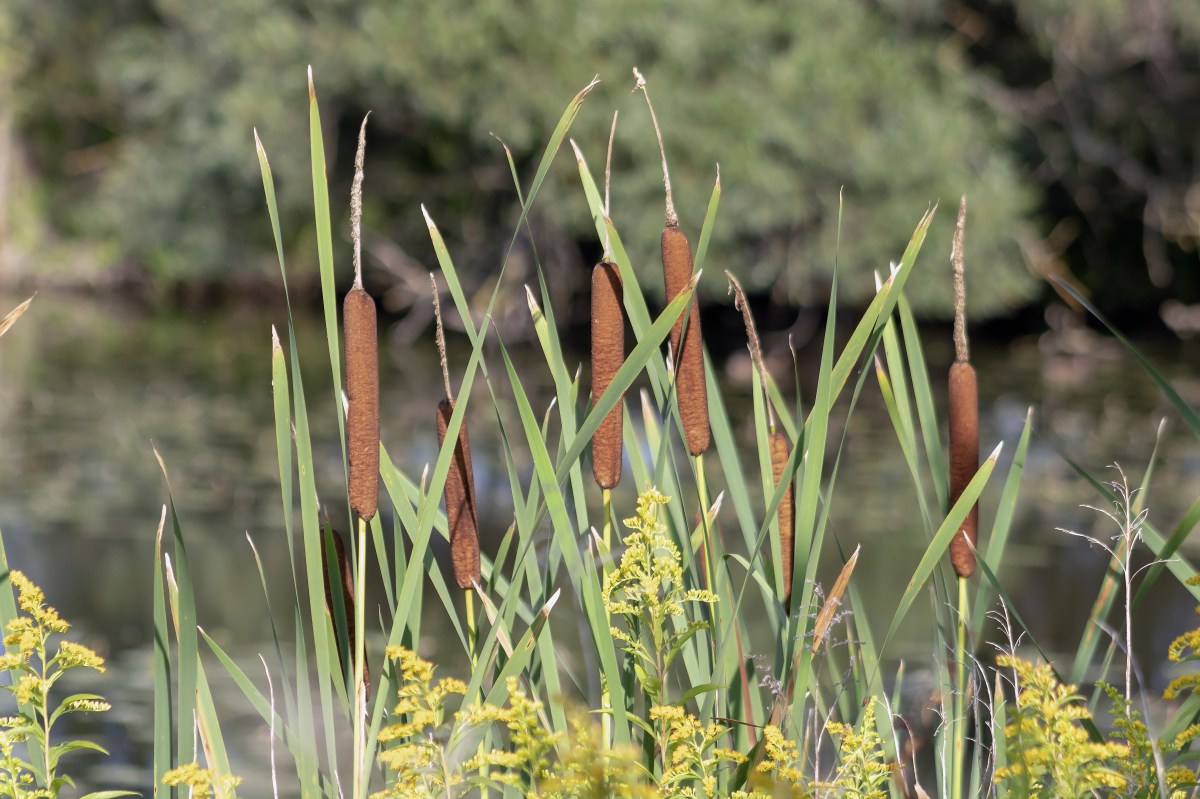
Cattails will do this, for example, which is a simple and yet completely miraculous fact. Here we have a swamp weed that can, over time—for phytoremediation, you must understand, is slow, the very opposite of a quick fix—can fill its roots and shoots with manganese, lead, and iron ore tailings, claiming them from soil that humans have casually worked to ruin.
The second I learned about phytoremediation, I wanted to build a story around it, complete with cattails. As I read on, I learned about another hyperaccumulator, one that doesn’t grow up near the Arctic Circle, where “Failed Acts of Predation” is set: pycnandra.
Oh, these trees!
First of all they hyperaccumulate nickel, another heavy metal that can have significant toxic effects on the land, water, and living things around it.
Pycnandra are tropical; they grow naturally in New Caledonia. They can tolerate incredibly high nickel levels in soil. Their sap is a vivid silvery-green color… when cut, they bleed liquid metal. Go search some pictures… you’ll be impressed!
Back? They’re gorgeous, right?
Rhapsodizing about trees aside, you may notice that so far I haven’t said a single thing that isn’t a present-day biological fact. It’s the stuff of a straight up ecology article. Phytoremediation is the science part… and now I want to talk about how I go about putting in the fiction.
My fiction mashes things together: in this case, phytoremediation, talk pads for pets, autistic burnout, near-future supply-chain failures, and the terrifying economic transition we are currently making as a society, this sea change so much on everyone’s minds, as robots and AI become increasingly capable of doing certain kinds of work for us.
The science a writer chooses to highlight in worldbuilding also affects the pace of the story, the nature of its unfolding.
When I write, I draw disparate threads into a fabric into which I weave people (and wild cats and bears, in this case) knotting together a complicated series of love stories.
It’s a glide from things that do exist to things that may be possible: to set this story in the north, I had to imagine genetically engineered pycnandra trees. Silver sap on snow: an imaginary species created for the landscape of my childhood, an environment very different from New Caledonia. It’s scientific speculation with a big dash of the improbable. At the same time, it’s an aesthetic choice. I could just do the story with cattails… and yet I can’t.
The science a writer chooses to highlight in worldbuilding also affects the pace of the story, the nature of its unfolding. This may seem obvious, but slow-bake ecological remediation doesn’t lend itself to an action-adventure narrative.
Okay, I know, there’s a bear attack. And… a slight helicopter crash. Maybe that’s how the world feels to me these days. But I still would argue this story is slow-paced. Am I wrong? We don’t always see our own work clearly. I think “Failed Acts of Predation” grows as slowly as the trees.
For pycnandra is not a tree that grows swiftly, and the downstream effect of that on “Failed Acts of Predation,”—its destiny, if you will—is to be a story about slow healing. In these much-troubled days, more than five years after the upheaval and losses of the Covid pandemic, I needed to write about a place where nickel hyperaccumulators are left to tend a wounded landscape for decades before the toxins can be extracted. That in turn populating that forest with characters who may be willing to spend a lifetime overwatching the recovery. Sedge, with his collection of robots and his adopted bobcat and his strengths and vulnerabilities, arises in that environment naturally.
As I write this, I see that I have also perhaps imbued the story with a little bit of a fairy-tale feel, with its talking animals and accursed forest. Even though this is a science fiction story, there’s a sense in which it is also about a man in a lonely and inaccessible place. Perhaps not a prince in a tower but someone who, like so many of us, is hoping for some magic, to weather the transformation of the world and somehow become stronger while they wait for someone to arrive and touch them—to make a connection.
I hope you can find something like that within this story, and take it with you as you wander out in your own landscapes, be they haunted or, hopefully, at least occasionally enchanted.

