Q&A with Hollis Joel Henry

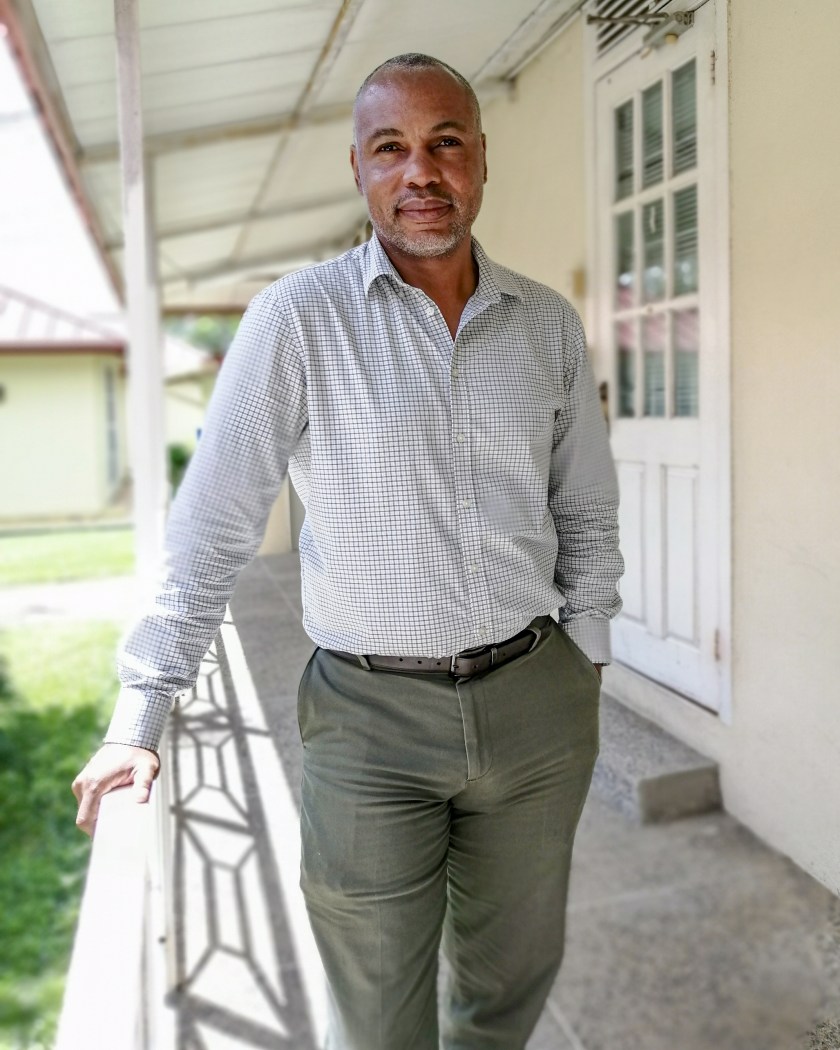
For Hollis Joel Henry, starting small and building a habit of writing half an hour each morning has bloomed into publishing his second story of 2020—his second published story ever! Read on to learn how “The Last Water Baron” [on sale now] draws on twenty years of ideas, a year and a half of determined effort, and a diverse panoply of SF influences.


Asimov’s Editor: What is the story behind “The Last Water Baron”?

HJH: I’ve had aspects of this story in my head for about two decades. I think it started with the character Vladimir. I liked the idea of a bionic/cyborg mercenary/assassin. But it was very basic, simple action hero stuff that I daydreamed about but never committed to paper. Then some years back I read in National Geographic about the potential for a water crisis and was both upset and intrigued. I’m very environmentally conscious now – particularly as the focus is gradually shifting from climate change to our impact on the natural world and planetary health.

However, the thing that really brought the story together was the idea of Tommy and people like him. I say that as if Tommy is somehow so very different to us, but that’s not true. He is very much like everybody else, and that’s really the point.

AE: Is this story part of a larger universe or is it standalone?

HJH: It’s part of a group of stories with shared themes. Everything I wrote in the last year and half is unified by certain themes. One is even a continuation of the other. They are all set in the future, not too far but far enough for us to start seeing even worse consequences for how we live as a species.

AE: What made you think of Asimov’s for this piece?

HJH: I think of Asimov’s for everything I write (which might not be too strategic sometimes, as my stories can tend towards the extremely dark and violent). I first read the Foundation and Robot series when I was maybe ten years old, and they made a great impact on me. The character of the Mule is probably reflected in some of the characters I’ve created. I’ve always been imaginative and dreamy, and the work of Asimov was there for me. I believe in bringing things full circle.

AE: Who or what are your greatest influences and inspirations?

HJH: Oh there are so many. I’m a lifelong lover of Sci-fi and fantasy, the classic stuff—Frank Herbert, Ray Bradbury, Ursula Le Guinn—Wizard of Earthsea is more of a friend than a book to me. I’m also a literature student and was impacted by writers like Dostoyevsky, Nikos Kazantzakis, Fitzgerald, and Dickens. I’m also from the Caribbean, and we have a great and inclusive literary tradition of West Indian writers like V.S. Naipaul and George Lamming, and also writers from the Global South such as Gabriel García Márquez, R.K. Narayan, and Ngugi wa Thiong’o. I’d say for this particular story, the care and compassion I put into Tommy is most reflective of Ngugi’s handling of the colonial officers in his native Kenya. He refused to make them cardboard villains.

I’m also a Gen-Xer. I grew up in the time of the emergence of comic books, kung fu, video games, and action animation. All of these things have influenced me.


“You can’t spot fix your writing. Look at your life. Look at your thoughts. Look at your patterns. Improve those and you may improve your writing.”


AE: Are there any themes that you find yourself returning to throughout your writing?

HJH: I definitely have my themes. A big one is self-deception. For me self-deception is dishonesty plus cowardice. I can abide an honest liar, like Tony Montoya in Scarface—“Even when I’m lying I’m telling the truth.” I have trouble with self-deception. Great evil has been perpetrated in the world because of it. Also, the very bruising journey from naivety to understanding is another major theme of mine.

AE: How did you break into writing?

HJH: I had my own hero’s journey, you could say. I’ve always been a good writer. I remember in kindergarten our class had to do a word exercise where we put a bunch of words into a paragraph. I wrote a short story called “The Little Eagle,” and the teacher went nuts when he read it. They published it in the school newsletter. It was like that for many years. I won the Writers Union of Trinidad and Tobago short story under seventeen competition with a crazy sci-fi story called The Daydreamer.

But after that I lost my way. I stalled and spent decades with writer’s block. I became a journalist, then a corporate writer. I did, am doing, alright for myself but I had that soul sickness, that feeling of guilt and restlessness writers feel. Then a couple years ago I decided why not? Why not just give it a go?

So I started small, a half hour a morning, every morning. I just wanted to form the habit. Then I built up and gradually spent more time. I started thinking in terms of filling time, not being inspired or writing a particular story, just spending the time every day. It adds up fast. I wrote about seven short stories in that time. I submitted with the same kind of mechanical approach. I wasn’t submitting to get accepted; I was submitting to meet a quota of submissions. I did my best to take ego out of it.

Within a space of a year and a half I sold two stories out of the seven. The first to Clarkesworld and the second to Asimov’s. I’m actually still in shock. But I have much more to do and much lost time to make up for.

AE: What SFnal prediction would you love to see come true?

HJH: I would love to see us reach the point of enlightenment, inquiry, and compassion depicted in the Federation of Planets from Star Trek. I feel like this is the answer everyone gives!

AE: What are you reading right now?

HJH: I’m actually reading the Jonathan Hickman X-men run—House of X and Powers of X. He has really revitalised the X-men universe. There is also a very chilling far future world presented in the comic that I would love to read a series on by itself.

AE: Do you have any advice for up-and-coming writers?

HJH: Hmm, I think each writer’s journey is so different, even though there are parallels. I would say that what helped me most was to stop thinking of writing as the solution to my life’s problems and also to stop trying to solve my writer’s block separate from other aspects of my life. Writer’s block is a symptom, not the problem, and I couldn’t solve it by focusing on it alone. It’s like how they say you can’t get abs by doing crunches alone. You can’t spot reduce your stomach. You can’t spot fix your writing. Look at your life. Look at your thoughts. Look at your patterns. Improve those and you may improve your writing.

rpt


Hollis Joel Henry is a writer living in Trinidad and Tobago. Born in the U.S. to Trinbagonian parents, he has spent his life between both countries. A lover of fantasy, science fiction, and horror from early childhood, he later became enthralled by the themes, wit, and craftsmanship of Caribbean, Latin American, African, and South Asian storytelling. The author does his best to reflect these influences in his work. Hollis is currently the editor of the official news magazine of The University of the West Indies (UWI) St. Augustine Campus, UWI Today. In February 2020, his first published short story, “Outer,” appeared in Clarkesworld. His second published story is “The Last Water Baron.”

2019 Readers’ Award Results!

This year our celebration was by necessity a virtual one. But that just means that we are able to invite ALL to take part! Watch below for editorial and author commentary as the final results of the annual readers’ awards are announced:


Asimov’s Science Fiction

Readers’ Award Winners

Best Novella:

Waterlines—Suzanne Palmer (July/August 2019)


Best Novelette:

In the Stillness Between the Stars—Mercurio D. Rivera (September/October 2019)


Best Short Story:

Sacrificial Iron—Ted Kosmatka (podcast) (May/June 2019)


Best Poem:

A Street Away—Jane Yolen (January/February 2019)


Best Cover:

July/August    Maurizio Manzieri


Rick Wilber and Brad Aiken on “Ithaca,” Writing, Collaborating, Playing Baseball, and Being a Physiatrist

“Ithaca” [in our May/June issue, on sale now] combines Brad Aiken and Rick Wilber’s interests in baseball and medical technology. Below, the coauthors discuss their interest in these topics, the collaborative process, and their other exciting writing projects.


BA: Rick, your experience and passion for the game of baseball really shines through in your stories. I’m a bit of a baseball junkie myself, so I can’t get enough of that stuff, but for the average SF reader, baseball is probably like quantum physics—too much of either can bog a story down. How do you decide how deep to go with it? Do you let the writing carry you away, then have to trim it back down?

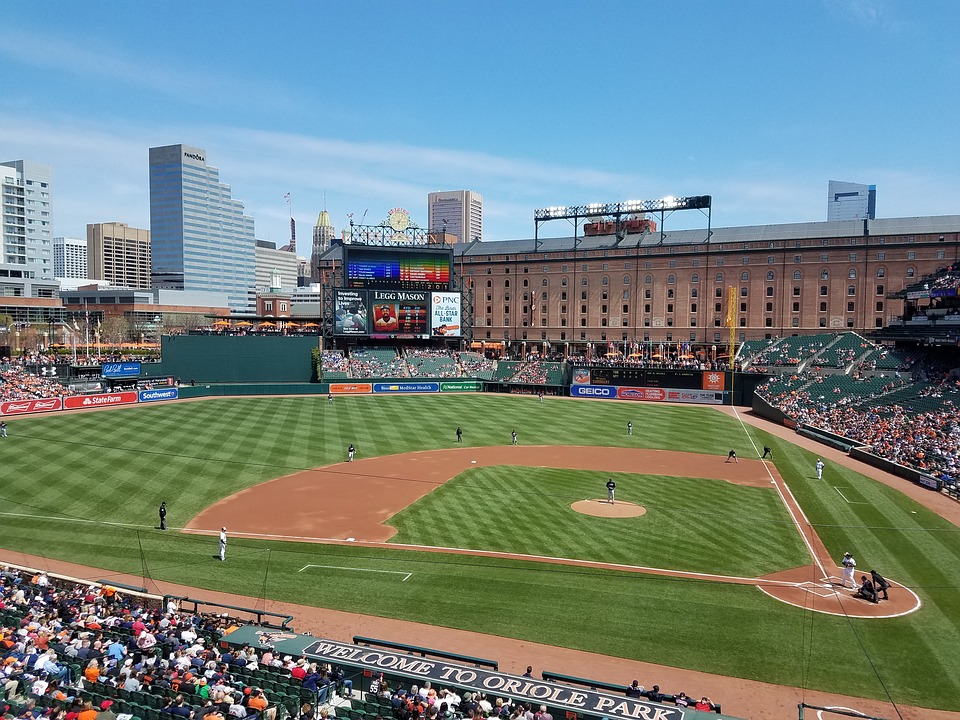
RW: You’re right to ask that, Brad. Every now and then I get a reviewer or commenter who says, “I hate baseball!” But I think they’re missing what any story, and especially this story, is really about when they say that. Baseball, for me, is just a means to an end, much as the medical field is for you. Generally, most readers, even non-fans, know the game well enough to understand what’s going on when we’re talking balls and strikes and pitching and hitting and running the bases. More specifically and personally, I have a deep familial connection to the game, since my father was a player, coach and (briefly) manger in the major leagues. In this particular story, there’s some sibling rivalry and we use baseball to set that up, inverting some expectations, I hope, in how we manage who envies whom in terms of playing the game.

Heck, the simple truth is that I know all about sibling rivalries and baseball, and so I’m really comfortable writing about that. I was certainly the weakest baseball player of the three sons in our family growing up, and both of my sisters, had they been given the chance, would have outplayed me as well; so I grew up being familiar with a certain kind of sibling envy. As a result, readers of the story will see right away which character I identify with the most. Unfortunately.

RW: So how about you, Brad, as a writer using your inside medical knowledge? Tell us something about how you wound up a top physiatrist (and yes, I had to look that up). What led you to specialize in physical rehabilitation and prosthetics? Of equal importance, how did you wind up a fan of the Baltimore Orioles? It’s not easy to be an Orioles fan these days. They finished last in the American League East last year. Ugh. Do they need a top physiatrist? And I bet they could use some prosthetics!

BA: Ouch. Thanks so much for bringing up my beloved O’s stellar record (223 losses the past two years). Still my favorite team, though. I became a die-hard fan as a ten-year-old when the upstart young 66 Orioles beat the powerhouse Dodgers in four straight to win the World series. Ironically, they are part of the reason I went into PM&R (Physical Medicine and Rehabilitation). As a freshman medical student, I had the good fortune to go to a lecture from Dr. B Stanley Cohen—a charismatic and brilliant physiatrist who treated the Orioles. That drew me to do my residency with him, and although I did get to treat some famous ballplayers, it was the other side of PM&R I fell in love with— helping people recover from strokes and other serious disabilities. Watching the marvels of medical technology unfold, seeing how technological advances affect peoples lives, fueled my life-long passion for SF, and has served as a rich source of story ideas. When you approached me about collaborating on a SF story about a ballplayer . . . wow, the opportunity to pursue three of my passions and work with an author I admire; it was a no-brainer. (And I take brains very seriously.)


“Watching the marvels of medical technology unfold, seeing how technological advances affect peoples lives, fueled my life-long passion for SF, and has served as a rich source of story ideas.” -Brad Aiken


BA: Speaking of collaboration . . . You took my original, initial, sinister ending for “Ithaca” and turned it into a whole different twist. That was a tough one for me on the first read-through, but after I let it sink in, I found the humanistic ending you introduced to be less formulaic and more meaningful. You and I seem to mesh well bouncing ideas off one another and merging changes to fine-tune a story. Have you ever had the opposite experience in co-writing (no names required) where one of you doesn’t want to give up a story element that the other thinks should change?

RW: I’ll name names! I’ve collaborated on short fiction with Ben Bova on a baseball fantasy piece that ran in Asimov’s, and with my pal Nick DiChario on a baseball piece that ran first in a slick baseball magazine called 108 that published our story and promptly went out of business, so we never got paid. Happily, Fantasy & Science Fiction picked up the story later. I also collaborated with Alan Smale on a novella that ran in Asimov’s, combining baseball and ancient Rome (the first being my interest, and the second being his). That story, “The Wandering Warriors,” was the only time I’ve had a cover story in the magazine. That story, I should add, will be out again in hardcover with two other reprint stories, one from me and one from Alan, in August from WordFire Press. Most recently I’ve collaborated on this piece and another with you, and also on a straight-ahead generation-ship science fiction novelette with Kevin J. Anderson. In all cases, I’ve enjoyed the process. It’s useful to see where another writer wants to take the story, and to then make your work mesh seamlessly with your collaborator’s work. Honestly, I’ve enjoyed all of these collaborations. Hey, Brad, let’s do another one!

RW: What’s in your writing future, Brad? Do you have a novel in mind, something that combines your writing passion with your medical work? I see a lot of mystery/thriller novels that are medically related; do you have one in mind? Or maybe some near-future medical science-fiction thriller, like the arrival of some frightening coronavirus that threatens global safety.

BA: Always lots of ideas spinning around. I wrote a medical techno thriller called Mind Fields several years ago and had a lot of fun with it. Lately I’ve been working on a story about a society of androids that are sent to populate another world, arming them with the human precursor cells they need to restart humanity when they get there. The kicker, of course, is why would a bunch of AIs that we have essentially treated like slaves want us around again? I just finished a short story about it, and, depending on the response, might expand into a novel. It was fun imbuing the AIs with human traits/flaws, then seeing what worked and what didn’t. I’m also playing with some ideas on how to expand on the dystopian world you and I created for our other collaboration, and how someone may use a certain physical disability to their advantage in the early days of the class war that led up to the near-future dystopia.

BA: I know you’ve got a short story collection coming out any day, but how about the sequel to Alien Morning? I can’t wait to read more about those wonderful characters.

RW: The short story collection, Rambunctious: Nine Tales of Determination, is from WordFire Press and just came out in late March in hardcover and ebook. It gathers together some favorite stories of mine from the last thirty years or so. One of the stories, “Something Real,” won the Sidewise Award a few years ago after first appearing in Asimov’s. And another one, “Today is Today,” talks about Down syndrome, the Hamilton Tiger-Cats in the Canadian Football League, and multiverse theory, which is a crazy mix, but seems to work really well. The story’s been reprinted a couple of times since it came out in 2018 in the small literary magazine, Stonecoast Review #9. It’s included in the Best Science Fiction and Fantasy of 2019 anthology, in fact, edited by Rich Horton.

And I’m so glad you asked about the sequel to Alien Morning. The second novel in that S’hudonni trilogy for Tor Books is Alien Day: Notes from Holmanville, which was scheduled for later in 2020 but has now been pushed back into 2021. I’ve recently sold the short story “False Bay,” that’s closely related to that Alien Day novel. The story will appear in July in a WordFire Press anthology called Monsters, Movies & Mayhem that was put together by graduate students working in the low-residency MA/MFA Creative Writing program at Western Colorado University. My pal Kevin J. Anderson runs the innovative Publishing MA program at Western, and his lucky students got to solicit, choose, edit and produce this terrific anthology. I’m proud to be in it. Other writers in it include Fran Wilde, who’s director of the Genre Fiction track in that program (where I’m on the faculty, I should add), Jonathan Maberry, David Gerrold, Steve Rasnic Tem, and a list of other great established—as well as newer—writers. And I’m also working right now on another piece, a novella, that is associated with that Alien Day: Notes from Holmanville novel. I will, no doubt, send it to Asimov’s, and we’ll see what happens. Nothing better than having your stories appear in Asimov’s, right, Brad?

BA: Wow! Sounds like you’ve been busy. I’m glad you made time to work with me on “Ithaca.” It’s so exciting to finally get a story into Asimov’s, even if it is on your coattails. It’s an incredible honor to be even a small part of a publication with such a rich history, and to stand in the shadows of so many of the writers whose names have become synonymous with science fiction.


Brad Aiken <bradaiken.comis a physician specializing in rehabilitation medicine and has long had a fascination for how advances in medical technology may influence our future. After graduating from medical school, he became interested in how medicine and SF influence each other and has presented at numerous medical conferences, science fiction conventions, and at the 2014 meeting of the World Future Society. His short fiction has appeared in various publications including Analog. Among his novels are the medical techno-thriller Mind Fields and the futuristic adventure series Starscape. His most recent publication is Small Doses of the Future, a collection of short medical SF published by Springer as part of their Science and Fiction series.

Rick Wilber’s interest in baseball and science fiction is well established, with more than twenty published stories that combine those elements, many of them first in Asimov’s. Rick’s short story collection, Rambunctious: Nine Tales of Determination, is just out from WordFire Press and features some of his favorite stories from a long writing career. Another WordFire collection, The Wandering Warriors, will be out in summer 2020 and features the eponymous coauthored novella (with Alan Smale) that first appeared in this magazine’s May/June 2018 issue, along with two other bonus stories. Rick’s contributions to that book, no surprise, both involve baseball.

Lies, Damn Lies, and Stories About Stories: About Writing “The Mrs. Innocents”

by Ian R Macleod

For me, it generally seems that the genesis of a story arrives from several places and sources over a period of time, even if there are often moments when things suddenly appear to come together. With “The Mrs. Innocents” [in our May/June issue, on sale now], I could say with some superficial confidence that the moment when I felt I’d grasped a worthwhile idea for a story came when I stumbled across the wonderfully named Mrs. Innocent, who was Queen Victoria’s personal midwife, but was also witness to the badly botched delivery of the child borne by her daughter Vicky in Berlin, who grew up to be Kaiser Wilhelm. Combine that with the people who oversaw the delivery all being men, and that the resulting oxygen deprivation and withered arm affected young Prince Wilhelm’s health and upbringing, and that his difficult personality was pivotal in the deathly dance which led to World War One, and I sniffed a linkage between what is and what might have been that felt intriguing.

Writing this out as I just have confirms a clear trail of evidence; it feels rather like those red threads detectives weave from pin to pin across walls linking the culprit with the crime scene and the various bits of evidence and circumstance in between. But, again, and rather like those threads (and, indeed, cases as they are generally presented in court) this is a plausible version that can be used to reflect what happened in a believable way rather than the actual truth of what really occurred. When it comes to crimes rather than insights into a writing a story, we all know that most of them are committed not as the result of a cunning web cleverly woven by some master criminal, but more likely some half-thought-through impulse. It’s also often said that juries find this “well, it just kinda happened” explanation of crimes deeply unpersuasive, reared as we all are on a diet of complex fictional whodunnits which offer up neatly tied conclusions and clever twists. The same could be broadly said of fiction, at least when every schoolkid is required to “explain” exactly what William Shakespeare or Mark Twain had in mind when they wrote about a particular thing in a particular way, and every writer of fiction is expected to be able to “talk through” the process that ended up with a particular piece of fiction.

Even if you exclude writers, essayists and lawyers, we are all inveterate spinners of explanatory tales. It’s how we frame our lives and the things we see around us, from the tale of how we first encountered our loved ones to the way we deal with and react to world events. It’s also how we process memories, not to mention story ideas, although, as much clinical research shows, the supposed facts we end up telling ourselves often have at best a loose relationship with the hard actual business of unforgiving reality. The falsity of exact memory, and the way our brains are always striving to string things together irrespective of any real linkage, combined with what we now know about the largely subconscious processes by we actually make even trivial decisions, all tell us that the sudden moments of insight we think we had, we probably didn’t.


Even if you exclude writers, essayists and lawyers, we are all inveterate spinners of explanatory tales. It’s how we frame our lives and the things we see around us, from the tale of how we first encountered our loved ones to the way we deal with and react to world events.


So when I write about the genesis of my story “The Mrs. Innocents” being in the discovery of the name and circumstances of Queen Victoria’s midwife, there’s some element of truth to it, but also an element of wishful thinking, and probably downright fabrication. I certainly have a long-standing interest in nineteenth and twentieth century history, but intimate biographies of royals such as Queen Victoria really aren’t my thing, so I must have already been researching to some degree when I first came across Mrs. Innocent. What exactly triggered that research, I’m not sure, although it could have been knowing about Kaiser Wilhelm’s withered arm and wondering about the effect it might have had on world history. Then, I’d also long nurtured the idea of writing a story from the viewpoint of a pregnant woman. And I’m fascinated by, if not very knowledgeable about, the work of Nikola Tesla. I could even claim that I’d been thinking of writing about the Tesla Tower, his most bizarre and ambitious invention, but in truth I’m not sure, although I do reckon it was somewhere in the background. Oh, and I went to Berlin a few years back, which is surely another genesis of my story.

Like every other decision we make and every impulse we act on, the origins of a story lie in a mishmash of largely subconscious processes, random accidents and occasional moments of vague insight, along with a considerable number of dead ends, which, like some lazy boss, the conscious “I” then strings together and chooses to take the entire credit for in retrospect. Which I’m more than fine with. After all, it’s so much better to describe myself as a wise, clever and ever-creative storyteller stringing all the elements together into a complex web than to admit the truth. Which is, at the end of the day, “well, it just kinda happened.”


Ian R. MacLeod, who lives in the riverside town of Bewdley, England, has written many alternate histories over the years, of which The Summer Isles—which appeared in novella form in Asimov’s back in October/November 1998 and won the World Fantasy Award and Sidewise Prize for Best Alternate History both in this form and as a novel—is perhaps the best known example.

Q&A with Eleanor Arnason

Eleanor Arnason’s character Lydia Duluth returns to Asimov’s pages in her novelette “Tunnels” [in our May June issue, on sale now]. Eleanor took the time to tell us about the inspiration for this story, how she relates to Lydia, and the career of hers that’s had the strongest influence on her writing—You might be surprised!


Asimov’s Editor: Is this story part of a larger universe, or is it stand-alone?

EA: This is part of a series, which I call The Adventures of Lydia Duluth. Lydia is a location scout for Stellar Harvest, a holoplay company producing dramas that are loosely based on the classic Hong Kong martial arts movies of the late twentieth century. (Stellar Harvest also makes musicals in the manner of Bollywood. Ramona Patel is the great star of these.)

Each story takes Lydia to a new planet, where she stumbles into a new adventure. The stories are my homage to Hong Kong movies and to space opera and planetary romance. There are seven preceding Lydia Duluth stories, also three additional stories set in her universe. Most were published by Asimov’s.

AE: What is the story behind this piece?

EA: My significant other worked for many years with homeless people living in tents or empty buildings or caves along the Mississippi. I heard a lot about these people and wanted to write about them.

The Goxhat come from a couple of earlier Lydia Duluth stories. (One of these, “Knapsack Poems,” was published in Asimov’s and was a Nebula finalist.) They are an alien species who have no sense of themselves as individuals. They usually live in small groups of four to sixteen bodies, which they see as a single person. Over time they have also come to believe that their entire species is one person, though they have no trouble identifying individual bodies, genders and personalities. Is this confusing? Not to them.

I no longer remember where the self-building concrete tunnels come from.

AE: Do you particularly relate to any of the characters in this story?

EA: I noticed decades ago that almost all the protagonists in my fiction have names that begin with E, A, L, or N. The reason for E and A should be obvious. L and N become obvious if you sound out my first name. (After I figured out that I was doing this, I kept doing it. Why not?) So I would say I relate to Lydia, though Lydia is more of less named after my friend Lyda Morehouse, another SFF writer. Also, Duluth—an old industrial and shipping town on Lake Superior—is one of my favorite cities. You haven’t lived till you have seen a thousand-foot-long lake boat come in through the Duluth shipping canal, on its way to be loaded with ore from Minnesota’s Mesabi Iron Range. I like to think I have some of Lydia’s idealism. I certainly have some of her discouragement after fifty years of neoliberalism; and like her I have done non-art work for arts organizations.


Why does anyone tell stories? To entertain others (my kid brother). To entertain oneself. To make sense of the world, and to oppose the pain and injustice of much of the human world with something that is well-made and just and funny.


AE: How did you break into writing?

EA: I sold two stories to New Worlds in the early 1970s and then three stories to Damon Knight’s Orbit anthology series, also in the 1970s. My first novel, The Sword Smith, came out in 1978 from a small publishing house that turned out to be a tax-avoidance scheme. In order for the scheme to look plausible, the publisher had to actually publish some books, and he didn’t much care what they were. An acquaintance of mine was working for the company, not realizing that it was fake, and bought my book. It did not do well, as you might imagine. It has recently been republished in ebook version by Aqueduct Press. It’s really pretty good, a fantasy about a sword smith on a non-epic quest, aided by a small female prepubescent dragon. The important part of all this is: the IRS nailed the publisher for tax avoidance, and he went to prison.

AE: What inspired you to start writing?

EA: As far back as I can remember, I have wanted to create stories. I told my kid brother made-up stories before I could read or write. Why does anyone tell stories? To entertain others (my kid brother). To entertain oneself. To make sense of the world, and to oppose the pain and injustice of much of the human world with something that is well-made and just and funny. (My third novel, Daughter of the Bear King, is a fantasy about the epic struggle between the forces of integrity and shoddiness.) As Archy the cockroach typed, “Expression is the need of my soul.”

AE: What other projects are you working on?

EA: A collection of Lydia Duluth stories to be called (I think) The Adventures of Lydia Duluth, which I hope to complete real soon, though I keep writing stories about Lydia, and it’s possible that Asimov’s readers will see one or two.

AE: If you could choose one SFnal universe, what universe would it be, and why?

EA: Star Trek, off the top of my head. I have only seen the original TV series, plus several of the following movies, so it would be that version of Star Trek. For the obvious reasons: Star Trek’s universe is mostly fair and humane and sane.

AE: What SFnal prediction would you like to see come true?

EA: Universal peace with justice. Also, I wouldn’t mind FTL and trips to other star systems.

AE: What are you reading right now?

EA:
I am rereading C.J. Cherryh’s Foreigner series, before getting the most recently published novel in the series; and I am about to reread Naomi Kritzer’s Catfishing on Catnet. Naomi is in my writing group, so I have seen the alpha version, but still need to read the final version.

AE: What other careers have you had, and how have they affected your writing?

EA: I’ve done a lot of office work, in addition to working in warehouses (as an order puller and packer) and art museums (as a librarian and a script writer for an audio system that never worked properly). Most important, I have done a lot of accounting for small organizations, both for-profits and nonprofits. The accounting shows up in a fair amount of my fiction, including “Tunnels.” Accounting is very important and not treated with the respect it deserves.

AE: How can our readers follow you and your writing?

EA: A good question. I have a blog, easily found by googling “Eleanor Arnason.” I have not been good at keeping it up. My website is still under construction. In a more normal time, people could find me at cons in the Twin Cities and at Wiscon. We can all hope that normal times return.


Eleanor Arnason’s first story appeared in 1973. Since then, she has published six novels and fifty works of shorter fiction. Her novel A Woman of the Iron People won the James Tiptree Jr. and Mythopoeic Society Awards. Her novel Ring of Swords won a Minnesota Book Award. Other works have been finalists for the Nebula, Hugo, Sturgeon, and Sidewise Awards. Eleanor’s most recent books are Hidden Folk (2014), a collection of short stories based on Icelandic folklore, and Hwarhath Stories (2016), a collection of short fiction set in the universe of Ring of Swords. A new edition of Ring of Swords came out in 2018. The author lives in the Twin Cities Metro Area. Her current goals are to finish the long-long-past-due sequel to Ring of Swords and a collection of Lydia Duluth stories.


Q&A with Derek Künsken

We’re used to grand world-building from Derek Künsken, but in “Tachyon Hearts Cannot Love” [in our March/April issue, on sale now] he challenged himself to write on a smaller, more personal scale. Below, he gets more personal still, diving into this story’s origins, his long history with Asimov’s, and the impact his winding career path has had on his writing.


Asimov’s Editor: What is the story behind this piece?

DK: I’ve been unbelievably fortunate that my science fiction has been well received in China. One of my Chinese publishers has commissioned short fiction from me with various futurism prompts. Last year, they invited me to write a story for the Chinese Lunar New Year celebration, with the cultural prompt that it had to do with homecoming. “Tachyon Hearts Cannot Love” came out of that invitation, and when I was considering its English-language home, I was very happy that it was a fit for Asimov’s.

AE: How did this story germinate? Was there a spark of inspiration, or did it come to you slowly?

DK: My normal short fiction length falls naturally at ten thousand words or fourteen thousand words, in part because most of my stories are heavily world-built with a fair amount of science-y sense of wonder that needs room. This story needed to be less than three thousand words, so I knew my normal world-building wouldn’t fit, and that it would need to be more personal.

I decided that if I was going to consider anyplace home in the deepest sense, it would be the village where my mother had been born (and all my uncles and aunts, and all my grandparents going back six generations). I feel rooted to that village.

And in terms of a personal story, I decided to dig into my reaction to my first heartbreak, which happened when I was twenty-five. At the time, I didn’t know what to do to make the feeling of bleakness go away, or how to manage it, so as soon as I could, I went far away. I saw many things and met new people who were different from me. When I’d gotten as far as I could be geographically and emotionally, I didn’t feel particularly better and my one solace seemed to be dreaming of going home—not to the place where I grew up, but to where all my roots were. That wasn’t a story I’d ever told. I usually approach my fiction as a kind of sense-of-wonder escape. This felt like the right time and right way to write a story about what I knew.

AE: What made you think of Asimov’s for this story?

DK: Sheila bought my second story ever in 2007 and “Tachyon Hearts Cannot Love” will be my ninth appearance in the magazine. She’s bought the hardest scifi I’ve ever written, and she’s also taken pieces that are quieter and more introspective. I felt that she might enjoy this one.

AE: What is your history with Asimov’s?

DK: After she bought “Beneath Sunlit Shallows,” I received two to three years of rejections from Sheila, but they were always kind and encouraging. When I met her in Montreal in 2009, she remembered each of my rejected stories and gave me some additional feedback, which I took to heart. In 2010, Sheila bought a light scifi satire, “To Live and Die in Gibbontown” (which is available as a free audio podcast at the Asimov’s site).

Then I decided to return to the space opera and hard scifi settings that I love. Sheila bought the extremely alien “Way of the Needle,” which won the Asimov’s Readers’ Award. She also published the equally alien “Schools of Clay” and “Pollen From a Future Harvest,” both of which contribute science fictional or political elements to my novels The Quantum Magician, The Quantum Garden and The House of Styx. I’m grateful for the editorial encouragement I’ve had over the last 12 years from Asimov’s.


I usually approach my fiction as a kind of sense-of-wonder escape. This felt like the right time and right way to write a story about what I knew.


AE: Who or what are your greatest influences and inspirations?

DK: My early reading was comic books and Edgar Rice Burroughs and Tolkien, none of which were particularly helpful for an aspiring novelist or short story writer. As I became a more discerning reader, I discovered David Brin’s Uplift, Stephen Baxter’s Ring, Robert Holdstock’s Mythago Wood, Alastair Reynolds’ short and long fiction, Charles Stross, and of course, Dune. On the more literary side, One Hundred Years of Solitude remains my favourite novel, while I enjoyed a lot of the short fiction of Nadine Gordimer, Alice Munro and Anton Chekhov. And I remain deeply indebted to Podcastle and Escapepod for feeding me short fiction through a firehose as I was trying to improve my writing.

AE: What is your process?

DK: After many unpublishable failures, I don’t trust myself to pants anything. So I’m a detailed outliner and I interrogate the ending and denouement especially to see that they work before I write a single word. I tend to start with setting or some bizarre detail of physics, biology or ecology. Characters and plot grow out of that world.

AE: What are you reading right now?

DK: 2019 was a really busy time with lots of travel and family time, so intellectual and emotional bandwidth felt a bit constrained. So as sort of popcorn reading, I’ve been listening to a lot of comic book history documentaries and I’m currently trying to read the entirety of the X-Men, from 1963 to the present. So far I’ve reached 1970. I’m also really enjoying Al Ewing’s The Immortal Hulk and a bunch of Image titles.

My audible account has a Ted Chiang collection, Astounding by Alec Nevala-Lee, Arkady Martine’s Memory and Empire, Greg Egan’s Incandescence, Peng Shephard’s Book of M, and Stanley Chan’s Waste Tide.

AE: What other careers have you had, and how have they affected your writing?

DK: While I was still in university, I was a reserve air force officer. And during grad school, I built genetically engineered viruses to test as vector systems for the delivery of therapeutic genes into tumours. The former encouraged an understanding and appreciation of the traditions of a military of a middle power like Canada, which at that time identified strongly with opposing fascism and Nazism in the two world wars and being important peace-keeping forces in modern times. The latter career enabled a lot of kind of heavy technical alien building that is probably a characteristic of my writing.

After grad school, I worked with street kids in Honduras as a volunteer for almost a year, before joining the Canadian Foreign Service, where my first job was processing in-country refugee applications during the civil conflict in Colombia. Both of those jobs depended on having a very strong heart, to withstand both the successes and failures that came with each.

I’ve tried, usually unsuccessfully, but occasionally adequately, to write about street kids. Most of the failures involve me not feeling like I’m capable (literarily or thematically) of doing justice to what the kids have gone through, and not knowing how to fictionalize what I saw. I did write a literary story (“Getting High With Thomas the Apostle”—free read here: http://subterrain.ca/magazine/49/subterrain-issue-52), a fantasy story (“Juan Caceres and the Zapatero’s Workshop”—free listen here: http://podcastle.org/2013/09/07/podcastle-276-juan-caceres-in-the-zapeteros-workshop/), and a comic book short story (in press). I think the refugee themes have made their way into my short fiction and novels.

Fatherhood is its own career and that theme has run through a few of my stories and novels.

AE: How can our readers follow you and your writing?

DK: I tweet from @derekkunsken in the snowy wastes of Canada (well, they’re snowy now . . .). I blog about comic books and the comic industry every two weeks at http://www.blackgate.com. Writing-wise, the events of my first novel, The Quantum Magician, occur about two hundred and fifty years after the events in The House of Styx. The Quantum Magician and its sequel, The Quantum Garden are available everywhere via

The Quantum Magician: https://books2read.com/u/bQav7D

The Quantum Garden: https://books2read.com/u/m2rgn6

I also write a retro-futuristic, Flash Gordon-esque young adult jet-pack adventure webcomic called Briarworld available to read for free at http://www.bitly.com/briarworld. Check it out or show your kids!


Derek Künsken writes science fiction and fantasy in Gatineau, Québec. In previous incarnations, he did molecular biology experiments, worked with street kids in Honduras and Colombia, and served in the Canadian Foreign Service. His short fiction has appeared in Asimov’s, Analog, Clarkesworld, and BCS, as well as in several year’s best anthologies. His first novel, The Quantum Magician, is a space opera heist story, and its sequel The Quantum Garden was published in October. “Tachyon Hearts Cannot Love” is his ninth appearance in Asimov’s.

Q&A with Lia Swope Mitchell

Lia Swope Mitchell’s “Rena in the Desert” [in our March/April issue, on sale now] explores the difficulty of transitions, a theme Lia identifies as resonant with both her own life and the current condition of the United States as a whole. She took the time to talk with us about the uncertainty of the future, editing with an eye toward connecting with readers, and her work as a translator.


Asimov’s Editor: How did this story germinate? Was there a spark of inspiration, or did it come to you slowly?

LSM: This story grew relatively quickly from its very prosaic title: “Rena in the Desert” is quite simply the story of Rena, who is crossing the arid landscape of the Great Basin, on the way from Chicago (in the now oppressive and authoritarian United States) to Tahoe (where refugees arrive in the newly independent Pacific Coast). Of course, driving through the desert isn’t as easy as she’d imagined. When she arrives at what seems like an oasis, she finds a little girl who lives, apparently alone, in an automated motel.

AE: What is the story behind this piece?

LSM: I wrote this story at the same time that I was working on the final chapter of my dissertation. It took me a long time to finish my PhD, in large part because I didn’t know what I would do after graduate school, and the conflict that I was feeling then is what I see now as the central theme of “Rena in the Desert.” It’s a story about the difficulty of making a transition, of leaving the situation you know—which may seem quite comfortable, or at least have the comfort of familiarity, even as it becomes less and less stable and sustaining. When you recognize that the status quo is no longer tenable, change—however difficult or unknowable it might seem—becomes the only real option.

AE: Is this story part of a larger universe, or is it stand-alone?

LSM: While “Rena in the Desert” is a stand-alone story, I can imagine writing more in this or a similar setting; it’s partly an extrapolation from certain currents in the culture of the United States today, as well as influenced by other things I’ve seen or read. So it may continue to feel relevant for future works.

AE: How much or little do current events impact your writing?

LSM: My writing certainly reflects my understanding of the state of the world. Continuing with the theme of transition in “Rena in the Desert,” and beyond my personal situation: while things are always changing, my impression is that the United States, and maybe the whole world, is in a more volatile transitional period than I have previously known. There’s a lot of competing visions of the future, and some of the potential roads look pretty rough. But it’s impossible to stand still, and equally impossible to return to the past—so all we can do is hope to find the best way forward.

AE: What is your process?

LSM: When I’m drafting a story, I try not to think too hard about anything outside of the story—I think about the characters, the plot, the prose, etc. But throughout the revision process, I usually ask myself: how does this relate to my life and my state of mind? What are its main questions and themes, and how can the story communicate those more clearly? This is less about transmitting a specific message and more about opening the story up for the reader, creating a sort of mental connection between them and me. My hope is that this process results in something that is, first and foremost, a good and satisfying story, but also a story with depth and resonance, that makes contact with the reader and leaves them with something more.


There’s a lot of competing visions of the future, and some of the potential roads look pretty rough. But it’s impossible to stand still, and equally impossible to return to the past—so all we can do is hope to find the best way forward.


AE: How do you deal with writers’ block?

LSM: Often if I’m stuck it’s because something isn’t working and I don’t know what. Sometimes it helps to change something up: add a character, switch perspectives, work on the setting, do some research. Other times it’s better to accept that I’m stuck and do something else, and come back to the work when I’m ready. This can slow things down a lot, to be honest. Maybe I don’t deal with it the best way!

AE: What other projects are you currently working on?

LSM: I have several projects lurking around. There’s an almost-done novella and a couple stories that I’ve completed but that need significant revisions. I’ve also written some new things recently that I want to ferment a while before I return to them. 2019 involved a lot of final work on my dissertation and a lot of translation work, so unfortunately my fiction was on the backburner more than I liked.

AE: What other careers have you had, and how have they affected your writing?

LSM: I work as a freelance translator, of mostly scholarly and literary works. Over the past year I’ve been working on a short novel by Antoine Volodine—in French it’s Alto Solo, and in English it may or may not be Solo Viola—which will come out from the University of Minnesota Press. I’ve also been working on some private commissions, works by a contemporary Belgian poet and a pacifist Jesuit priest from the mid-twentieth century. Very different voices, very different frames of reference, and all challenging in different ways. Translation is great writing practice, because it develops an attunement to all those different voices—and the varying registers they have—and how those differences can be conveyed through all the nuances of language. In fact, I’d recommend translation as practice for any writer with even just a reading knowledge of a second language.

AE: How can our readers follow you and your writing?

LSM: Website: http://www.liaswopemitchell.com. Twitter: @lswopemitchell.


Lia Swope Mitchell is a writer and translator from Minneapolis. She recently earned her PhD in French from the University of Minnesota by writing about visual technology and representations of the body in French speculative fiction from 1865 to 1926. Her short fiction includes appearances in Apex, Cosmos, Terraform, and Shimmer. Lia’s first book-length translation, Georges Didi-Huberman’s Survival of the Fireflies, appeared in 2018 from the University of Minnesota Press. In the turbulent future of her first story for Asimov’s, we learn of an odd encounter for . . . “Rena in the Desert.”

The Dell Magazines Award for Undergraduate Excellence in Science Fiction & Fantasy Writing – 2020

This year’s Dell Magazines presentation was held via Zoom on Saturday, March 21st at 7 p.m. EDT. Enjoy this video of award-winner Rona Wang reading her story “Imitation Game.”


The International Association for the Fantastic in the Arts and Asimov’s Science Fiction magazine have named Rona Wang of the Massachusetts Institute of Technology the winner of the 2020 Dell Magazines Award for Undergraduate Excellence in Science Fiction and Fantasy Writing, for the story, “Imitation Game.”

Rona Wang

Rona Wang

First Runner-up for the 2020 award is Cyrus Lloyd of Vanderbilt University for the story, “The Death of F209-5.”

Cyrus Lloyd big.jpg

Cyrus Lloyd

Second Runner-up for the 2020 is a tie between Kaley Mamo of Columbia University for her story, “The Bendix Diner,” and Wenmimareba Klobah Collins of the University of Puerto Rico–Rio Piedras Campus for the story, “Journey From Middle to Nowhere.”

Kaley Mamo

Kaley Mamo

Third Runner-up for the 2020 award is Grace Yang of Indiana University—Bloomington for the story, “Dragon Fall.”

GraceYangPic

Grace Yang

Honorable Mentions for the 2020 award go to Clair Spaulding of Columbia University for the story, “Halfsies,” Alexandra Rose Nagele of the University of Pennsylvania for the story, “Cell Culture,” Moe Kirkpatrick of the University of British Columbia for the story, “Ode to Andromeda,” C.E. McGill of North Carolina State University for the story, “Things to Bring, Things to Burn, Things Best Left Behind,” and M.H. Chau of Brown University for the story, “The Last Deer in Heaven.”

20200319_075450

Claire Spaulding

IMG_1978

Alexandra Rose Nagele

Charlie McGil

C.E. McGill


The deadline for submissions for the 2021 Dell Magazines Award is 11:59 p.m. on Tuesday, January 5, 2021. Submissions should be made through the award’s website at www.dellaward.com. The award also has a site on Facebook. For more information or submission guidelines contact Award Director Dr. Rick Wilber (Rickwilber@tampabay.rr.com) or see the magazine’s website.

The International Association for the Fantastic in the Arts is a worldwide network of scholars, educators, writers, artists, filmmakers, critics, editors, publishers, and performers who share an interest in studying and celebrating the fantastic in all artforms, disciplines and media: literature, art, film, drama, music, philosophy, religion, the sciences, popular culture, and interdisciplinary areas. IAFA publishes an interdisciplinary quarterly, Journal of the Fantastic in the Arts, the IAFA Newsletter, and an annual IAFA Membership Directory. IAFA also sponsors and organizes the annual International Conference on the Fantastic in the Arts (ICFA), which hosts the world’s broadest and largest selection of scholarly papers on the fantastic and has become the major forum for the exchange of ideas and dissemination of scholarship on the fantastic.

The Dell Magazines Award for Undergraduate Excellence in Science Fiction and Fantasy Writing is co-sponsored by Asimov’s Science Fiction magazine and the International Association for the Fantastic in the Arts and supported by Western Colorado University’s Graduate Program in Creative Writing, Low-Residency MA and MFA, Genre Fiction Concentration.


Q&A with Garrett Ashley

Garrett Ashley counts mold and decomposition among his sources of writing inspiration. This is reflected in his unsettling story “Skin” [in our March/April issue on sale now]. Below, Garrett discusses his literary influences, “Skin”‘s origins, and its transformation into a longer manuscript.


Asimov’s Editor: How did “Skin” germinate? Was there a spark of inspiration, or did it come to you slowly?

GA: Normally, when I get the spark to write something, I’m able to do it quickly, but I’m currently teaching classes and finishing a PhD, so I’ll take any time I can get these days.

As for inspiration, I love working with prompts. Give me a weird prompt, and I can at the very least get words on paper—good or bad. “Skin” began with a prompt. I wish I could remember what it was exactly: something about a stranger on a bus. There’s a scene on a bus roughly midway through “Skin” that I had so much fun writing I decided to do more with it. That means I had to write in both directions from the original material I’d started with. This sort of thing is painful to me, so it took me a few months to get the story right.

AE: Do you particularly relate to any of the characters in this story?

GA: I think the characters in this story and many of the stories I write think as I would think, do as I’d do—maybe if I were a lot braver. I do try to push away from making my characters look/feel too much like myself, in any case. It gets boring writing about myself all the time.

AE: How did the title for this piece come to you?

GA: I’m really bad at titles. I remember hearing Ray Bradbury speak about planning his stories—he liked to start with titles. He’d make a list of them and create stories around his titles. I wish I could do that. This story is about synthetic “skin,” so I titled it that way because I had no idea what else to call it.

AE: Who or what are your greatest influences and inspirations?

GA: My favorite weird writer to ever blow my mind is Tatyana Tolstaya. I wish I had written The Slynx. Anyone who is able to inject weirdness into their work not just for the sake of weirdness, but to have it move the story the way Tolstaya does, is super inspiring. I’m also really into Romana Ausubel, although I haven’t been able to read her new collection of stories yet. Aside from reading inspirations, I love dioramas, models, maps, food, plants, mold, decomposition.


It took me a long time to realize that characterization doesn’t belong just to people.


AE: Are there any themes that you find yourself returning to throughout your writing?

GA: Animals, our relationship with the natural world, etc. To add to my list of inspirations, Sharona Muir’s Invisible Beasts really changed the way I wanted to incorporate non-humanity into my writing. It took me a long time to realize that characterization doesn’t belong just to people.

AE: How do you deal with writers’ block?

GA: I have a shelf with a dozen or so books that I’ll turn to for writing energy. Maybe I’ll pick up random books and read all the first sentences and get inspiration that way. I think my problem, too, is that slow days are usually rooted in the sentence level.

AE: What other projects are you currently working on?

GA: In addition to finishing my dissertation (hopefully it’ll be defended by the time this comes out), I’m turning “Skin” into a longer manuscript. To be honest, having this piece taken by Asimov’s was incredibly validating to me—I want to explore more of the world these characters inhabit, and I’ve always hated the feeling of being done with something once it’s gone through the submissions process. I’ve been able to stick with this manuscript the longest of all the work I’ve started, and I should be done with it by the summer. I wrote a scene recently featuring a colony of mold under a house: the mold is studying a woman living there, preparing to become human itself. This is some of the most fun writing I’ve ever done, and hopefully it’ll work for whomever I can trick into reading it first.

 AE: What are you reading right now? What do you want to read?

GA: Journals, mostly, when I’m not doing school-related reading. Recent fun reading includes Anne Carson’s Nox and Micah Hicks’s Break the Bodies, Haunt the Bones, which is an incredible book. In addition to my writer’s block shelf, I have a “to read” shelf, which includes Lavie Tidhar’s Central Station, Famous Men Who Never Lived by K. Chess, and Arkady and Boris Strugatsky’s Roadside Picnic.

AE: Do you have any advice for up-and-coming writers?

GA: There are a couple things I wish I would have been told at an early stage: One, don’t get too hung up on subgenre, literary vs. speculative, etc. Write what you want to write, and if you have a reader or two that thinks it might be categorized as science fiction, or fantasy, or whatever, then you can try submitting it as such. I’ve never had much success with starting in on a project with a particular subgenre in mind.

And two, break the ice on submissions early, and get your first rejection out of the way. Don’t keep working on something until it’s dead and you’re out of energy and love. I know a few people who’ve done that.

AE: How can our readers follow you and your writing?

GA: I can be found on Twitter @GAAshley1. I’m also building a website at https://garrettashley0.wixsite.com/writer.


Garrett Ashley’s stories have appeared or are forthcoming at Asimov’s Science Fiction, Analog Science Fiction and Fact, Sonora Review, Reed Magazine, and DIAGRAM, among others. The short fiction collection in which “Skin” appears, My Grandfather Ran Off to the Woods, was a semifinalist at The Journal‘s 2019 Non/Fiction Collection Prize. He’s currently working on a novel.

Q&A with Nancy Kress

“Semper Augustus” [in our March/April issue on sale now] continues Nancy Kress’s decades-long tradition of writing about economic disturbances caused by automation. Read on to learn how the story also connects to tulips, how Nancy can tell when a story in progress has taken a wrong turn, and what her ideal society looks like.


Asimov’s Editor: How did “Semper Augustus” germinate? Was there a spark of inspiration, or did it come to you slowly?

NK: Any piece of fiction has multiple sources. In one way, everything a writer has ever experienced, read, seen, or heard is a source, in that these things stock the deep well of the mind from which stories flow. But that’s a pretty general statement, isn’t it? For this story specifically, I was concerned with the condition of the United States right now. We have greater, and nastier, political divides than I have ever seen before. We have enormous income inequality. We have increasing automation putting people out of well-paying jobs, and that is likely to increase.

I wanted to write a story about these things, and I wanted in particular to make the fictional situation as complex as real life can be. Revolution—as history shows us—can start by aiming for justice but also include leaders more interested in power than justice. Aristocrats, as history also shows us, may disdain and exploit those on the bottom of the socioeconomic heap, but exploiters are not one-dimensional: they have personal lives, affections, fears and failures. I don’t like fiction with unnuanced villains or heroic paragons. It feels false to reality.

As Jennie moves through various strata of society, she sees all of this complexity. She learns from it. Initially, I thought Cora might be the protagonist. But as the story grew—slowly—I learned more about what I wanted to say. Cora isn’t really capable of learning. Her daughter is. So Jennie became my focus.

And the tulips? I’m fascinated by the stock-market-like frenzy over trading tulip futures in 1600s Holland. It was so bizarre—future tulip bulbs, those that promised to be “broken” into new color patterns, sold for today’s equivalent of thousands of dollars. And the new colors were the result of a virus that eventually wrecked the plants! Unknowingly, the tulip madness was rewarding disease. There was my metaphor.

AE: Is this story part of a larger universe, or is it stand-alone?

NK: The novella is very much a stand-alone, but it does have an antecedent. In 2017 I published a story called “Dear Sarah,” in Jonathan Strahan’s anthology Infinity Wars. The background of that story was the same as that of “Semper Augustus:” a country whose economy becomes concentrated in the few who could exploit advanced alien technology, with a resulting revolution by the poor and militant. The protagonist of “Dear Sarah,” however, is a far different person from Jennie, and she makes far different choices.

In another sense, even my novel Beggars in Spain is connected to these stories, in that since the 1990s I’ve been writing about economic disturbances caused by automation.

AE: Do you particularly relate to any of the characters in this story?

NK: Weirdly, I relate to Gran. She’s a bad mother (which I hope I was not), a marginally better grandmother, harsh and controlling. But she does the best she can in impossible circumstances, and the central piece of advice she gives Grace, Cora, and Jennie is as true as anything I know: “Do what you have to, but be prepared for the shit you get doing it.” A definition, in its own way, of heroism.

AE: How did the title for this piece come to you?

NK: I am not good at titles. Usually my husband, writer Jack Skillingstead, ends up titling my work for me. But in this case, the name of the most famous tulip in the 1600s frenzy, the red-streaked Semper Augustus, fit the story. “Always Augustus”—but nothing is forever. Especially not society as we think we know it at any given moment.


. . . the central piece of advice [Gran] gives Grace, Cora, and Jennie is as true as anything I know: “Do what you have to, but be prepared for the shit you get doing it.” A definition, in its own way, of heroism.


AE: What is your process?

NK: I usually start with just an initial scene and a general set-up, often involving some sort of technology. That might be genetic engineering (it often is), automation, some weird alien tech I’ve dreamed up. The first scene, with a character clear in my mind, comes to me all at once, and I write the scene very quickly. If I’m lucky, the second scene also occurs to me, and I write that equally quickly (this is what happened with “Semper Augustus.”) Then I pause and begin the real work of thinking through the implications of what I’ve written. Who are these people? What do they want? What do they have to do to get it? What effect would this tech have on their society? What ideas do I want to explore here?

Then I write, much more slowly, trying to feel my way through the story by feeling my way into the characters. I know the general direction I’m going, but not the specific ending. That occurs to me, usually, about half way through, which means extensive rewriting of the first half.

All this writing and rewriting, incidentally, takes place beginning early each morning. I am very much a morning person. If it doesn’t get written by noon, it doesn’t get written. At least, not that day.

AE: How do you deal with writers’ block?

NK: I don’t get blocked, per se. But sometimes I find that I’m reluctant to work on a story—oh! I must scrub the kitchen floor! Oh! I must write an email to my second cousin whom I haven’t seen in ten years! That’s usually a sign that the story has taken a wrong turn. I find the last scene where I felt no reluctance to write, because that’s where the story took a wrong turn. Then I replot from there, usually discarding what didn’t work. And cursing a lot at having to do so.

AE: How did you break into writing?

NK: The only way possible—by writing stories, sending them out, having them rejected, sending them out again, getting rejected . . . repeat until something sells. Meanwhile, I examined any personal note on a rejection slip with the scrutiny afforded a treasure map, trying to figure out what needed to be done differently. Feedback from a competent instructor can help this learning process go faster, which is why I now teach aspiring SF writers.

AE: If you could choose one SFnal universe to live in, what universe would it be, and why?

NK: I would like to live in Ursula LeGuin’s anarchistic society Anarres in her novel The Dispossessed. Not because I think anarchy can actually work (I don’t), but because in her novel it does work. Everything is shared, there is very little crime, and income inequality does not exist because income does not exist. Everyone can do their chosen work, or no work, without the energy-sucking distractions of juggling bills and time. The level of existence isn’t high, but it’s adequate, healthy, and technologically sophisticated. I would be willing to give up luxury for equality and solidarity.

Interestingly, when I taught The Dispossessed at the University of Leipzig, students in the former East Germany did not agree. When offered a hypothetical choice, only two students chose Anarres over the capitalistic and exploitive sister planet, Urras.

AE: What SFnal prediction would you like to see come true?

NK: Self-driving cars. I am not a particularly good driver and I don’t like driving. Also, I’m still waiting for my personal jet pack.

AE: What are you reading right now?

NK: Andrew Yang’s The War On Normal People. His idea of a universal basic income was something I explored in Beggars In Spain. Yang has brought together in his book an enormous number of statistics, some personal experiences, and trenchant insights into class differences in the contemporary United States. And he writes well. I don’t necessarily agree with everything he says, but I’m interested.

 AE: How can our readers follow you and your writing?

NK: I was on Facebook, but during a period of illness I got away from it, and somehow never went back. I have a website but am woefully bad at keeping it up to date. I need to do better. I will. Maybe. Meanwhile, there’s always Amazon for my two forthcoming works, both out in May, 2020: a stand-alone novella, Sea Change (Tachyon) and a space-opera novel, The Eleventh Gate (Baen).


Nancy Kress is the author of thirty-three books, including twenty-six novels, four collections of short stories, and three books on writing. Her work has won six Nebulas, two Hugos, a Sturgeon, and the John W. Campbell Memorial Award. Forthcoming in May, 2020, are a stand-alone novella, Sea Change (Tachyon) and an SF novel, The Eleventh Gate (Baen). Nancy’s fiction has been translated into Swedish, Danish, French, Italian, German, Spanish, Polish, Croatian, Chinese, Lithuanian, Romanian, Japanese, Korean, Hebrew, Russian, and Klingon, none of which she can read. In addition to writing, Kress often teaches at various venues around the country and abroad, including a semester as guest lecturer at the University of Leipzig, an intensive workshop in Beijing, and the annual two-week workshop Taos Toolbox, which she teaches with Walter Jon Williams. Kress lives in Seattle with her husband, writer Jack Skillingstead.