
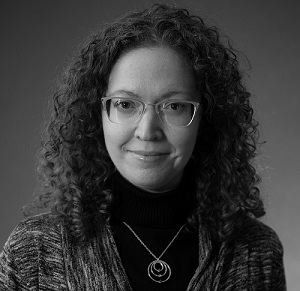
Stephanie Feldman returns to Asimov’s with “Half Inside the Spirit Box”, in our [May/June issue, on sale now!] Read this Q&A to learn more about her inspiration for the story and her creative process.
Asimov’s editor: How did this story germinate? Was there a spark of inspiration, or did it come to you slowly?
Stephanie Feldman: I’ve been curious about the relationship between early-twentieth century mediums and their investigators for many years now. Those seances seem so theatrical and goofy, but also atmospheric and fraught with grief and longing. I intended to write about the gendered, and sexualized, power dynamic between the mostly female mediums and mostly male debunkers. When I sat down to write, though, it turned into something different, about a Houdini-esque figure and his psychological battle and emotional kinship with his subject, Madame Livermore. My Winston Montecarlo departs from Houdini in a significant way—Houdini changed his name, but never hid his past.
AE: Do you particularly relate to any of the characters in this story?
SF: I think I was drawn to these characters for all the ways they’re different from me. Montecarlo and Livermore are both gifted performers, savvy people-readers, and wily operators. I’m okay with a microphone, but I’m not really trying to whip an audience into a frenzy or run a scheme. I enjoyed imagining it, though.
AE: How did the title for this piece come to you?
SF: Most of my published work is titled with the main subject—like my novels The Angel of Losses and Saturnalia, and stories “The Getaway” and “The Sorcerer’s Test.” I tell myself it’s a motif in my body of work, but really it’s because I struggle with crafting titles. I’m trying to get more exciting. For a while, this was called “The Handcuff King Jumps”—had to get a verb in there—but then I settled on the image of the spirit box, one of Madame Livermore’s seance tools. The title isn’t just about box, but the trapped, in-between space the characters find themselves in, both literally and figuratively. There’s an implied action: they’re either going all the way in, or breaking free.
AE: What made you think of Asimov’s for this story?
SF: I love Asimov’s historical speculative stories. I don’t usually set stories in the past, but when I was done with this, I immediately thought of Asimov’s.
AE: What is your history with Asimov’s?
SF: My first short story sale was to Asimov’s—“The Witch of Osborne Park” (there’s that title formula again), published in 2018. At the time, I felt like a novelist by nature, but I kept working on short fiction, and now that story will appear in my collection The Night Parade and Other Stories, coming in October. I love that Asimov’s is a genre flagship publication that embraces strange stories that straddle style and genre.
I’m a big fan of easy goals: 100 words, a couple sentences, 15 minutes. Building and maintaining momentum, a little bit at a time, is a great way to break through.
AE: How much or little do current events impact your writing?
SF: I want to grapple with current events—and I know I am, we all are, however consciously or directly or not—but it’s a puzzle. How do we depict a world shifting at such great speed? (Another reason why I love speculative worlds, which allow us to explore realism without accuracy.) Right now, current events are more directly affecting my organizing efforts. I cofounded Buried Creek Collective, a group dedicated to creative climate resilience, with nonfiction writer Sara Davis, and we’re launching our inaugural Climate Education for Writers Program in fall 2026. It’s a course for Philly-area writers of all genres, at all stages of the career, who want to address our changing world in their work, and includes instruction on environment and infrastructure, field trips to sites of local crisis and renewal, and meetings with experts. We believe that informed storytelling is essential for creating a better future as we adapt to a hotter, drier world.
AE: How do you deal with writers’ block?
SF: This year, I’m struggling a lot with focus. Breaking news and social media have finally destroyed my concentration. I’m excited about my latest project, I have ideas and plans, but I just can’t put down words. As my semester comes to an end, I’m going to try to get back to writing every day. When I stick to that routine, I keep my head in the world of the story and block the doubting editor in my mind. I’m a big fan of easy goals: 100 words, a couple sentences, 15 minutes. Building and maintaining momentum, a little bit at a time, is a great way to break through.
AE: What are you reading right now?
SF: I’m currently reading James Morrow’s The Last Witchfinder. I love his imagination and voice. I just finished Lauren Groff’s Matrix, about a medieval abbess seeking power and freedom for her community of women, and for herself, and it was wonderful. This year, I also loved Theodore McCombs’ beautiful collection Uranians and Erin L. McCoy’s Underlake, about a flooded town that’s survived inside a reservoir.
AE: Do you have any advice for up-and-coming writers?
SF: I’ll join the chorus encouraging you to write a lot, read a lot, finish your drafts, and make friends with other writers. Recently, when I talk to students, I find myself reminding them that the writing life is long. It takes many words, drafts, and stories before you find some control over your craft, and even then, every new project poses its own problems to solve and struggles to endure. Settle in for the long game, don’t be too hard on yourself, and keep working.
AE: Bonus Question: How can our readers follow you and your writing? (IE: Social media handles, website URL…)
SF: www.stephaniefeldman.com
Blue Sky: @sbfeldman
Instagram: @Stephanie.feldman


I found this Q&A really interesting because it gives insight into how the author develops ideas, especially how inspiration can come from curiosity about history, human behavior, and emotional dynamics between characters. It reminded me that writing speculative fiction often involves blending imagination with real-world themes like grief, performance, and psychological conflict, turning those ideas into stories that explore both human nature and mystery in creative ways.
LikeLike